Smart home company SmartRent (NYSE: SMRT) reported Q3 2026 results beating Wall Street’s revenue expectations, with revenue up 14.8% year on year to $41.57 million. Its GAAP loss of $0.02 per share was in line with analysts’ consensus estimates.
For more on SmartRent, read our free full research report.
SmartRent (SMRT) Q3 2026 highlights:
- Revenue $41.57 million vs S&P analysts’ consensus estimates of $40.05 million (14.8% year-on-year growth, 3.8% beat)
- EPS (GAAP) -$0.02 vs analysts’ consensus estimates of -$0.02 (in line)
- Adjusted EBITDA $1.06 million vs analysts’ consensus estimates of $678,670 (2.5% margin, relatively in line)
- Operating margin -11.6%, up from -19.4% in the same quarter last year
- Free cash flow $484,000, up from -$2.22 million in the same quarter last year
- Annual recurring revenue $62.9 million (10.5% year-on-year growth)
- Market capitalization $262.5 million
“SmartRent has now delivered four successive quarters of accelerating growth and margin trends as we successfully execute against our Vision 2028 Strategic Plan. The positive momentum extends across all facets of the business including our sales muscle, critical technology advancements and operations effectiveness,” said Frank Martell, President and Chief Executive Officer of SmartRent. “In my view, our third quarter results, the Company’s strongest quarterly financial and operational results in over two years, provide a clear proof point. Third quarter Core Revenues were up 24%, Gross Margins expanded by 1,500 basis points to 41% and we continued to build our backlog of customer orders for our solutions.”
Revenue growth
A company’s long-term revenue performance is one signal of its overall quality. Even a bad business can perform well for one or two quarters, but a top-tier one grows for years. Over the last five years, SmartRent grew its revenue at an impressive 11.8% compounded annual growth rate. Its growth beat the average industrials company and shows its offerings resonate with customers.
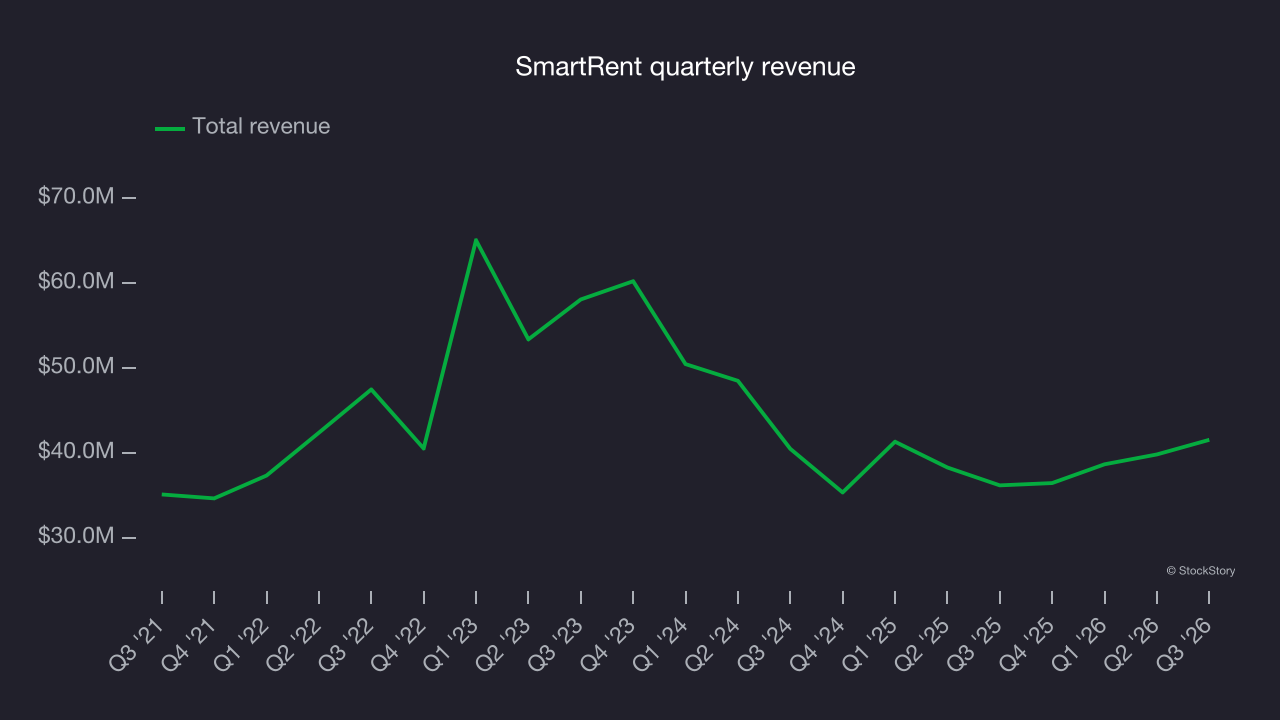
Long-term growth matters most, but within industrials, a half-decade historical view may miss cycles, industry trends or a company capitalizing on catalysts such as a new contract win or a successful product line. SmartRent’s recent performance marks a sharp pivot from its five-year trend as its revenue has shown annualized declines of 11.5% over the last two years. 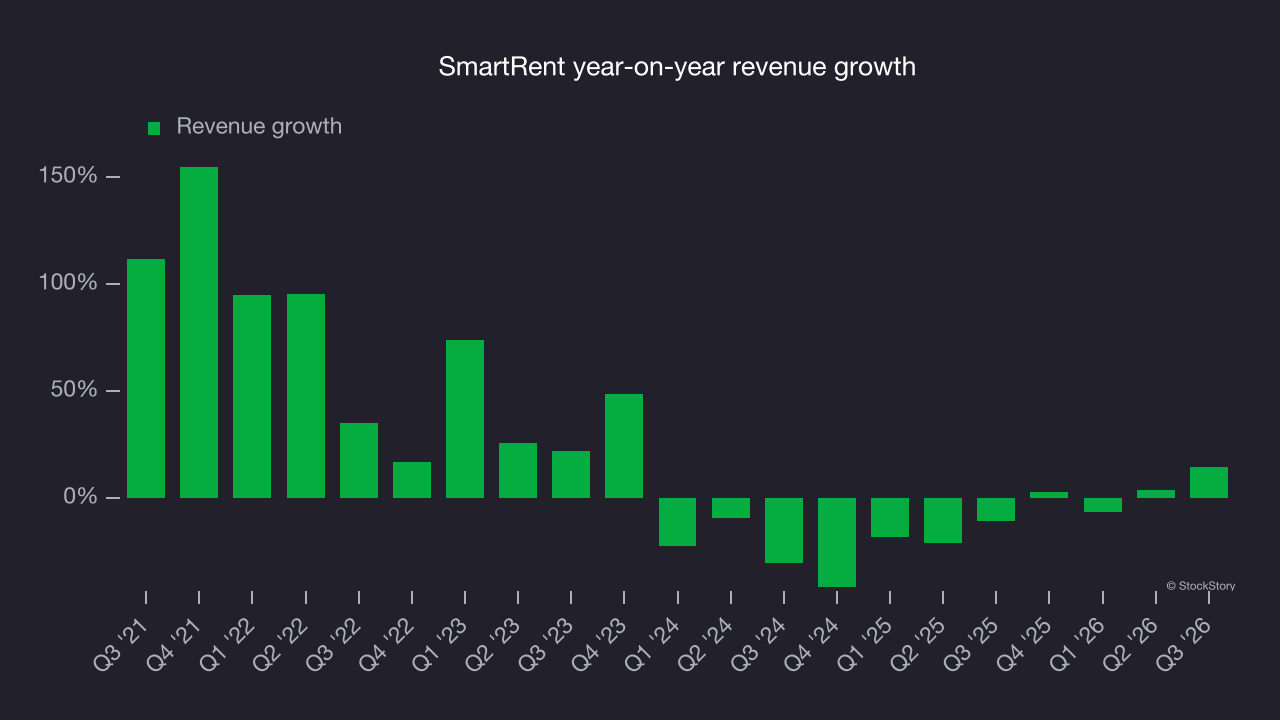
The company’s annual recurring revenue, or ARR, helps explain its revenue dynamics by measuring predictable, normalized yearly income from subscriptions and contracts. SmartRent’s ARR reached $62.9 million in the latest quarter and averaged 11.7% year-on-year growth over the last two years. ARR growth outpaced total revenue growth, indicating that the company’s proportion of recurring revenue from long-term contracts and subscriptions has increased. This implies more stability in its business model and revenue streams. 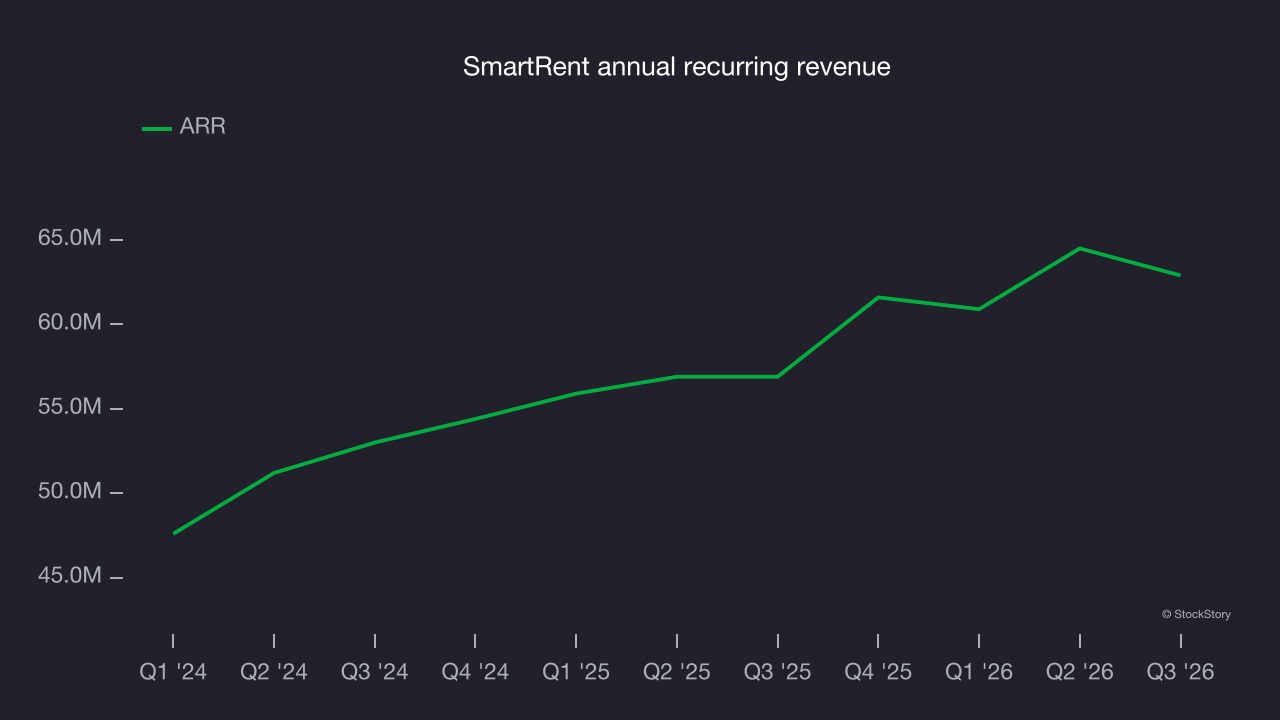
This quarter, SmartRent reported year-on-year revenue growth of 14.8%, and its $41.57 million of revenue exceeded Wall Street’s consensus estimates by 3.8%.
Looking ahead, sell-side analysts expect revenue to grow 14.3% over the next 12 months, according to S&P, an improvement versus the last two years. This favorable projection indicates its newer products and services will drive better revenue performance.
Operating margin
Operating margin is one of the best measures of profitability because it shows how much money a company retains after procuring and manufacturing its products, marketing and selling those products and, most importantly, keeping them relevant through research and development.
SmartRent’s high expenses have contributed to an average operating margin of negative 26% over the last five years. Unprofitable industrials companies require extra attention because downturns can expose their financial vulnerabilities. Their ability to endure a full cycle is uncertain.
On the positive side, SmartRent’s operating margin rose by 53.8 percentage points over the last five years, as its revenue growth provided operating leverage. Still, it will take much more for the company to reach long-term profitability.
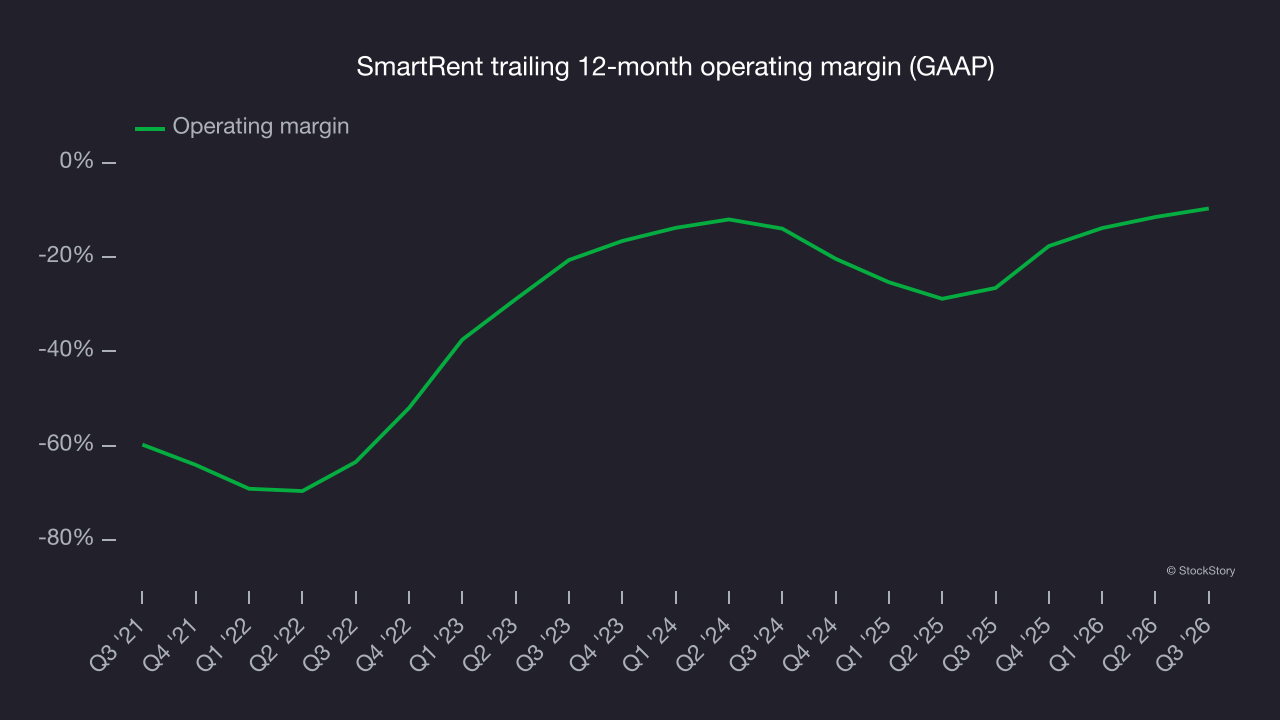
This quarter, SmartRent generated a negative 11.6% operating margin.
Earnings per share
Long-term changes in earnings per share, or EPS, matter for the same reason as long-term revenue growth. Compared to revenue, however, EPS highlights whether a company’s growth is profitable.
Although SmartRent’s full-year earnings are still negative, it reduced its losses and improved its EPS by 35.2% annually over the last four years. The next few quarters will be critical for assessing its long-term profitability.
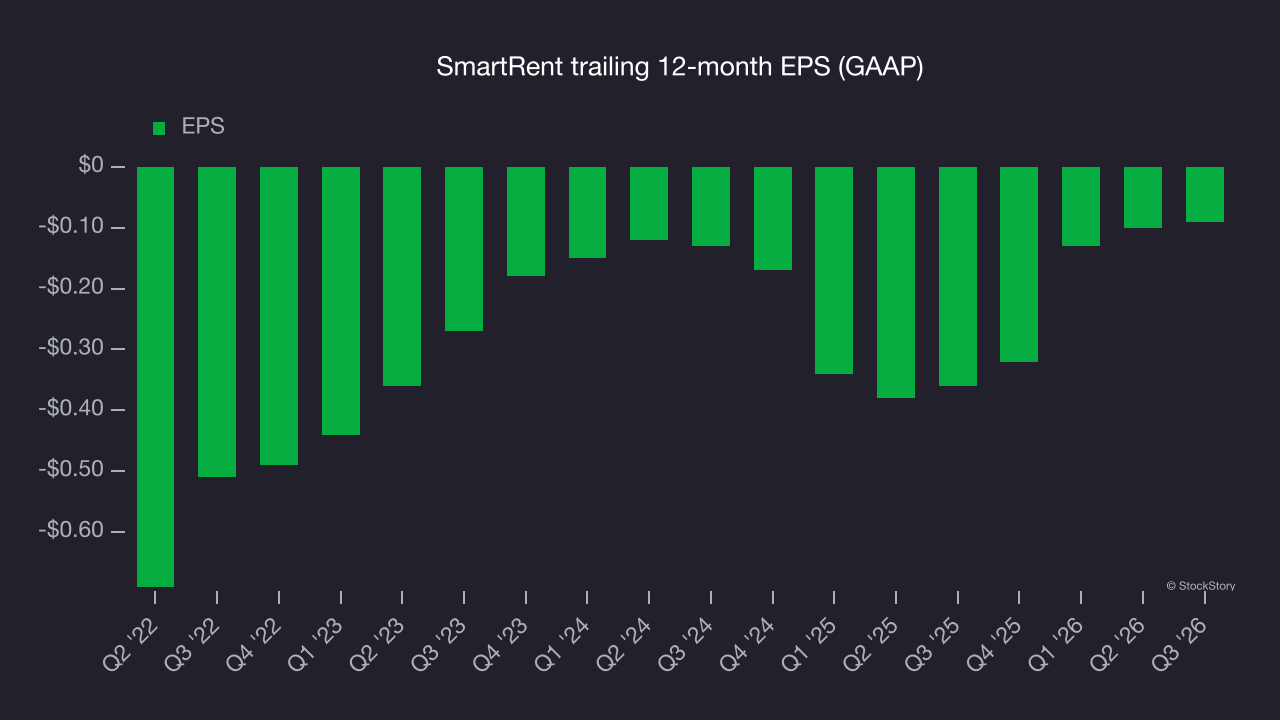
As with revenue, analyzing EPS over a more recent period can provide insight into an emerging theme or development for the business.
SmartRent’s two-year annual EPS growth of 16.8% was lower than its four-year trend, but still a good pace.
In Q3, SmartRent reported EPS of negative $0.02, in line with the same quarter last year. This result was close to analysts’ consensus estimates. Over the next 12 months, Wall Street expects SmartRent to narrow its losses. Analysts forecast its full-year EPS will improve from negative $0.09 to negative $0.08, according to S&P.
Key takeaways from SmartRent’s Q3 results
SmartRent delivered sizable beats on both EBITDA and revenue relative to analysts’ consensus estimates, giving the quarter some important positives. Shares surged 5.8% to $1.45 immediately after the results.
SmartRent reported solid earnings, but one quarter doesn’t necessarily make the stock a buy. The latest quarter is only one part of the longer-term assessment of business quality. Quality, when combined with valuation, can help determine if the stock is a buy. For more on SmartRent, read our full research report here (it’s free).