Alternate site health provider Option Care Health (NASDAQ: OPCH) reported revenue ahead of Wall Street’s expectations in Q3 2026, with revenue up 4.1% year on year to $1.49 billion. Its non-GAAP profit of $0.49 per share was in line with analysts’ consensus estimates.
For more on Option Care Health, read our free full research report.
Option Care Health (OPCH) Q3 2026 highlights:
- Revenue $1.49 billion vs S&P analysts’ consensus estimates of $1.48 billion (4.1% year-on-year growth, 1.2% beat)
- Adjusted EPS $0.49 vs S&P analysts’ consensus estimates of $0.49 (in line)
- Adjusted EBITDA $124.6 million vs analysts’ consensus estimates of $123.5 million (8.3% margin, 0.9% beat)
- Operating margin 6%, in line with the same quarter last year
- Market capitalization $4.76 billion
Revenue growth
Reviewing a company’s long-term revenue performance reveals insights into its quality. Any business can deliver a good quarter or two, but many enduring ones grow for years. Option Care Health’s 11.6% annualized revenue growth over the last five years was decent. Its growth was slightly above the average healthcare company and shows its offerings resonate with customers.
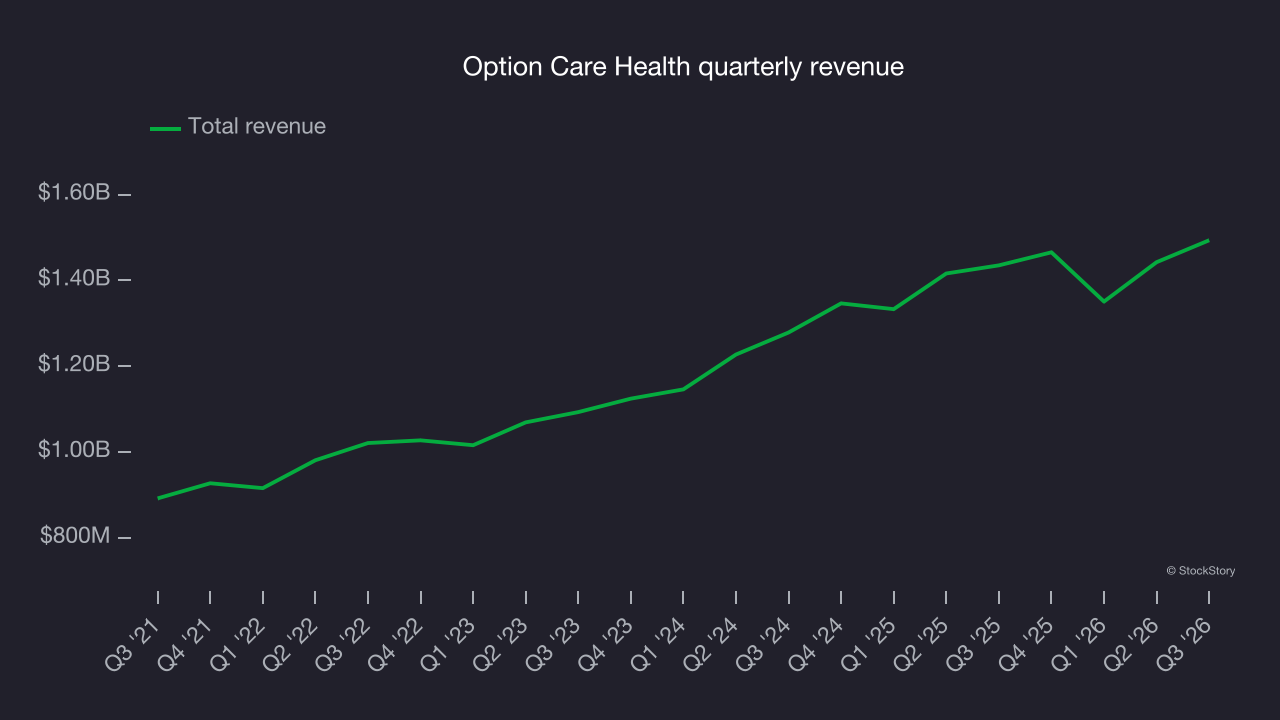
Long-term growth is the most important, but within healthcare, a half-decade historical view may miss new innovations or demand cycles. Option Care Health’s annualized revenue growth of 9.7% over the last two years is below its five-year trend, but the results were still respectable.
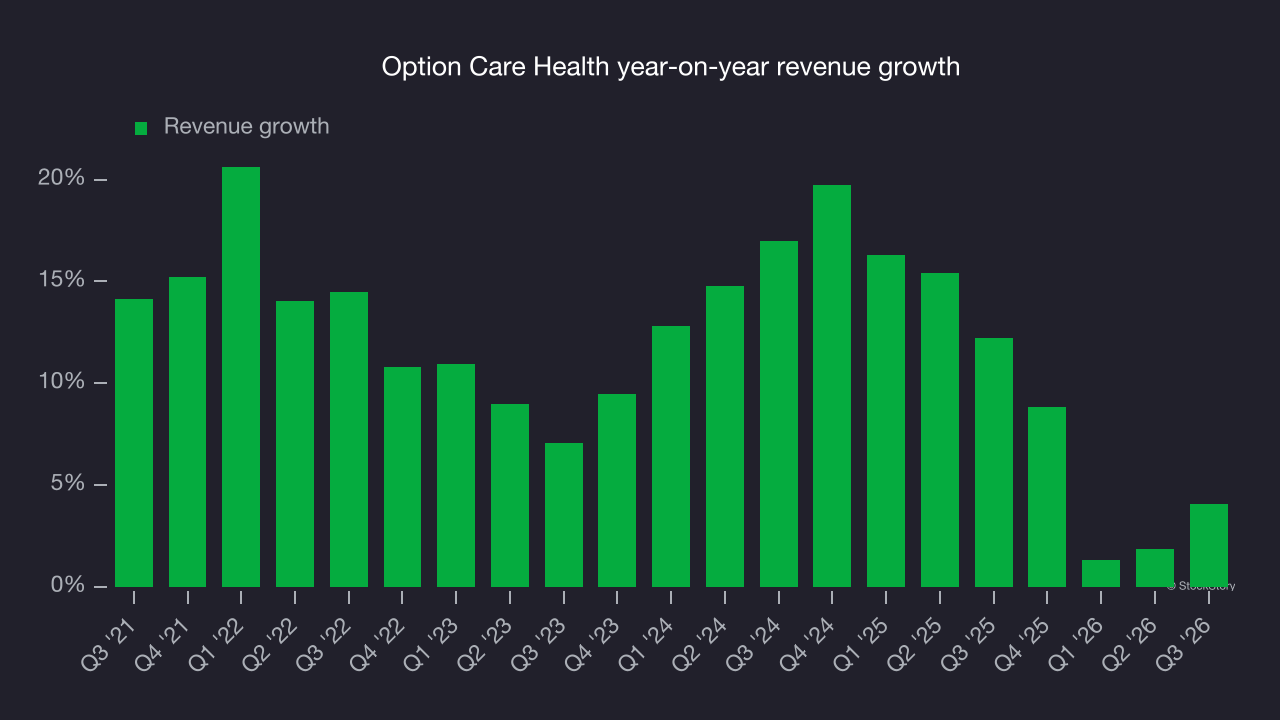
This quarter, Option Care Health reported modest year-on-year revenue growth of 4.1% but beat Wall Street’s consensus estimates by 1.2%.
Looking ahead, sell-side analysts expect revenue to grow 4.8% over the next 12 months, according to S&P, a deceleration versus the last two years. This uninspiring projection implies its products and services will face some demand challenges.
Adjusted operating margin
Option Care Health’s adjusted operating margin has been largely unchanged over the last 12 months, averaging 7.5% over the last five years. This profitability was mediocre for a healthcare business, reflecting its suboptimal cost structure.
Option Care Health’s adjusted operating margin has fluctuated slightly but generally stayed the same over the last five years. This raises questions about the company’s expense base because its revenue growth should have given it leverage on its fixed costs, resulting in better economies of scale and profitability.
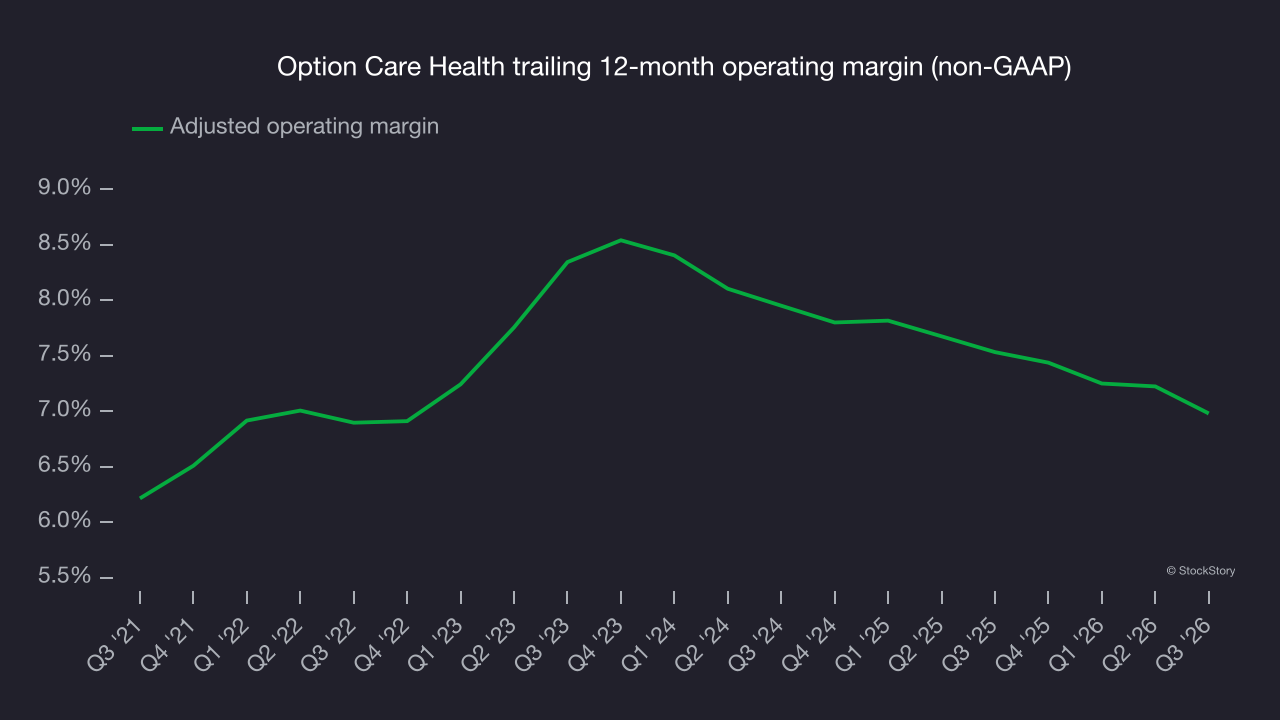
In Q3, Option Care Health generated an adjusted operating margin of 6.6%, in line with the same quarter last year. This indicates the company’s overall cost structure has been relatively stable.
Earnings per share
Long-term growth in earnings per share, or EPS, matters for the same reason as long-term revenue growth. Compared to revenue, however, EPS highlights whether a company’s growth is profitable.
Option Care Health’s EPS grew at a 22.9% compounded annual growth rate over the last five years, higher than its 11.6% annualized revenue growth. However, this alone doesn’t tell us much about its business quality because its adjusted operating margin didn’t improve.
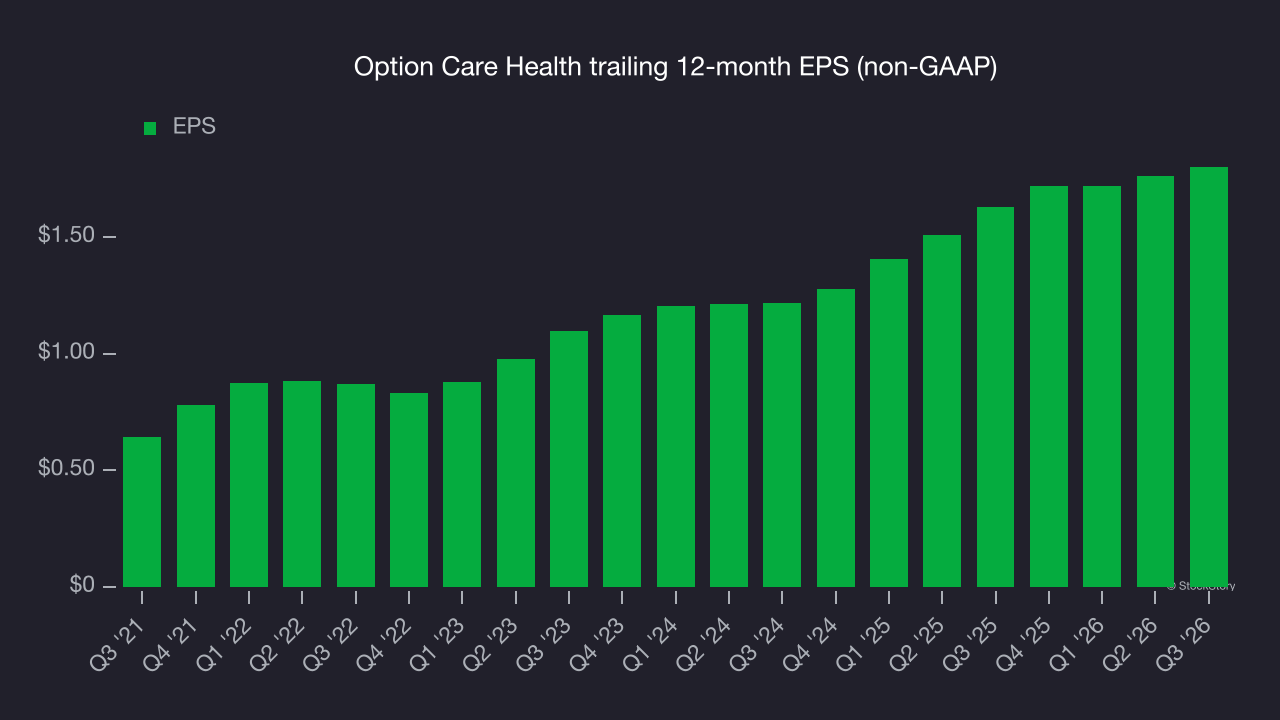
A closer look at Option Care Health’s earnings helps explain its performance. A five-year view shows that Option Care Health has repurchased its stock, shrinking its share count by 17.1%. Its EPS outperformed revenue not because of increased operational efficiency but because of financial engineering, as buybacks boost per share earnings.
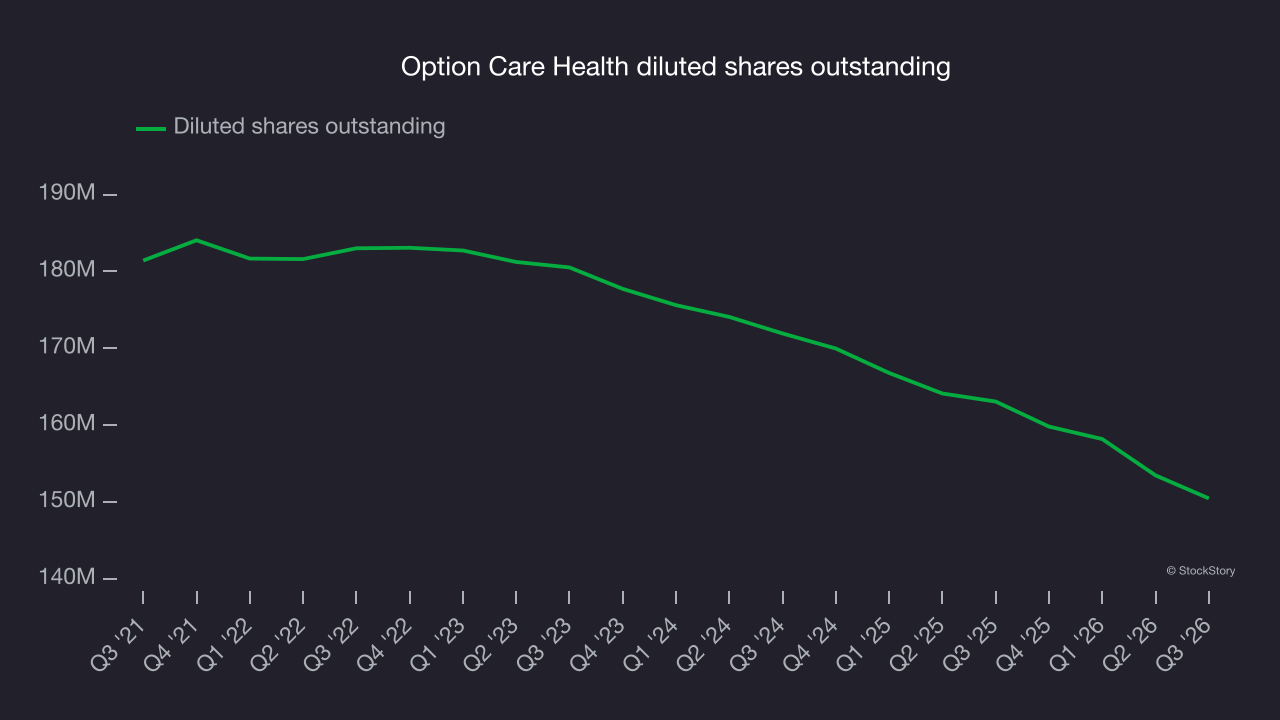
In Q3, Option Care Health reported adjusted EPS of $0.49, up from $0.45 in the same quarter last year. This result was close to analysts’ consensus estimates. Over the next 12 months, Wall Street expects Option Care Health’s full-year EPS to grow 13% from $1.80 to $2.03, according to S&P.
Key takeaways from Option Care Health’s Q3 results
Option Care Health’s narrow revenue beat against analysts’ consensus estimates was a key positive in a solid quarter. Shares edged higher 1.9% to $32.39 immediately after the results.
Option Care Health’s latest quarter matters, but longer-term fundamentals and valuation matter more when deciding whether the stock is a buy. Read the full research report here (it’s free).