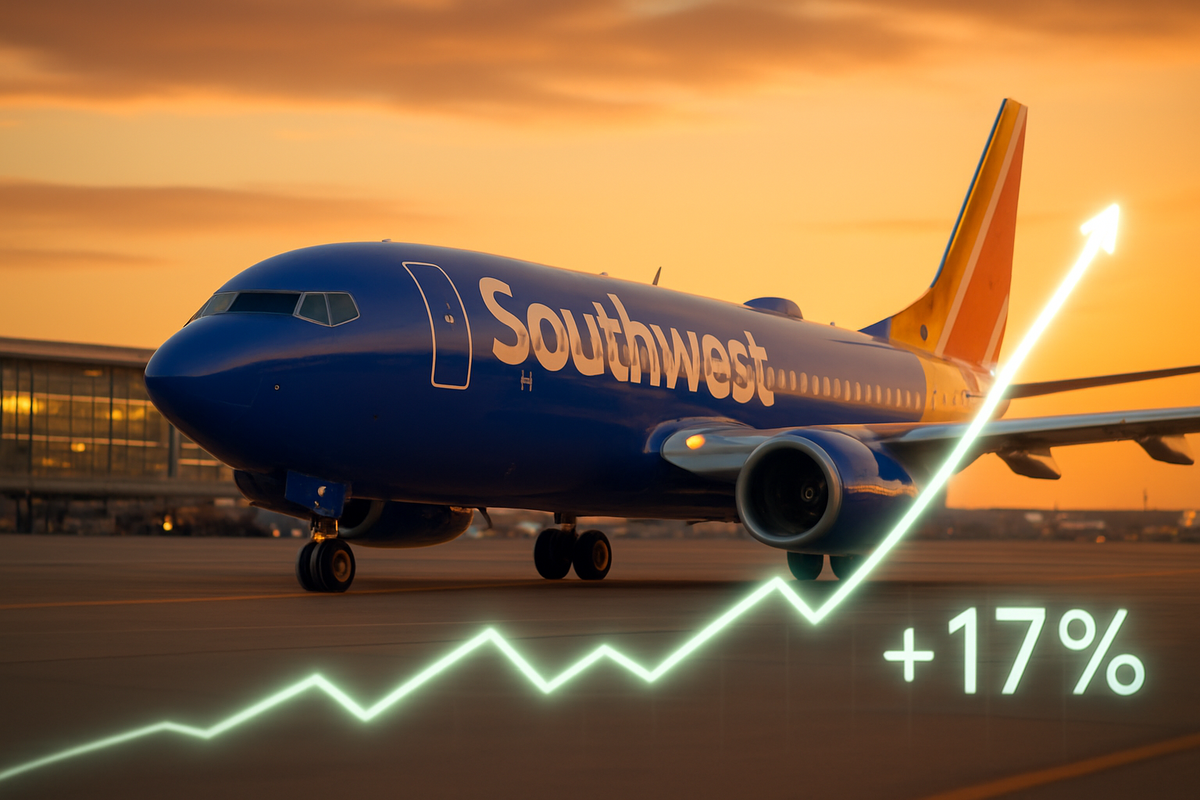
In a watershed moment for the aviation industry, Southwest Airlines (NYSE: LUV) saw its shares skyrocket by 17% this January, culminating in a massive single-day surge following the release of its fourth-quarter 2025 earnings and an aggressive 2026 financial outlook. The Dallas-based carrier, once the stubborn holdout of the "low-cost, no-frills" philosophy, has captivated Wall Street by proving that its radical pivot toward premium services and ancillary fees is already yielding historic returns.
The stock’s rally reflects a profound shift in investor sentiment as the airline officially moves past its 50-year-old "cattle call" boarding and "Bags Fly Free" identity. By providing a 2026 profit forecast that shattered analyst expectations, Southwest has signaled that its transformation—driven by pressure from activist investors and a changing travel landscape—is no longer a risky experiment, but a highly profitable reality.
A Strategic Overhaul: The New Southwest Takes Flight
The 17% climb in Southwest’s valuation was punctuated on January 28 and 29, 2026, when the airline reported a blowout quarter and issued guidance that "crushed" previous estimates. For the full year 2026, Southwest management projected an adjusted earnings per share (EPS) of at least $4.00, dwarfing the $3.20 consensus held by analysts just weeks ago. This optimism is rooted in the "Go-Live" of its new cabin experience on January 27, 2026, which marked the official end of unassigned seating across its entire fleet of over 800 Boeing 737 aircraft.
This transformation was not an overnight decision but the culmination of a high-stakes battle with Elliott Investment Management, which began in mid-2024. Following a settlement that saw the retirement of former Executive Chairman Gary Kelly and the appointment of five Elliott-backed board members, the airline accelerated its modernization efforts. The January results are the first concrete proof that the "New Southwest" can successfully monetize its passenger base through a tiered fare structure—Basic, Choice, Choice Preferred, and Choice Extra—while maintaining its operational efficiency.
Initial market reactions were overwhelmingly bullish. Analysts at J.P. Morgan (NYSE: JPM) issued a rare double-upgrade for the stock early in the month, citing high confidence in the airline’s ability to capture premium revenue. By the time the 2026 guidance was released, trading volume for LUV reached nearly triple its 30-day average, as institutional investors scrambled to adjust their positions in a company that is now competing directly for high-yield business travelers.
Winners and Losers in the Premium Pivot
The primary winner in this scenario is undoubtedly the Southwest shareholder, who has seen the company return nearly $3 billion in capital through buybacks over the past year. However, the move also benefits major legacy carriers like Delta Air Lines (NYSE: DAL) and United Airlines (NASDAQ: UAL). As Southwest ends its "Bags Fly Free" policy—now charging $35 for the first checked bag on lower-tier fares—the industry-wide pricing floor for ancillary services has been solidified. This reduces the downward pricing pressure that Southwest’s "disrupter" status previously exerted on the market.
On the losing side are the ultra-low-cost carriers (ULCCs) like Spirit Airlines (NYSE: SAVE) and Frontier Group Holdings (NASDAQ: ULCC). For years, these airlines survived by offering the lowest base fares while charging for every extra. With Southwest now offering a similar unbundled "Basic" fare but with a superior network and the reputation of its "Heart" hospitality, the value proposition for ULCCs is under intense threat. Furthermore, budget-conscious travelers who relied on Southwest’s previous two-bags-free policy are facing a significant increase in the total cost of their journeys, effectively ending the era of truly "free" amenities in the U.S. domestic market.
Boeing (NYSE: BA) also stands as a secondary winner. To facilitate the "Extra Legroom" sections—which offer up to 35 inches of pitch in the first six rows—Southwest had to aggressively manage its fleet renewals and retrofits. The commitment to a standardized 737 fleet remains intact, providing Boeing with a stable, long-term partner as Southwest looks to replace older -700 models with more fuel-efficient MAX variants to support its 2026 capacity growth goals.
The Wider Significance: A Farewell to the LCC Model
The 2026 transformation of Southwest represents the final nail in the coffin for the traditional "Low-Cost Carrier" (LCC) model in the United States. Historically, Southwest was the standard-bearer for simplicity: one aircraft type, no assigned seats, and no hidden fees. Its surrender to the "premiumization" trend confirms that the industry has shifted toward a "segmentation" model, where the most profitable growth comes from selling comfort and flexibility to those willing to pay, rather than just moving the maximum number of people at the lowest price.
This event mirrors historical precedents like the "merger era" of the 2010s, but instead of consolidating companies, the industry is consolidating business models. When Southwest—the last major holdout—adopted checked-bag fees and assigned seating, it effectively created a unified domestic product standard. Regulatory bodies like the Department of Transportation (DOT) may take note of this diminishing choice in service models, though the current focus remains on fee transparency rather than the fees themselves.
The ripple effects will likely reach beyond the U.S. borders. International budget carriers in Europe and Asia often look to Southwest as the original blueprint for success. Southwest’s successful pivot to a premium-hybrid model provides a new roadmap for global LCCs struggling with thin margins and rising fuel costs, potentially triggering a global wave of "unbundling" and cabin reconfigurations.
What Comes Next: Maintaining the "Heart" While Raising Prices
In the short term, Southwest must navigate the logistical challenges of its new 8-group boarding system and the potential friction caused by the new baggage fees. The first half of 2026 will be a critical test of brand loyalty. While investors are cheering the 17% stock jump, the airline’s management must ensure that the "Southwest Heart"—its reputation for customer service—isn't lost in a sea of surcharges. Any significant drop in customer satisfaction scores could lead to a strategic pivot or a cooling of the current stock rally.
Long-term, the focus will shift to how Southwest uses its newfound capital. With a projected EPS of over $4.00, the airline will have the financial fire-power to potentially explore international expansion beyond its current near-international footprint. There is also the possibility of a move into a "Basic Economy" product that is even more restrictive, or conversely, the introduction of a true "First Class" cabin if the "Extra Legroom" rows prove to be a runaway success.
Investors should watch for the "revenue per available seat mile" (RASM) figures in the coming quarters. If Southwest can maintain its projected 9.5% rise in RASM, it will prove that the market has accepted the new pricing. However, the risk of a "price war" remains if legacy carriers decide to aggressively discount their own premium seats to keep Southwest from encroaching on their corporate travel turf.
Closing Thoughts: A Landmark Transformation
The 17% surge in Southwest Airlines' shares this January is more than just a reaction to a strong earnings report; it is a validation of a corporate metamorphosis. By shedding its 50-year-old constraints and embracing the high-margin world of assigned seating and ancillary fees, Southwest has positioned itself to be a dominant financial force in the late 2020s.
For the market, the message is clear: the demand for premium travel is robust, and even the most traditional companies can find new life through radical strategic change. Moving forward, the "New Southwest" will be judged not by its ability to provide the cheapest flight, but by its ability to balance its historic culture with its new, more aggressive profit motives. Investors should keep a close eye on quarterly passenger load factors and the performance of the "Choice" fare tiers to see if this historic rally has more room to run.
This content is intended for informational purposes only and is not financial advice.