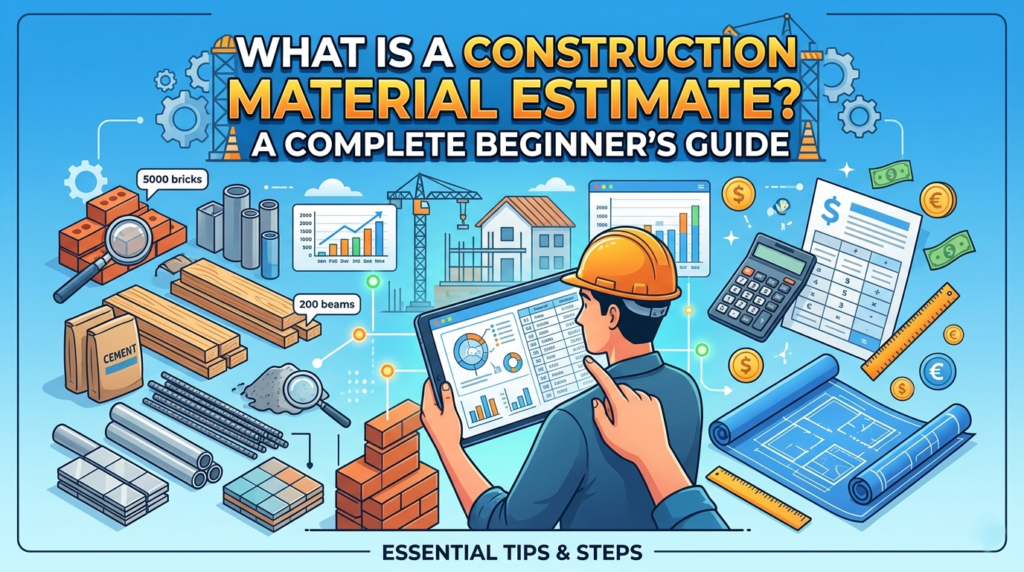
A construction material estimate is necessary to prevent financial issues. You need an accurate cost estimate even if you are working on a small project. The beginners might feel that this process is quite difficult. But, they are important in creating a roadmap for your project’s material needs and budget. Most of the beginners always fail because they rush into things. They want to quickly learn and implement everything. But, this is not the right approach. It takes time!
After getting an education, they must get hands-on experience to understand how things work. They need to understand all the steps from start to end properly. The Top Construction Estimating Services provide precise outputs due to their experience in the field. They have top estimators in which SMA Estimating LLC is one of the top companies.
What is a Construction Material Estimate?
It is the process of calculating the quantities and cost of all materials required to complete a construction project. This is a complete list that provides as a base for budgeting, planning, etc.
Some people confuse between the concept of material takeoff with a material estimate.
- A material takeoff is also known as a quantity takeoff. It is the process of listing all the materials needed for the project on the basis of construction drawings.
- It focuses on quantities. Such as 500 bricks, 100 feet of 2×4 lumber, or 15 light fixtures.
- A material estimate is generated on the basis of a takeoff. The cost is assigned to each of those materials. The quantities are multiplied by current market prices and adding factors like taxes and delivery fees.
Why is Accurate Material Estimation So Important?
The importance of an accurate material estimate cannot be neglected. It is the base of a successful project. You need to understand that inaccurate estimates will lead you to budget overruns and delays.
- Budget Management is the most obvious reason. Inaccurate estimates are a leading cause of cost overruns. It can sometimes reach 15 – 30% of the project budget. You need to know that an accurate estimate ensures you have a realistic budget and helps secure the necessary financing.
- If you go short on bricks in the middle of the project. Material shortages can bring a project to costly delays
- For contractors, a precise estimate is essential for winning jobs. A high bid will make you lose. A low bid might help you win the contract but lose money on the project
- Overestimating materials can result in unnecessary waste. A good estimate helps you order efficiently.
Key Units of Measurement in Material Estimating
Count
This is for the single units that are installed.
Examples:
- Doors
- windows
- light fixtures
- electrical outlets
- sinks
- appliances
- bricks
Length
This is used for materials that are installed in linear dimensions. It is typically measured in feet or meters.
Examples:
- Piping
- wiring
- lumber for framing
- baseboards
- conduit
Area
This measures the two-dimensional space a material needs to cover.
It is typically calculated in the form of length multiplied by width.
It is written in square feet or square meters.
Examples
- Drywall
- flooring (tile, carpet)
- paint
- roofing shingles
- plywood sheathing
Volume
This measures the three-dimensional space a material will occupy.
It is calculated by:
= length into width into height (or depth)
The results are generated in cubic feet or cubic meters.
Examples
- Concrete
- fill dirt
- gravel for a driveway
- Sand
Professional Construction Takeoff Services are reliable because they accurately measure everything according to the project details. So do not take risks with manual
Steps to Estimating Construction Materials
Step 1: Understand the Project
You need to start reviewing all project documents. This includes architectural:
- drawings
- blueprints
- specifications
Understand the scope of work. They also need to check the quality of materials required.
Step 2: Visiting site
A site visit can help you look into important details that you can not see on paper.
Factors like site conditions can all directly impact material choices and quantities.
Step 3: Break Down the Project and Perform a Quantity Takeoff
Divide the project into phases for each trade. Then, working from your blueprints you need to start the quantity takeoff.
This involves measuring and listing every single material required for each section.
Step 4: Choose an Estimating Method
There are several ways to approach the costing part of the estimate:
- Unit Pricing:
- The Square Foot Method
- Assembly Estimating
Step 5: Research and Calculate Material Costs
Once you have your quantities, look for current material prices.
Contact local suppliers and get quotes from multiple vendors.
Your total material cost is calculated as:
= (Material Quantity x Unit Cost) + Taxes + Delivery Fees
Step 6: Add for Waste and Contingencies
In every construction project, materials get damaged or lost. You need to add a percentage to your quantities to consider this waste.
- Add 5-10% for materials.
- For more complex installations, add 10-15%
- A contingency budget of 5-10%
Conclusion
A Construction Material Estimate is not just about listing. It is important to plan to protect your project’s budget and timeline. By understanding the right concept of a cost estimate and following the right steps. You can develop a solid foundation for accurate estimation.