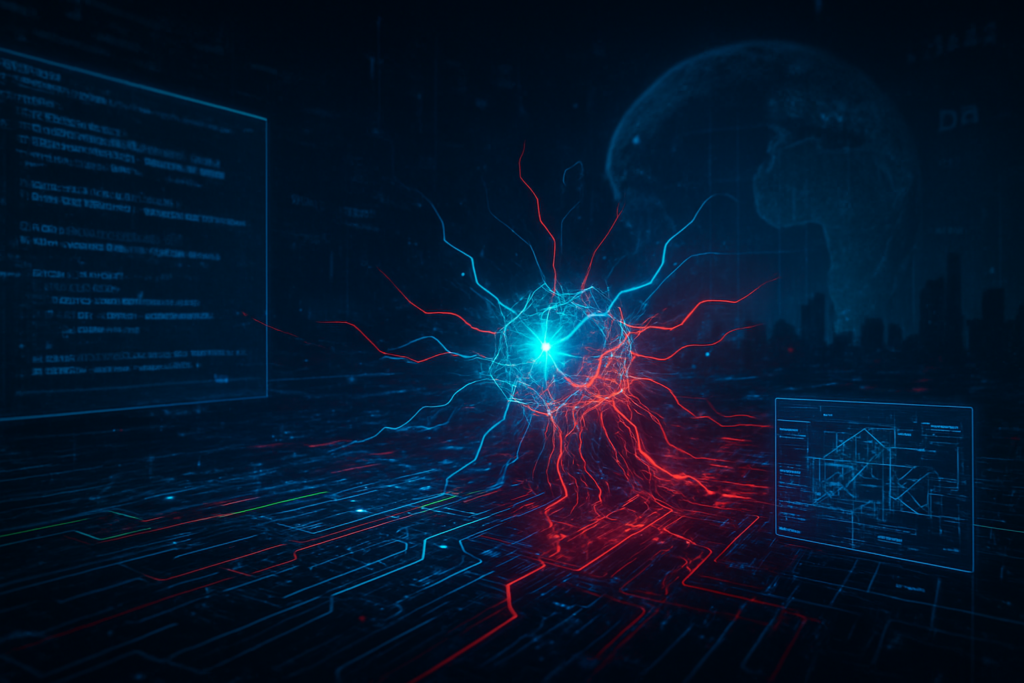
In a landmark report released this week, Moody’s Corporation (NYSE: MCO) has sounded a stark alarm for the global enterprise landscape, predicting that 2026 will be the year autonomous, self-evolving cyber threats become the primary challenge for businesses. The "2026 Global Cyber Outlook" describes a fundamental shift in the digital battlefield, where human-led "reconnaissance" is being replaced by AI agents capable of executing entire attack lifecycles in seconds. This transition marks the end of traditional cybersecurity as we know it, forcing a radical reassessment of corporate resilience and credit risk.
The significance of this forecast cannot be overstated. By elevating autonomous cyber threats to the same level of credit risk as natural disasters, Moody’s is signaling to investors and boards that the "AI arms race" is no longer a theoretical concern for IT departments, but a direct threat to financial solvency. As these self-evolving attacks begin to outpace human defensive capabilities, the ability of an enterprise to survive a breach will depend less on its "war rooms" and more on its autonomous defensive architecture.
The Rise of AI-Native Malware and Self-Evolving Code
According to Moody’s technical analysis, the defining characteristic of 2026’s threat landscape is the emergence of "AI-native" malware. Unlike previous generations of polymorphic malware that used basic encryption to hide, these new threats—such as the notorious "PromptLock" ransomware—integrate Large Language Models (LLMs) directly into their core logic. This allows the malware to "reason" about the target’s specific defensive environment in real-time. When an AI-native attack hits a network, it doesn't just run a script; it scans the environment, identifies specific security tools like Endpoint Detection and Response (EDR) systems, and rewrites its own source code on the fly to bypass those specific signatures.
This "compression of the kill chain" is the most disruptive technical advancement cited in the report. In the past, a sophisticated breach might take weeks of human-led lateral movement and data staging. In 2026, autonomous agents can compress this entire process—from initial entry to data exfiltration—into a window of time so small that human intervention is physically impossible. Furthermore, these attacks are increasingly "agentic," meaning they act as independent operators that can conduct multi-channel social engineering. An AI agent might simultaneously target a CFO via a deepfake video call while sending personalized, context-aware phishing messages to IT administrators on Slack and LinkedIn, all without a human attacker pulling the strings.
Industry experts have reacted to these findings by declaring the start of the "Post-Malware Era." Analysts at firms like CrowdStrike Holdings, Inc. (NASDAQ: CRWD) and Palo Alto Networks, Inc. (NASDAQ: PANW) have noted that the democratization of these sophisticated tools has removed the traditional barriers to entry. What was once the exclusive domain of nation-state actors is now available to smaller criminal syndicates through "Fraud-as-a-Service" platforms. This shift has forced cybersecurity researchers to pivot toward "Defense-AI"—autonomous agents designed to hunt and neutralize attacking agents in a machine-vs-machine conflict that plays out at millisecond speeds.
Competitive Implications for the Cybersecurity Giants
The Moody’s forecast creates a clear divide in the technology sector between those who can provide autonomous defense and those who cannot. Legacy security providers that rely on human-in-the-loop signatures are facing an existential crisis. Conversely, tech giants like Microsoft (NASDAQ: MSFT) and specialized firms like CrowdStrike are positioned to benefit as enterprises scramble to upgrade to AI-driven, self-healing infrastructures. The market is shifting from a "protection" model to a "resilience" model, where the most valuable products are those that can autonomously isolate and remediate threats without waiting for an admin's approval.
For major AI labs and cloud providers, the competitive implications are equally intense. There is a growing demand for "Secure AI" architectures that can withstand the very autonomous agents they helped create. Companies that can integrate security directly into the AI stack—ensuring that LLMs cannot be subverted into "reasoning" for an attacker—will hold a significant strategic advantage. However, Moody's warns of a "defensive asymmetry": while the cost of launching an AI-powered attack is plummeting toward zero, the cost of maintaining a top-tier AI defense continues to rise, potentially squeezing the margins of mid-sized enterprises that lack the scale of the Fortune 500.
This environment is also ripe for disruption by startups focusing on "Agentic Governance" and automated patching. As the speed of attacks increases, the window for manual patching has effectively closed. Startups that can offer real-time, AI-driven vulnerability remediation are seeing massive influxes of venture capital. The strategic positioning of 2026 is no longer about who has the best firewall, but who has the most intelligent and fastest-acting autonomous defensive agents.
A New Paradigm for Global Risk and Regulation
The wider significance of Moody’s report lies in its treatment of cyber risk as a systemic economic "event risk." By explicitly linking autonomous AI threats to credit rating downgrades, Moody’s is forcing the financial world to view cybersecurity through the same lens as climate change or geopolitical instability. A single successful autonomous fraud event—such as a deepfake-authorized multi-million dollar transfer—can now trigger immediate stock price volatility and a revision of a company's debt rating. This creates a powerful new incentive for boards to prioritize AI security as a fiduciary duty.
However, this shift also brings significant concerns, most notably the risk of "cascading AI failure." Experts worry that as enterprises deploy more autonomous agents to defend their networks, these agents might make "reasonable" but incorrect decisions at scale, leading to systemic collapses that were not intended by either the attacker or the defender. This is a new type of risk—not a breach of data, but a failure of logic in an automated system that governs critical business processes.
Comparing this to previous AI milestones, the 2026 landscape represents the jump from "AI as a tool" to "AI as an actor." While the 2023-2024 period was defined by the excitement of generative content, 2026 is defined by the consequences of generative agency. This has led to a complex regulatory environment; while the EU AI Act and other global frameworks attempt to provide guardrails, the sheer speed of autonomous evolution is currently outstripping the ability of regulators to keep pace, leaving a vacuum that is currently being filled by private rating agencies and insurance providers.
The Road Ahead: Defending the Autonomous Frontier
In the near term, we can expect a surge in the adoption of "Cyber-Resilience Metrics" as a standard part of corporate reporting. These metrics will focus on how quickly a company’s systems can autonomously recover from a total wipeout. In the long term, the focus will likely shift toward "Biological-Inspired Defense," where networks act more like immune systems, constantly evolving and adapting to new pathogens without the need for external updates.
The challenges remain daunting. The democratization of AI means that "machine-driven, intelligent persistence" is now a permanent feature of the internet. Experts predict that the next frontier will be the "Internet of Autonomous Things," where everything from smart factories to autonomous vehicle fleets becomes a target for self-evolving malware. To address this, the industry must solve the problem of AI explainability; if a defensive agent makes a split-second decision to shut down a factory to prevent a breach, humans must be able to understand why that decision was made after the fact.
Conclusion: Navigating the Machine-Speed Future
The Moody’s 2026 Global Cyber Outlook serves as a definitive turning point in the history of artificial intelligence. The key takeaway is clear: the era of human-led cybersecurity is over. We have entered the age of machine-speed warfare, where the primary threat to enterprise stability is no longer a hacker in a basement, but a self-evolving algorithm capable of out-thinking and out-pacing traditional defenses.
This development marks a significant milestone where AI’s potential for disruption has moved from the digital world into the very foundations of global credit and finance. In the coming weeks and months, investors should watch for a widening "security gap" between top-tier firms and those struggling to modernize, as well as the first major credit rating actions tied directly to autonomous AI breaches. The long-term impact will be a total reinvention of corporate infrastructure, built on the premise that in 2026, the only way to beat a machine is with a faster, smarter machine.
This content is intended for informational purposes only and represents analysis of current AI developments.
TokenRing AI delivers enterprise-grade solutions for multi-agent AI workflow orchestration, AI-powered development tools, and seamless remote collaboration platforms.
For more information, visit https://www.tokenring.ai/.