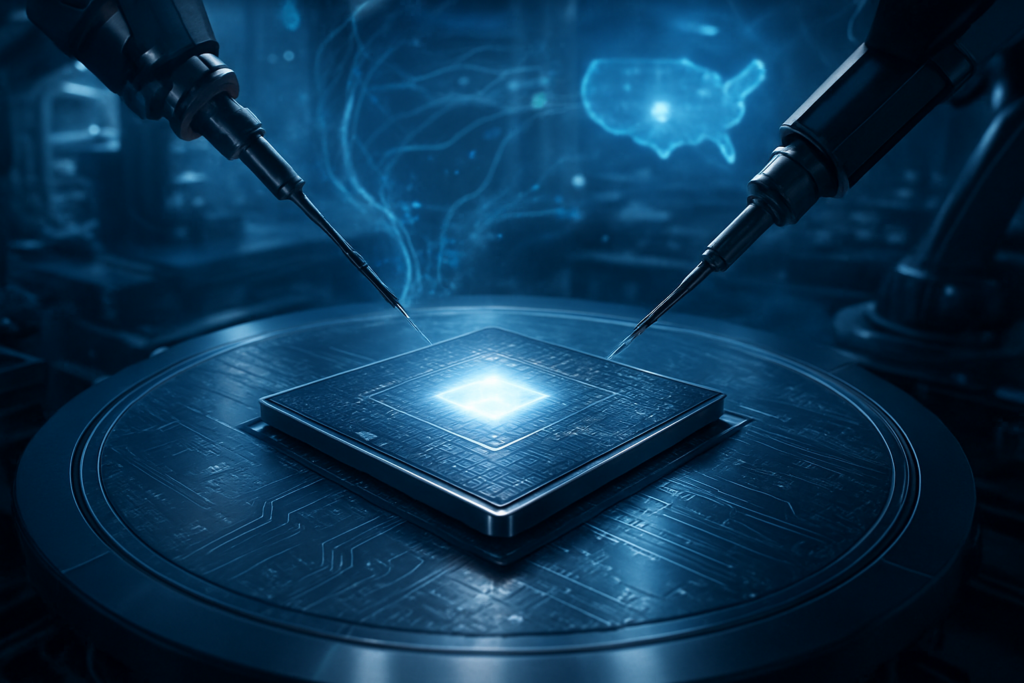
In a move that signals a tectonic shift in the global semiconductor landscape, reports have emerged as of late December 2025 that Apple Inc. (NASDAQ: AAPL) has successfully entered the critical qualification phase for Intel Corporation’s (NASDAQ: INTC) 18A manufacturing process. This development marks the first time since the "Apple Silicon" transition in 2020 that the iPhone maker has seriously considered a primary manufacturing partner other than Taiwan Semiconductor Manufacturing Company (NYSE: TSM). By qualifying the 1.8nm-class node for future entry-level M-series chips, Apple is effectively ending TSMC’s decade-long monopoly on its high-end processor production, a strategy aimed at diversifying its supply chain and securing domestic U.S. manufacturing capabilities.
The immediate significance of this partnership cannot be overstated. For Intel, securing Apple as a foundry customer is the ultimate validation of its "five nodes in four years" (5N4Y) turnaround strategy led by CEO Pat Gelsinger. For the broader technology industry, it represents a pivotal moment in the "re-shoring" of advanced chipmaking to American soil. As geopolitical tensions continue to cast a shadow over the Taiwan Strait, Apple’s move to utilize Intel’s Arizona-based "Fab 52" provides a necessary hedge against regional instability while potentially lowering logistics costs and lead times for its highest-volume products, such as the MacBook Air and iPad Pro.
Technical Breakthroughs: RibbonFET and the PowerVia Advantage
At the heart of this historic partnership is Intel’s 18A node, a 1.8nm-class process that introduces two of the most significant architectural changes in transistor design in over a decade. The first is RibbonFET, Intel’s proprietary implementation of Gate-All-Around (GAA) technology. Unlike the FinFET transistors used in previous generations, RibbonFET surrounds the conducting channel with the gate on all four sides. This allows for superior electrostatic control, drastically reducing power leakage—a critical requirement for the thin-and-light designs of Apple’s portable devices—while simultaneously increasing switching speeds.
The second, and perhaps more disruptive, technical milestone is PowerVia, the industry’s first commercial implementation of backside power delivery. By moving power routing to the back of the silicon wafer and keeping signal routing on the front, Intel has solved one of the most persistent bottlenecks in chip design: "IR drop" or voltage loss. According to technical briefings from late 2025, PowerVia allows for a 5% to 10% improvement in cell utilization and a significant boost in performance-per-watt. Reports indicate that Apple has specifically been working with the 18AP (Performance) variant, a specialized version of the node optimized for high-efficiency mobile workloads, which offers an additional 15% to 20% improvement in performance-per-watt over the standard 18A process.
Initial reactions from the semiconductor research community have been cautiously optimistic. While early reports from partners like Broadcom (NASDAQ: AVGO) and NVIDIA (NASDAQ: NVDA) suggested that Intel’s 18A yields were initially hovering in the 60% to 65% range—below the 70% threshold typically required for high-margin mass production—the news that Apple has received the PDK 0.9.1 GA (Process Design Kit) suggests those hurdles are being cleared. Industry experts note that Apple’s rigorous qualification standards are the "gold seal" of foundry reliability; if Intel can meet Apple’s stringent requirements for the M-series, it proves the 18A node is ready for the most demanding consumer electronics in the world.
A New Power Dynamic: Disrupting the Foundry Monopoly
The strategic implications of this partnership extend far beyond technical specifications. By bringing Intel into the fold, Apple gains immense leverage over TSMC. For years, TSMC has been the sole provider of the world’s most advanced nodes, allowing it to command premium pricing and dictate production schedules. With Intel 18A now a viable alternative, Apple can exert downward pressure on TSMC’s 2nm (N2) pricing. This "dual-foundry" strategy will likely see TSMC retain the manufacturing rights for the high-end "Pro," "Max," and "Ultra" variants of the M-series, while Intel handles the high-volume base models, estimated to reach 15 to 20 million units annually.
For Intel, this is a transformative win that repositions its Intel Foundry division as a top-tier competitor to TSMC and Samsung (KRX: 005930). Following the news of Apple’s qualification efforts in November 2025, Intel’s stock saw a double-digit surge, reflecting investor confidence that the company can finally monetize its massive capital investments in U.S. manufacturing. The partnership also creates a "halo effect" for Intel Foundry, making it a more attractive option for other tech giants like Microsoft (NASDAQ: MSFT) and Amazon (NASDAQ: AMZN), who are increasingly designing their own custom AI and server silicon.
However, this development poses a significant challenge to TSMC’s market dominance. While TSMC’s N2 node is still widely considered the gold standard for power efficiency, the geographic concentration of its facilities has become a strategic liability. Apple’s shift toward Intel signals to the rest of the industry that "geopolitical de-risking" is no longer a theoretical preference but a practical manufacturing requirement. If more "fabless" companies follow Apple’s lead, the semiconductor industry could see a more balanced distribution of power between East and West for the first time in thirty years.
The Broader AI Landscape and the "Made in USA" Mandate
The Apple-Intel 18A partnership is a cornerstone of the broader trend toward vertical integration and localized supply chains. As AI-driven workloads become the primary focus of consumer hardware, the need for specialized silicon that balances high-performance neural engines with extreme power efficiency has never been greater. Intel’s 18A node is designed with these AI-centric architectures in mind, offering the density required to pack more transistors into the small footprints of next-generation iPads and MacBooks. This fits perfectly into Apple's "Apple Intelligence" roadmap, which demands increasingly powerful on-device processing to handle complex LLM (Large Language Model) tasks without sacrificing battery life.
This move also aligns with the objectives of the U.S. CHIPS and Science Act. By qualifying a node that will be manufactured in Arizona, Apple is effectively participating in a national effort to secure the semiconductor supply chain. This reduces the risk of global disruptions caused by potential conflicts or pandemics. Comparisons are already being drawn to the 2010s, when Apple transitioned from Samsung to TSMC; that shift redefined the mobile industry, and many analysts believe this return to a domestic partner could have an even greater impact on the future of computing.
There are, however, potential concerns regarding the transition. Moving a chip design from TSMC’s ecosystem to Intel’s requires significant engineering resources. Apple’s "qualification" of the node does not yet equal a signed high-volume contract for the entire product line. Some industry skeptics worry that if Intel’s yields do not reach the 70-80% mark by mid-2026, Apple may scale back its commitment, potentially leaving Intel with massive, underutilized capacity. Furthermore, the complexity of PowerVia and RibbonFET introduces new manufacturing risks that could lead to delays if not managed perfectly.
Looking Ahead: The Road to 2027
The near-term roadmap for this partnership is clear. Apple is expected to reach a final "go/no-go" decision by the first quarter of 2026, following the release of Intel’s finalized PDK 1.0. If the qualification continues on its current trajectory, the industry expects to see the first Intel-manufactured Apple M-series chips enter mass production in the second or third quarter of 2027. These chips will likely power a refreshed MacBook Air and perhaps a new generation of iPad Pro, marking the commercial debut of "Apple Silicon: Made in America."
Long-term, this partnership could expand to include iPhone processors (the A-series) or even custom AI accelerators for Apple’s data centers. Experts predict that the success of the 18A node will determine the trajectory of the semiconductor industry for the next decade. If Intel delivers on its performance promises, it could trigger a massive migration of U.S. chip designers back to domestic foundries. The primary challenge remains the execution of High-NA EUV (Extreme Ultraviolet) lithography, a technology Intel is betting heavily on to maintain its lead over TSMC in the sub-2nm era.
Summary of a Historic Realignment
The qualification of Intel’s 18A node by Apple represents a landmark achievement in semiconductor engineering and a strategic masterstroke in corporate diplomacy. By bridging the gap between the world’s leading consumer electronics brand and the resurgent American chipmaker, this partnership addresses the two biggest challenges of the modern tech era: the need for unprecedented computational power for AI and the necessity of a resilient, diversified supply chain.
As we move into 2026, the industry will be watching Intel’s yield rates and Apple’s final production orders with intense scrutiny. The significance of this development in AI history is profound; it provides the physical foundation upon which the next generation of on-device intelligence will be built. For now, the "historic" nature of this partnership is clear: Apple and Intel, once rivals and then distant acquaintances, have found a common cause in the pursuit of silicon sovereignty.
This content is intended for informational purposes only and represents analysis of current AI and semiconductor developments as of December 29, 2025.
TokenRing AI delivers enterprise-grade solutions for multi-agent AI workflow orchestration, AI-powered development tools, and seamless remote collaboration platforms. For more information, visit https://www.tokenring.ai/.