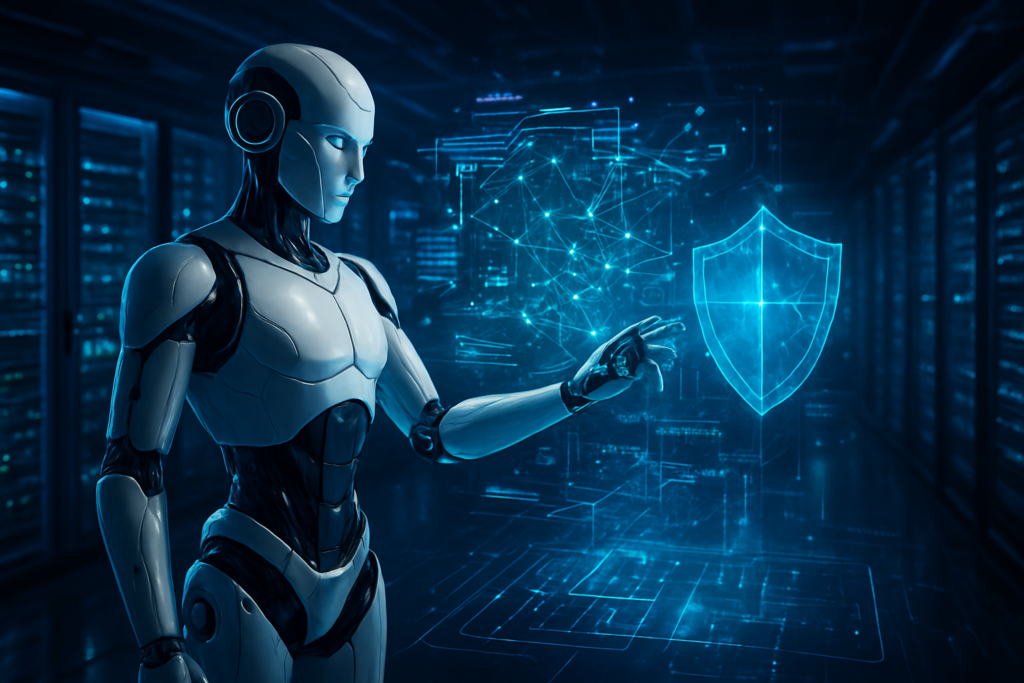
As 2025 draws to a close, the artificial intelligence investment landscape has undergone a profound transformation. The "generative hype" of previous years has matured into a disciplined focus on the infrastructure of trust and the physical manifestation of intelligence. This shift is most visible in the surge of specialized Exchange-Traded Funds (ETFs) targeting AI Security and Humanoid Robotics, which have become the dual engines of the sector's growth. Investors are no longer just betting on models that can write; they are betting on systems that can move and, more importantly, systems that cannot be compromised.
The immediate significance of this development lies in the realization that enterprise AI adoption has hit a "security ceiling." While the global AI market is projected to reach $243.72 billion by the end of 2025, a staggering 94% of organizations still lack an advanced AI security strategy. This gap has turned AI security from a niche technical requirement into a multi-billion dollar investment theme, driving a new class of financial products designed to capture the "Second Wave" of the AI revolution.
The Rise of "Physical AI" and Secure Architectures
The technical narrative of 2025 is dominated by the emergence of "Embodied AI"—intelligence that interacts with the physical world. This has been codified by the launch of groundbreaking investment vehicles like the KraneShares Global Humanoid and Embodied Intelligence Index ETF (KOID). Unlike earlier robotics funds that focused on static industrial arms, KOID and the Themes Humanoid Robotics ETF (BOTT) specifically target the supply chain for bipedal and dexterous robots. These ETFs represent a bet on the "Physical AI" foundation models developed by companies like NVIDIA (NASDAQ: NVDA), whose Cosmos and Omniverse platforms are now providing the "digital twins" necessary to train robots in virtual environments before they ever touch a factory floor.
On the security front, the industry is grappling with technical threats that were theoretical just two years ago. "Prompt Injection" has become the modern equivalent of the SQL injection, where malicious users bypass a model's safety guardrails to extract sensitive data. Even more insidious is "Data Poisoning," a "slow-kill" attack where adversaries corrupt a model's training set to manipulate its logic months after deployment. To combat this, a new sub-sector called AI Security Posture Management (AI-SPM) has emerged. This technology differs from traditional cybersecurity by focusing on the "weights and biases" of the models themselves, rather than just the networks they run on.
Industry experts note that these technical challenges are the primary reason for the rebranding of major funds. For instance, BlackRock (NYSE: BLK) recently pivoted its iShares Future AI and Tech ETF (ARTY) to focus specifically on the "full value chain" of secure deployment. The consensus among researchers is that the "Wild West" era of AI experimentation is over; the era of the "Fortified Model" has begun.
Market Positioning: The Consolidation of AI Defense
The shift toward AI security has created a massive strategic advantage for "platform" companies that can offer integrated defense suites. Palo Alto Networks (NASDAQ: PANW) has emerged as a leader in this space through its "platformization" strategy, recently punctuated by its acquisition of Protect AI to secure the entire machine learning lifecycle. By consolidating AI security tools into a single pane of glass, PANW is positioning itself as the indispensable gatekeeper for enterprise AI. Similarly, CrowdStrike (NASDAQ: CRWD) has leveraged its Falcon platform to provide real-time AI threat hunting, preventing prompt injections at the user level before they can reach the core model.
In the robotics sector, the competitive implications are equally high-stakes. Figure AI, which reached a $39 billion valuation in 2025, has successfully integrated its Figure 02 humanoid into BMW (OTC: BMWYY) manufacturing facilities. This move has forced major tech giants to accelerate their own physical AI timelines. Tesla (NASDAQ: TSLA) has responded by deploying thousands of its Optimus Gen 2 robots within its own Gigafactories, aiming to prove commercial viability ahead of a broader enterprise launch slated for 2026.
This market positioning reflects a "winner-takes-most" dynamic. Companies like Palantir (NASDAQ: PLTR), with its AI Platform (AIP), are benefiting from a flight to "sovereign AI"—environments where data security and model integrity are guaranteed. For tech giants, the strategic advantage no longer comes from having the largest model, but from having the most secure and physically capable ecosystem.
Wider Significance: The Infrastructure of Trust
The rise of AI security and robotics ETFs fits into a broader trend of "De-risking AI." In the early 2020s, the focus was on capability; in 2025, the focus is on reliability. This transition is reminiscent of the early days of the internet, where e-commerce could not flourish until SSL encryption and secure payment gateways became standard. AI security is the "SSL moment" for the generative era. Without it, the massive investments made by Fortune 500 companies in Large Language Models (LLMs) remain a liability rather than an asset.
However, this evolution brings potential concerns. The concentration of security and robotics power in a handful of "platform" companies could lead to significant market gatekeeping. Furthermore, as AI becomes "embodied" in humanoid forms, the ethical and safety implications move from the digital realm to the physical one. A "hacked" chatbot is a PR disaster; a "hacked" humanoid robot in a warehouse is a physical threat. This has led to a surge in "AI Red Teaming"—where companies hire hackers to find vulnerabilities in their physical and digital AI systems—as a mandatory part of corporate governance.
Comparatively, this milestone exceeds previous AI breakthroughs like AlphaGo or the initial launch of ChatGPT. Those were demonstrations of potential; the current shift toward secure, physical AI is a demonstration of utility. We are moving from AI as a "consultant" to AI as a "worker" and a "guardian."
Future Developments: Toward General Purpose Autonomy
Looking ahead to 2026, experts predict the "scaling law" for robotics will mirror the scaling laws we saw for LLMs. As more data is gathered from physical interactions, humanoid robots will move from highly scripted tasks in controlled environments to "general-purpose" roles in unstructured settings like hospitals and retail stores. The near-term development to watch is the integration of "Vision-Language-Action" (VLA) models, which allow robots to understand verbal instructions and translate them into complex physical maneuvers in real-time.
Challenges remain, particularly in the realm of "Model Inversion" defense. Researchers are still struggling to find a foolproof way to prevent attackers from reverse-engineering training data from a model's outputs. Addressing this will be critical for industries like healthcare and finance, where data privacy is legally mandated. We expect to see a new wave of "Privacy-Preserving AI" startups that use synthetic data and homomorphic encryption to train models without ever "seeing" the underlying sensitive information.
Conclusion: The New Standard for Intelligence
The rise of AI Security and Robotics ETFs marks a turning point in the history of technology. It signifies the end of the experimental phase of artificial intelligence and the beginning of its integration into the bedrock of global industry. The key takeaway for 2025 is that intelligence is no longer enough; for AI to be truly transformative, it must be both secure and capable of physical labor.
The significance of this development cannot be overstated. By solving the security bottleneck, the industry is clearing the path for the next trillion dollars of enterprise value. In the coming weeks and months, investors should closely monitor the performance of "embodied AI" pilots in the automotive and logistics sectors, as well as the adoption rates of AI-SPM platforms among the Global 2000. The frontier has moved: the most valuable AI is no longer the one that talks the best, but the one that works the safest.
This content is intended for informational purposes only and represents analysis of current AI developments.
TokenRing AI delivers enterprise-grade solutions for multi-agent AI workflow orchestration, AI-powered development tools, and seamless remote collaboration platforms.
For more information, visit https://www.tokenring.ai/.