As the craze of earnings season draws to a close, here’s a look back at some of the most exciting (and some less so) results from Q2. Today, we are looking at hvac and water systems stocks, starting with CSW (NYSE: CSW).
Many HVAC and water systems companies sell essential, non-discretionary infrastructure for buildings. Since the useful lives of these water heaters and vents are fairly standard, these companies have a portion of predictable replacement revenue. In the last decade, trends in energy efficiency and clean water are driving innovation that is leading to incremental demand. On the other hand, new installations for these companies are at the whim of residential and commercial construction volumes, which tend to be cyclical and can be impacted heavily by economic factors such as interest rates.
The 9 hvac and water systems stocks we track reported a very strong Q2. As a group, revenues beat analysts’ consensus estimates by 4.7%.
Amidst this news, share prices of the companies have had a rough stretch. On average, they are down 11.1% since the latest earnings results.
CSW (NYSE: CSW)
With over two centuries of combined operations manufacturing and supplying, CSW (NYSE: CSW) offers special chemicals, coatings, sealants, and lubricants for various industries.
CSW reported revenues of $350.7 million, up 33% year on year. This print exceeded analysts’ expectations by 2.4%. Overall, it was an exceptional quarter for the company with an impressive beat of analysts’ EBITDA estimates and a beat of analysts’ EPS estimates.
Total revenue increased 33% to a record of $351 million, driven by acquisitions as well as organic growth. The Contractor Solutions Segment delivered organic revenue growth of 6%. Earnings per diluted share ("EPS") of $3.04 increased 25% compared to $2.43, driven primarily by increased revenue. Adjusted EPS, which excludes the amortization of acquisition-related intangible assets and nonrecurring expenses, was a record $3.84 and increased 35% compared to $2.85. Net income attributable to CSW of $50 million increased 22% compared to $41 million. Adjusted EBITDA increased 48% to a record $102 million, capitalizing on increased revenue. Cash flows from operations were a record $76 million, increasing 25%.
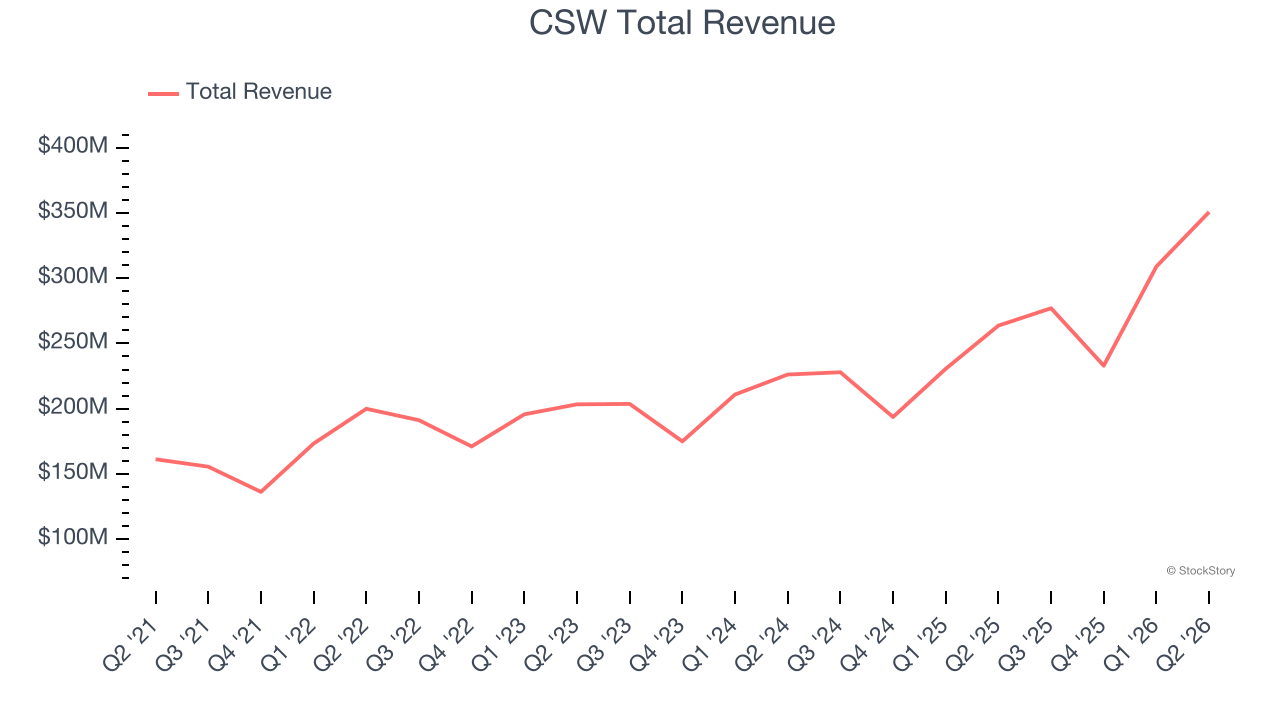
Interestingly, the stock is up 8% since reporting and currently trades at $294.55.
Best Q2: AAON (NASDAQ: AAON)
Backed by two million square feet of lab testing space, AAON (NASDAQ: AAON) makes heating, ventilation, and air conditioning equipment for different types of buildings.
AAON reported revenues of $627 million, up 101% year on year, outperforming analysts’ expectations by 24.6%. The business had an incredible quarter with a beat of analysts’ EPS estimates and an impressive beat of analysts’ EBITDA estimates.
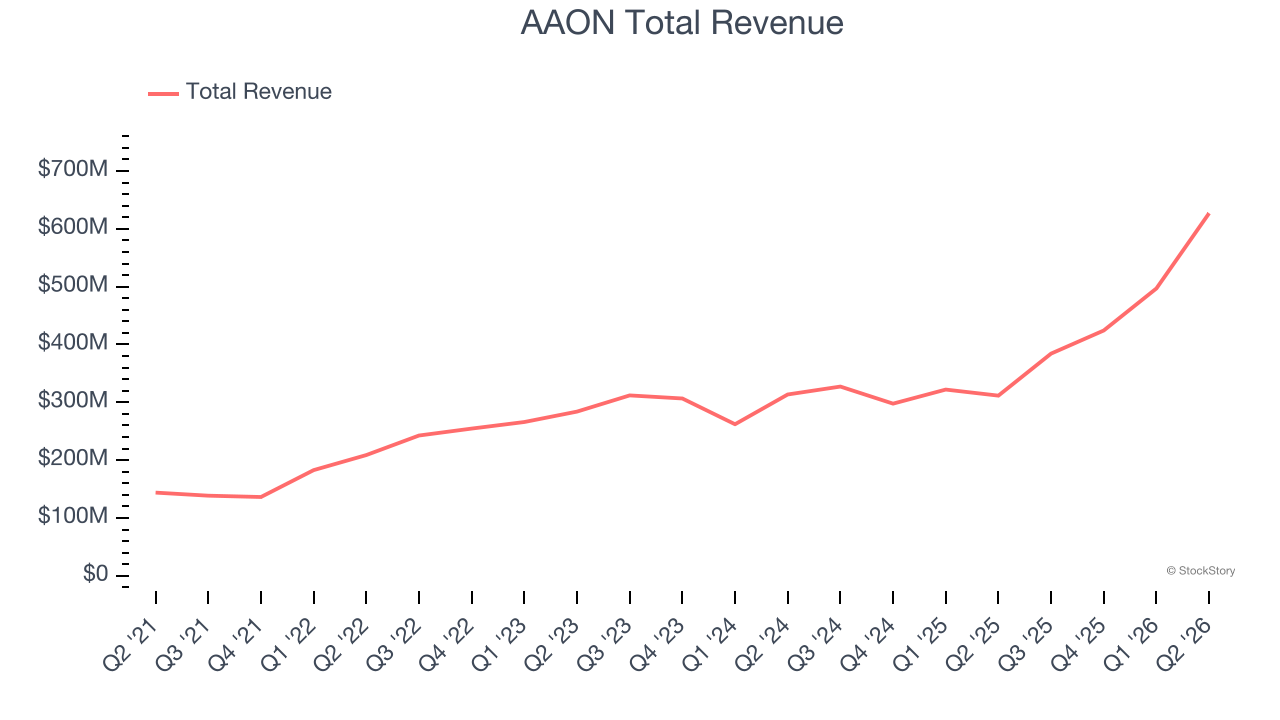
AAON delivered the biggest analyst estimate beat and fastest revenue growth among its peers. Although it had a fine quarter compared to its peers, the market seems unhappy with the results as the stock is down 12.4% since reporting. It currently trades at $83.12.
Is now the time to buy AAON? Access our full analysis of the earnings results here, it’s free.
Weakest Q2: Lennox (NYSE: LII)
Based in Texas and founded over a century ago, Lennox (NYSE: LII) is a climate control solutions company offering heating, ventilation, air conditioning, and refrigeration (HVACR) goods.
Lennox reported revenues of $1.55 billion, up 3% year on year, falling short of analysts’ expectations by 1%. It was a mixed quarter as it posted a solid beat of analysts’ organic revenue estimates but full-year EPS guidance missing analysts’ expectations significantly.
Lennox delivered the weakest performance against analyst estimates of the whole group. As expected, the stock is down 32.4% since the results and currently trades at $367.84.
Read our full analysis of Lennox’s results here.
Northwest Pipe (NASDAQ: NWPX)
Playing a large role in the Integrated Pipeline (IPL) project in Texas to deliver ~350 million gallons of water per day, Northwest Pipe (NASDAQ: NWPX) is a manufacturer of pipeline systems for water infrastructure.
Northwest Pipe reported revenues of $159.5 million, up 19.7% year on year. This print topped analysts’ expectations by 3.1%. It was a stunning quarter as it also put up a beat of analysts’ EPS estimates.
The stock is down 17.7% since reporting and currently trades at $101.38.
Read our full, actionable report on Northwest Pipe here, it’s free.
Carrier Global (NYSE: CARR)
Founded by the inventor of air conditioning, Carrier Global (NYSE: CARR) manufactures heating, ventilation, air conditioning, and refrigeration products.
Carrier Global reported revenues of $6.35 billion, up 3.9% year on year. This result beat analysts’ expectations by 5.6%. It was a stunning quarter as it also produced an impressive beat of analysts’ organic revenue estimates and full-year EPS guidance exceeding analysts’ expectations.
Carrier Global pulled off the highest full-year guidance raise in the group. The stock is down 20.8% since reporting and currently trades at $54.88.
Read our full, actionable report on Carrier Global here, it’s free.
Market Update
Over the past year, investors have been forced to repeatedly answer the same question: what is the market’s biggest risk? The answer has changed several times, and each shift has reshaped market leadership.
Late in 2025 and early 2026, artificial intelligence became the market’s primary uncertainty. Investors questioned whether AI would erode software pricing power and weaken competitive moats as AI made it easier to replicate once-differentiated products.
By the spring, technology took a back seat to geopolitics. The U.S. conflict with Iran briefly became the market’s dominant narrative, raising concerns about oil prices, inflation, and global growth. But as energy markets remained orderly and fears of a prolonged supply disruption faded, investors quickly turned their focus back to fundamentals.
Want to invest in winners with rock-solid fundamentals? Check out our Top 5 Growth Stocks and add them to your watchlist. These companies are poised for growth regardless of the political or macroeconomic climate.