
Social media management platform Sprout Social (NASDAQ: SPT) reported Q2 CY2026 results topping the market’s revenue expectations, with sales up 10.8% year on year to $123.8 million. The company expects next quarter’s revenue to be around $123.7 million, close to analysts’ estimates. Its non-GAAP profit of $0.26 per share was 62.5% above analysts’ consensus estimates.
Is now the time to buy Sprout Social? Find out by accessing our full research report, it’s free.
Sprout Social (SPT) Q2 CY2026 Highlights:
- Revenue: $123.8 million vs analyst estimates of $122.2 million (10.8% year-on-year growth, 1.4% beat)
- Adjusted EPS: $0.26 vs analyst estimates of $0.16 (62.5% beat)
- Adjusted Operating Income: $15.98 million vs analyst estimates of $10.13 million (12.9% margin, 57.8% beat)
- The company slightly lifted its revenue guidance for the full year to $494.3 million at the midpoint from $494 million
- Management raised its full-year Adjusted EPS guidance to $1.13 at the midpoint, a 22.2% increase
- Operating Margin: -2.2%, up from -11% in the same quarter last year
- Free Cash Flow Margin: 6.7%, down from 19.8% in the previous quarter
- Billings: $123 million at quarter end, up 12.9% year on year
- Market Capitalization: $518.7 million
Company Overview
Born from the recognition that businesses needed a centralized way to handle their growing social media presence, Sprout Social (NASDAQ: SPT) provides a comprehensive software platform that helps businesses manage, analyze, and optimize their presence across various social media networks.
Revenue Growth
Examining a company’s long-term performance can provide clues about its quality. Even a bad business can shine for one or two quarters, but a top-tier one grows for years. Thankfully, Sprout Social’s 25.2% annualized revenue growth over the last five years was solid. Its growth beat the average software company and shows its offerings resonate with customers.
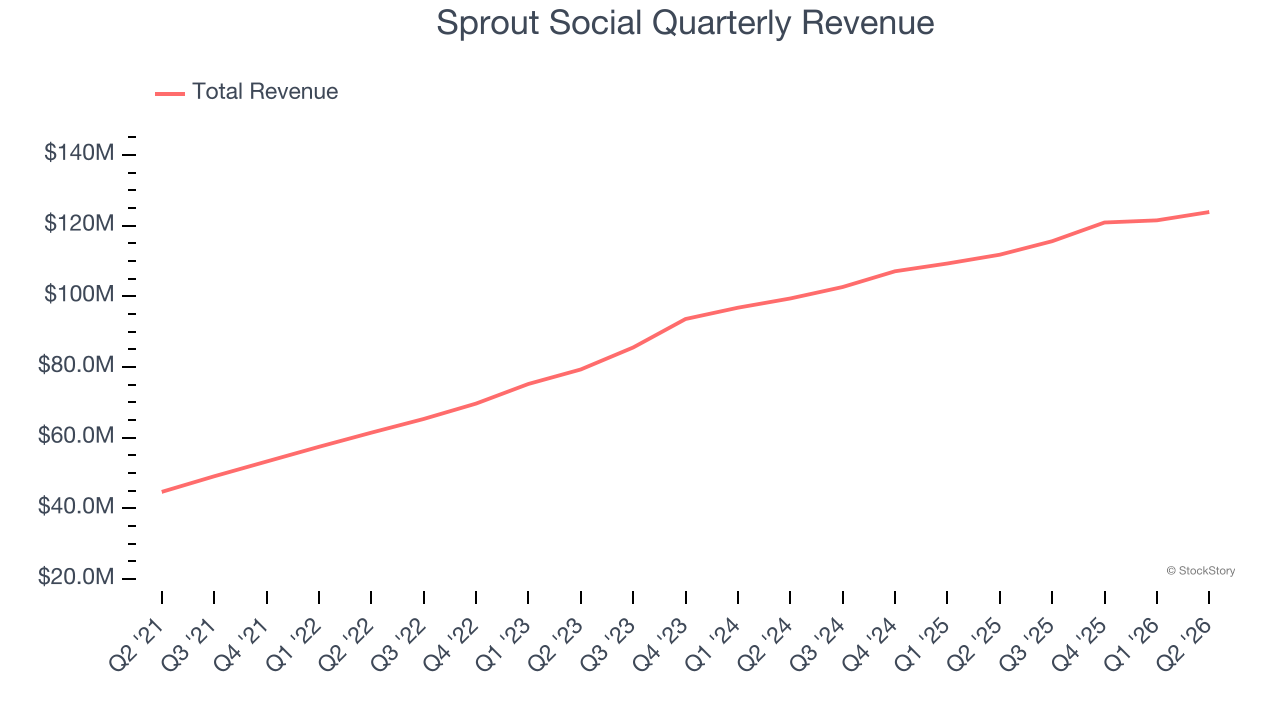
We at StockStory place the most emphasis on long-term growth, but within software, a half-decade historical view may miss recent innovations or disruptive industry trends. Sprout Social’s recent performance shows its demand has slowed as its annualized revenue growth of 13.3% over the last two years was below its five-year trend. We’re wary when companies in the sector see decelerations in revenue growth, as it could signal changing consumer tastes aided by low switching costs. 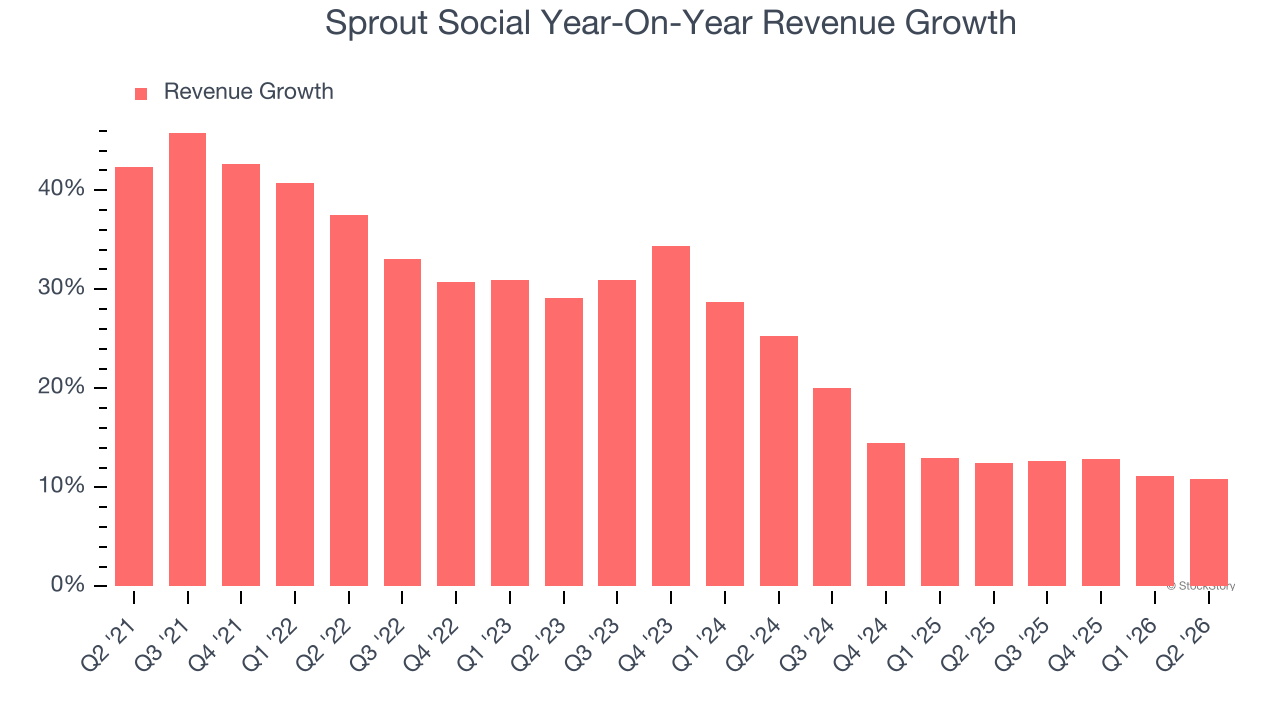
This quarter, Sprout Social reported year-on-year revenue growth of 10.8%, and its $123.8 million of revenue exceeded Wall Street’s estimates by 1.4%. Company management is currently guiding for a 7% year-on-year increase in sales next quarter.
Looking further ahead, sell-side analysts expect revenue to grow 6.1% over the next 12 months, a deceleration versus the last two years. This projection is underwhelming and indicates its products and services will face some demand challenges.
ONE MORE THING: The $21 AI Application Stock Wall Street Forgot. While Wall Street obsesses over who’s building AI, one company is already using it to print money. And nobody’s paying attention.
AI chip stocks trade at ridiculous valuations. This company processes a trillion consumer signals monthly using AI and trades at a third of the price. The gap won’t last. The institutions will figure it out. You need to see this first. Read the FREE Report Before They Notice.
Billings
Billings is a non-GAAP metric that is often called “cash revenue” because it shows how much money the company has collected from customers in a certain period. This is different from revenue, which must be recognized in pieces over the length of a contract.
Sprout Social’s billings came in at $123 million in Q2, and over the last four quarters, its growth was underwhelming as it averaged 11% year-on-year increases. This performance mirrored its total sales and suggests that increasing competition is causing challenges in acquiring/retaining customers. 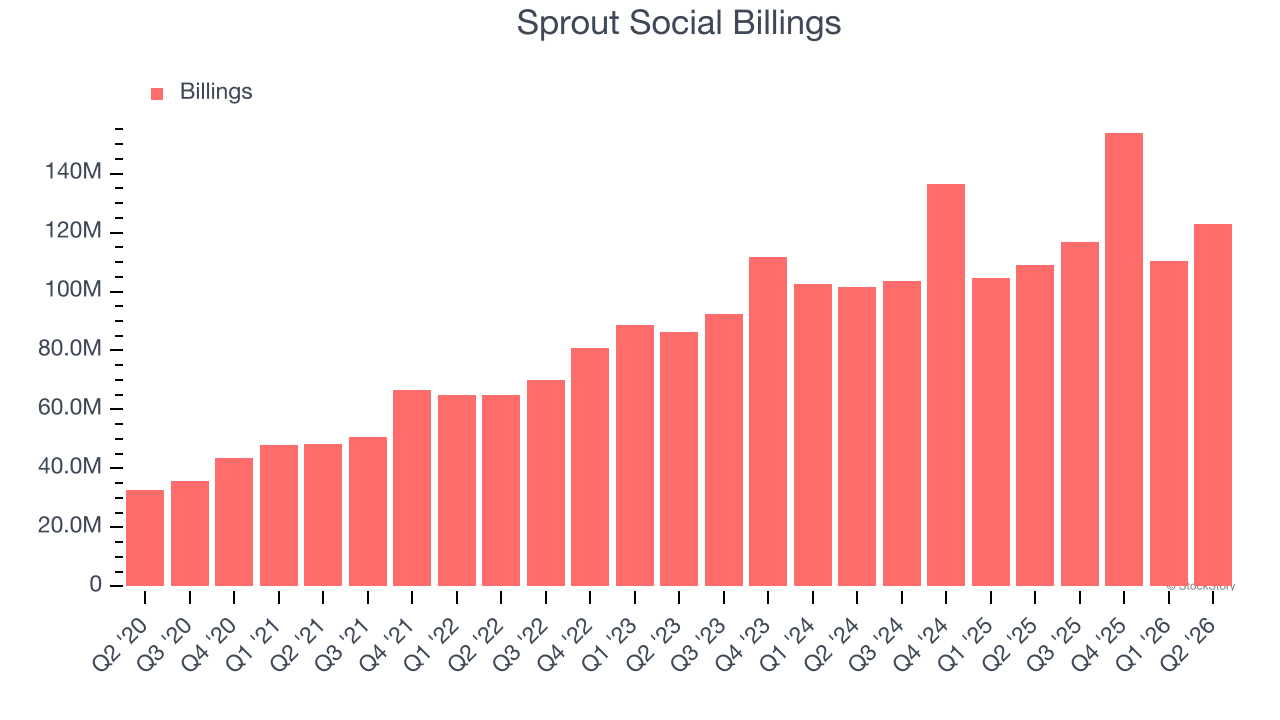
Customer Acquisition Efficiency
The customer acquisition cost (CAC) payback period measures the months a company needs to recoup the money spent on acquiring a new customer. This metric helps assess how quickly a business can break even on its sales and marketing investments.
It’s relatively expensive for Sprout Social to acquire new customers as its CAC payback period checked in at 117.3 months this quarter. The company’s slow recovery of its sales and marketing expenses indicates it operates in a highly competitive market and must invest to stand out, even if the return on that investment is low.
Key Takeaways from Sprout Social’s Q2 Results
We were impressed by Sprout Social’s optimistic EPS guidance for next quarter, which blew past analysts’ expectations. We were also excited its adjusted operating income outperformed Wall Street’s estimates by a wide margin. Zooming out, we think this quarter featured some important positives. The stock traded up 4.3% to $8.53 immediately following the results.
Sprout Social had an encouraging quarter, but one earnings result doesn’t necessarily make the stock a buy. Let’s see if this is a good investment. When making that decision, it’s important to consider its valuation, business qualities, as well as what has happened in the latest quarter. We cover that in our actionable full research report which you can read here (it’s free).