Biorefining company Green Plains (NASDAQ: GPRE) missed Wall Street’s revenue expectations in Q2 CY2026, with sales falling 19.3% year on year to $446.2 million. Its GAAP profit of $0.83 per share was 27% above analysts’ consensus estimates.
Is now the time to buy Green Plains? Find out by accessing our full research report, it’s free.
Green Plains (GPRE) Q2 CY2026 Highlights:
- Revenue: $446.2 million vs analyst estimates of $560 million (19.3% year-on-year decline, 20.3% miss)
- EPS (GAAP): $0.83 vs analyst estimates of $0.65 (27% beat)
- Adjusted EBITDA: $93.35 million vs analyst estimates of $91.3 million (20.9% margin, 2.2% beat)
- Operating Margin: 15.2%, up from -5.1% in the same quarter last year
- Free Cash Flow Margin: 16.9%, up from 8.6% in the same quarter last year
- Market Capitalization: $1.16 billion
Company Overview
Operating one of North America's largest ethanol platforms with capacity to process 310 million bushels of corn annually, Green Plains (NASDAQ: GPRE) operates ten biorefineries that convert corn into ethanol for fuel, distillers grains for animal feed, and renewable corn oil.
Revenue Growth
Cyclical sectors like Energy often flatter weaker operators during favorable price environments, but a longer-term lens separates those from businesses that can consistently perform across market cycles. Green Plains’s demand was weak over the last five years as its sales fell at a 3.5% annual rate. This wasn’t a great result and suggests it’s a low quality business.
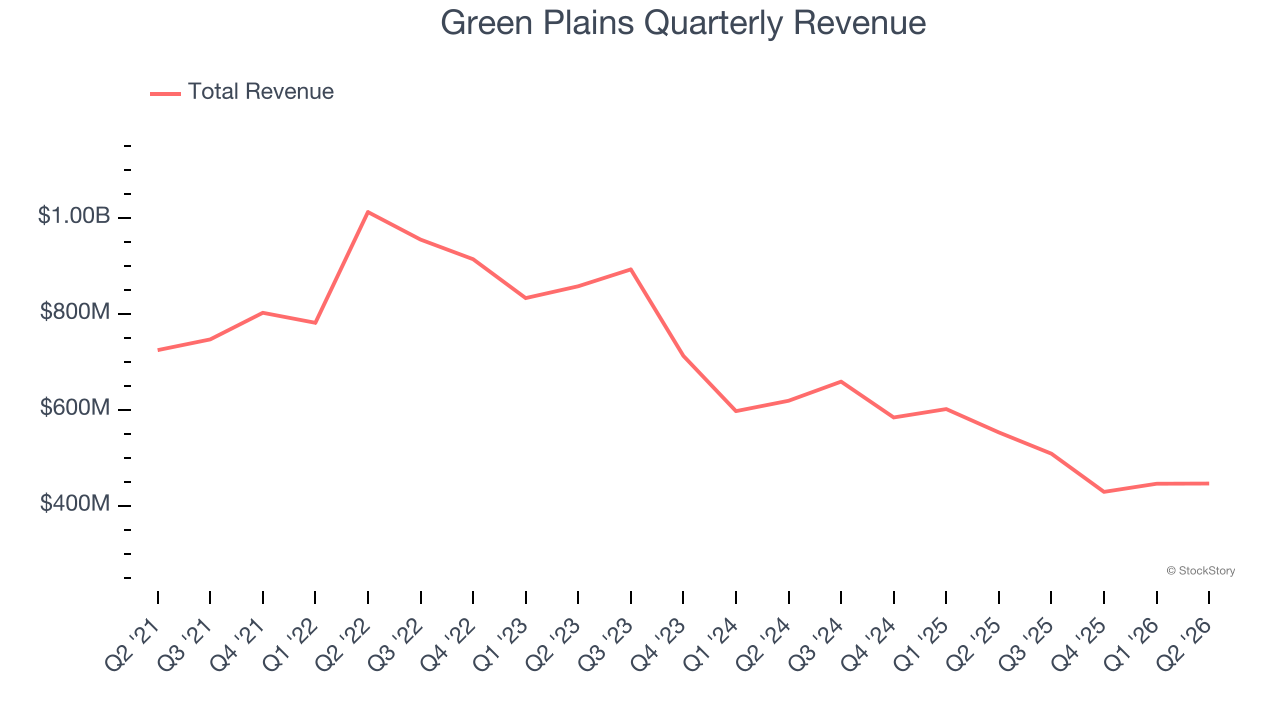
Even a long stretch in Energy can be shaped by a single commodity cycle, so extending the view to ten years adds another perspective and reveals which companies are built to grow regardless of the pricing regime. Green Plains’s recent performance shows its demand remained suppressed as its revenue has declined by 5.2% annually over the last ten years.
This quarter, Green Plains missed Wall Street’s estimates and reported a rather uninspiring 19.3% year-on-year revenue decline, generating $446.2 million of revenue.
ONE MORE THING: 3 Hidden Platforms Growing 3X Faster than Amazon, Google, and PayPal. Amazon, Google, and Meta all followed the same playbook: Dominate an ignored market. Build an unbeatable moat. Scale until you’re unstoppable.
These three platforms are running that exact playbook right now. The early investors in Amazon made fortunes. The early investors in these could do the same. Get All 3 Stocks Here for FREE.
Adjusted EBITDA Margin
Adjusted EBITDA margin is an important measure of profitability for the sector and accounts for the gross margins and operating costs mentioned previously. Unlike operating margin, it is not distorted by accounting conventions around reserves, drilling costs, and assumptions on commodity consumption from the well or basin. Adjusted EBITDA highlights the economic reality of how much cash the rock produces before the capital structure (debt service) and the drilling budget (capex) are considered.
Green Plains was profitable over the last five years but held back by its large cost base. Its average EBITDA margin of 2.4% was among the worst in the energy upstream and integrated energy sector.
On the plus side, Green Plains’s EBITDA margin rose by 13.2 percentage points over the last year.
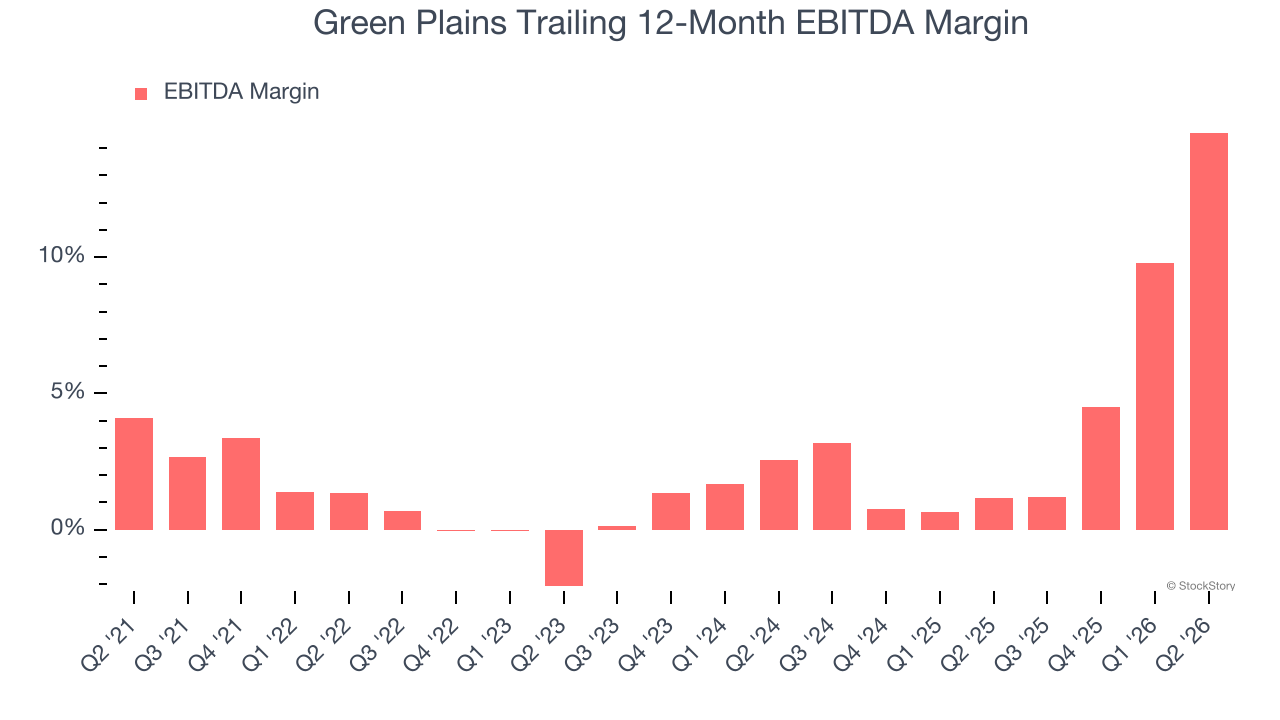
In Q2, Green Plains generated an EBITDA margin profit margin of 20.9%, up 17.9 percentage points year on year. This increase was a welcome development, especially since its revenue fell, showing it was more efficient because it scaled down its expenses. This adjusted EBITDA beat Wall Street’s estimates by 2.2%.
Cash Is King
As mentioned above, adjusted EBITDA ignores capital structure and drilling expenditure decisions. These are two huge aspects of an Energy producer, so in order to understand a comprehensive picture of business quality, an investor needs to account for these. Said differently, adjusted EBITDA margins could be solid but free cash flow is abysmal because decline rates of the asset are extreme and the drilling is expensive. Free cash flow tells you about not only the economics of the production that has happened but how much it costs to stay in business as well (further drilling or extraction).
While Green Plains posted positive free cash flow this quarter, the broader story hasn’t been so clean. Green Plains’s demanding reinvestments have consumed many resources over the last five years, contributing to an average free cash flow margin of negative 2.2%. This means it lit $2.22 of cash on fire for every $100 in revenue.
While the level of free cash flow margins is important, their consistency matters just as much.
Green Plains’s ratio of quarterly free cash flow volatility to WTI crude price volatility over the past five years was 35.4 (lower is better), indicating that its cash generation is far more sensitive to commodity-price swings than most peers. This elevated volatility limits its access to capital in downturns and makes it unlikely to act as a consolidator when weaker competitors come under pressure.
You may be asking why we wait until the free cash flow line to perform this stability analysis versus commodity prices. Why not compare revenue or EBITDA to WTI in the case of Green Plains? Because what ultimately matters is not how much revenue or profit you earn when prices are high but how much cash you can generate when prices are low. Free cash flow is the superior metric because it includes everything from hedging prowess to growth and maintenance capex to management behavior during good times and bad.
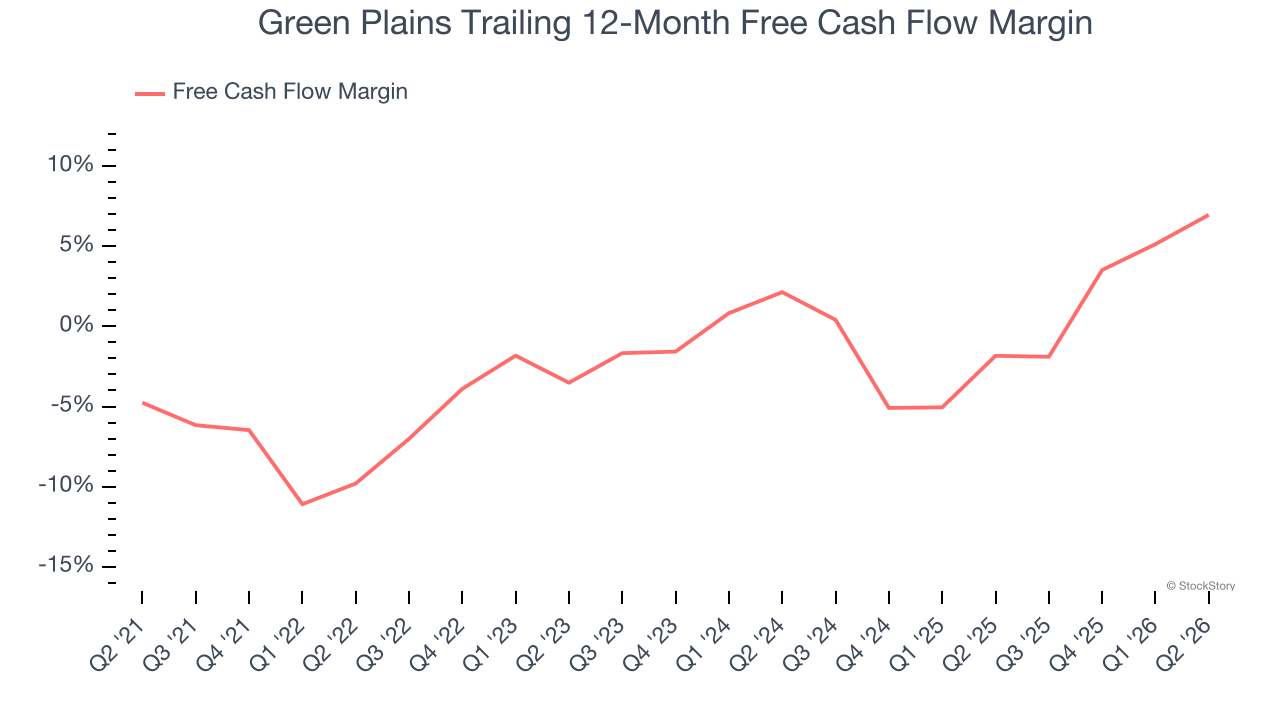
Green Plains’s free cash flow clocked in at $75.58 million in Q2, equivalent to a 16.9% margin. This result was good as its margin was 8.3 percentage points higher than in the same quarter last year, building on its favorable historical trend.
Key Takeaways from Green Plains’s Q2 Results
It was good to see Green Plains beat analysts’ EPS expectations this quarter. We were also happy its EBITDA outperformed Wall Street’s estimates. On the other hand, its revenue missed. Overall, this print had some key positives. The stock traded up 1.3% to $16.70 immediately following the results.
So should you invest in Green Plains right now? What happened in the latest quarter matters, but not as much as longer-term business quality and valuation, when deciding whether to invest in this stock. We cover that in our actionable full research report which you can read here (it’s free).