Language-learning app Duolingo (NASDAQ: DUOL) reported revenue ahead of Wall Street’s expectations in Q2 CY2026, with sales up 18.3% year on year to $298.5 million. On the other hand, next quarter’s revenue guidance of $302 million was less impressive, coming in 0.9% below analysts’ estimates. Its GAAP profit of $0.66 per share was 8.9% above analysts’ consensus estimates.
Is now the time to buy Duolingo? Find out by accessing our full research report, it’s free.
Duolingo (DUOL) Q2 CY2026 Highlights:
- Revenue: $298.5 million vs analyst estimates of $295.9 million (18.3% year-on-year growth, 0.9% beat)
- EPS (GAAP): $0.66 vs analyst estimates of $0.61 (8.9% beat)
- Adjusted EBITDA: $77.3 million vs analyst estimates of $71.55 million (25.9% margin, 8% beat)
- The company slightly lifted its revenue guidance for the full year to $1.21 billion at the midpoint from $1.21 billion
- EBITDA guidance for the full year is $320 million at the midpoint, above analyst estimates of $312.4 million
- Operating Margin: 11.4%, down from 13.2% in the same quarter last year
- Free Cash Flow Margin: 26.3%, down from 50.6% in the previous quarter
- Market Capitalization: $6.42 billion
Company Overview
Founded by a Carnegie Mellon computer science professor and his Ph.D. student, Duolingo (NASDAQ: DUOL) is a mobile app helping people learn new languages.
Revenue Growth
A company’s long-term sales performance can indicate its overall quality. Any business can put up a good quarter or two, but the best consistently grow over the long haul. Luckily, Duolingo’s sales grew at an incredible 37.3% compounded annual growth rate over the last three years. Its growth surpassed the average consumer internet company and shows its offerings resonate with customers, a great starting point for our analysis.
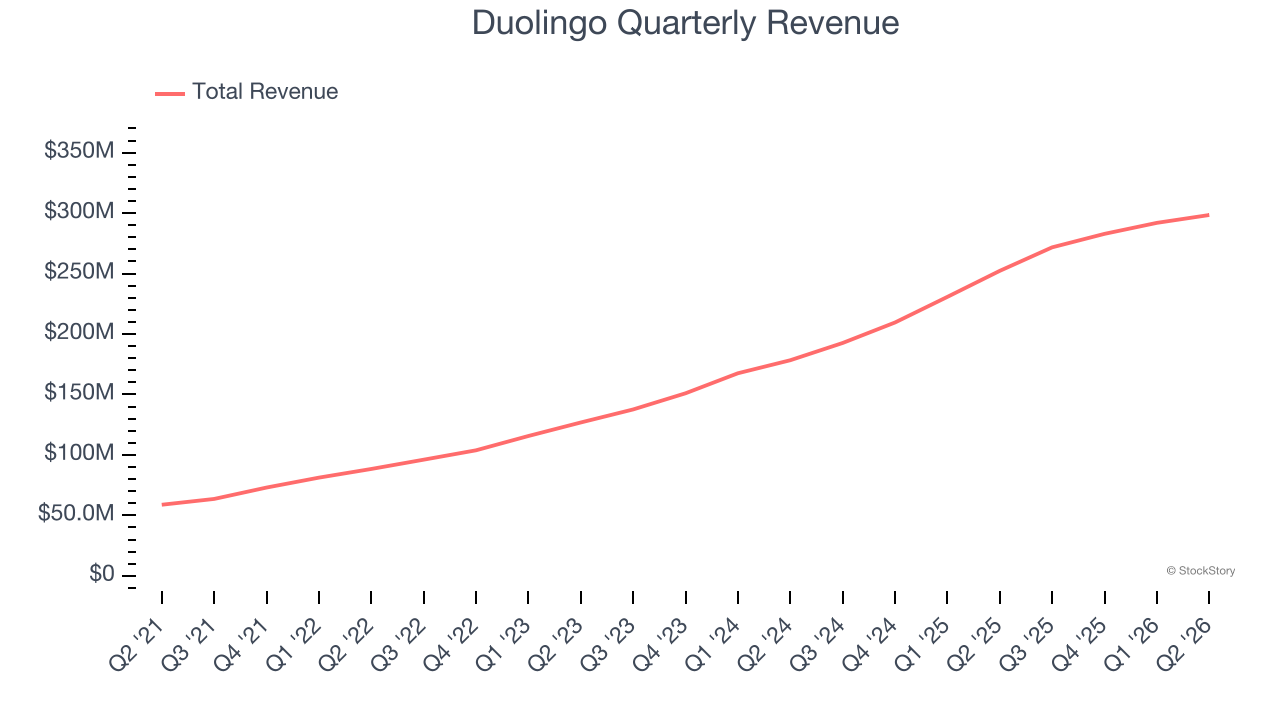
This quarter, Duolingo reported year-on-year revenue growth of 18.3%, and its $298.5 million of revenue exceeded Wall Street’s estimates by 0.9%. Company management is currently guiding for a 11.1% year-on-year increase in sales next quarter.
Looking further ahead, sell-side analysts expect revenue to grow 11.7% over the next 12 months, a deceleration versus the last three years. Despite the slowdown, this projection is above average for the sector and suggests the market sees some success for its newer products and services.
ALSO WORTH WATCHING: Nvidia’s Quiet Partner. Nvidia’s chips cost a hundred grand. The connectors that make them work cost even more. One company makes them all.
Every AI server needs specialized infrastructure the chip companies don’t make. High-speed cables. Power connectors. Thermal sensors. This 90-year-old company built a monopoly on it. The AI boom just started. This stock is still flying under the radar. Claim The Stock Ticker Here for FREE.
Cash Is King
Although EBITDA is undoubtedly valuable for assessing company performance, we believe cash is king because you can’t use accounting profits to pay the bills.
Duolingo has shown terrific cash profitability, driven by its lucrative business model and cost-effective customer acquisition strategy that enable it to stay ahead of the competition through investments in new products rather than sales and marketing. The company’s free cash flow margin was among the best in the consumer internet sector, averaging an eye-popping 35.4% over the last two years.
Taking a step back, we can see that Duolingo’s margin expanded by 17.1 percentage points over the last few years. This is encouraging because it gives the company more optionality.
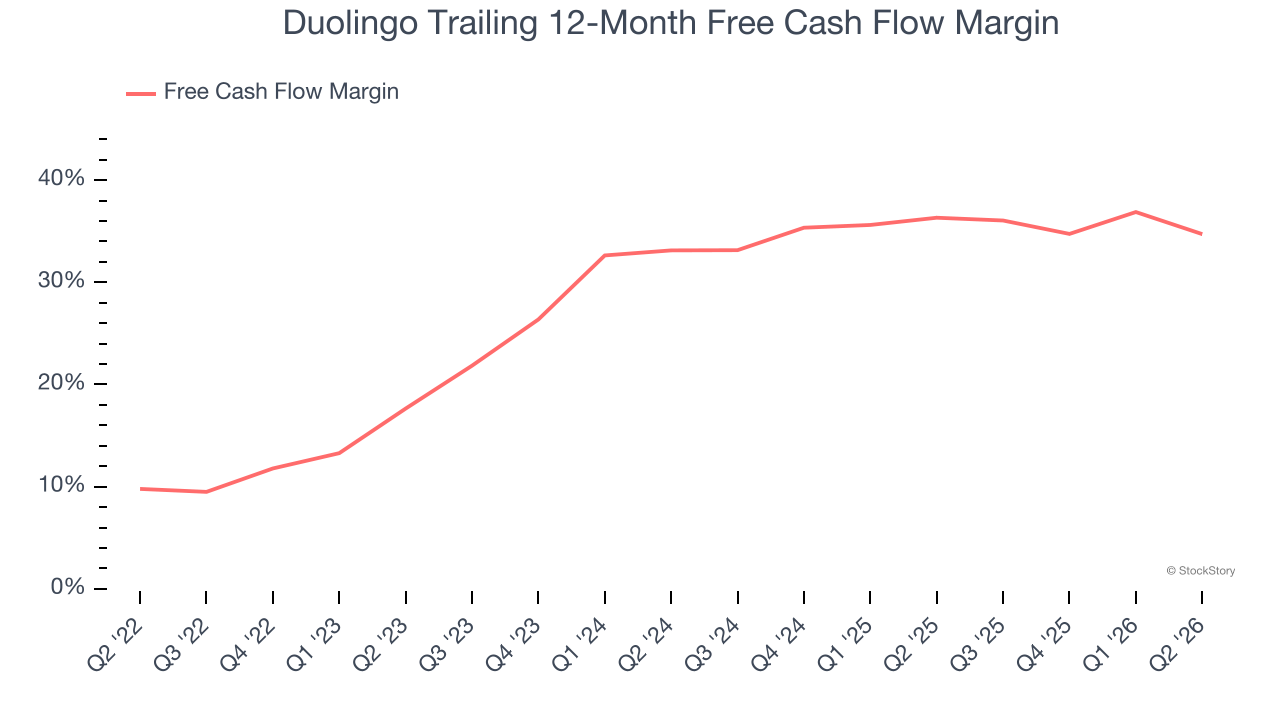
Duolingo’s free cash flow clocked in at $78.63 million in Q2, equivalent to a 26.3% margin. The company’s cash profitability regressed as it was 7.9 percentage points lower than in the same quarter last year, but we wouldn’t read too much into the short term because investment needs can be seasonal, leading to temporary swings. Long-term trends carry greater meaning.
Key Takeaways from Duolingo’s Q2 Results
We were impressed by how significantly Duolingo blew past analysts’ EBITDA expectations this quarter. We were also glad its full-year EBITDA guidance exceeded Wall Street’s estimates. On the other hand, its revenue guidance for next quarter slightly missed. Overall, this print had some key positives. Investors were likely hoping for more, and shares traded down 12% to $119.25 immediately after reporting.
Is Duolingo an attractive investment opportunity at the current price? What happened in the latest quarter matters, but not as much as longer-term business quality and valuation, when deciding whether to invest in this stock. We cover that in our actionable full research report which you can read here (it’s free).