As the craze of earnings season draws to a close, here’s a look back at some of the most exciting (and some less so) results from Q2. Today, we are looking at consumer internet stocks, starting with Expedia (NASDAQ: EXPE).
The ways people shop, transport, communicate, learn and play are undergoing a tremendous, technology-enabled change. Consumer internet companies are playing a key role in lives being transformed, simplified and made more accessible.
The 44 consumer internet stocks we track reported a mixed Q2. As a group, revenues beat analysts’ consensus estimates by 1.3% while next quarter’s revenue guidance was 3% below.
While some consumer internet stocks have fared somewhat better than others, they have collectively declined. On average, share prices are down 2.2% since the latest earnings results.
Expedia (NASDAQ: EXPE)
Originally founded as a part of Microsoft, Expedia (NASDAQ: EXPE) is one of the world’s leading online travel agencies.
Expedia reported revenues of $4.32 billion, up 14% year on year. This print exceeded analysts’ expectations by 3.5%. Overall, it was a very strong quarter for the company with an impressive beat of analysts’ EBITDA estimates and revenue guidance for next quarter slightly topping analysts’ expectations.
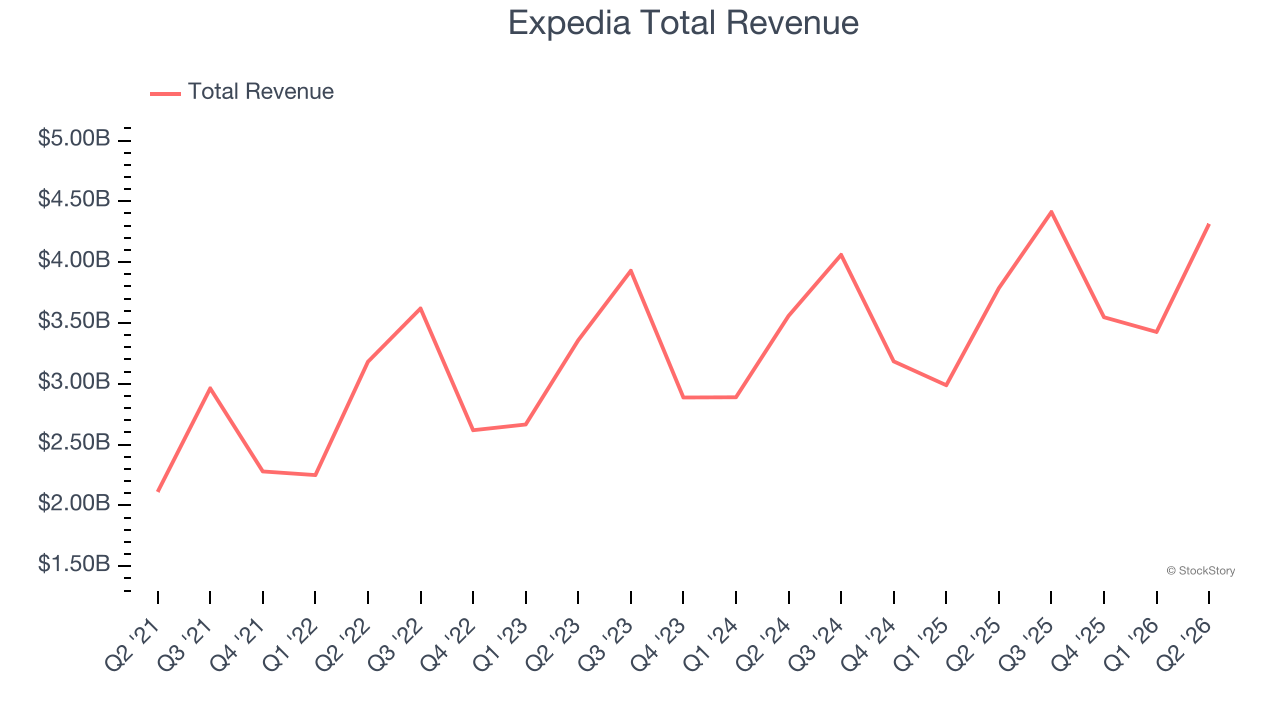
Interestingly, the stock is up 1.6% since reporting and currently trades at $324.91.
Is now the time to buy Expedia? Access our full analysis of the earnings results here, it’s free.
Best Q2: Alphabet (NASDAQ: GOOGL)
Started by Stanford students Larry Page and Sergey Brin in a Menlo Park garage, Alphabet (NASDAQ: GOOGL) is the parent company of the eponymous Google Search engine, Google Cloud Platform, and YouTube.
Alphabet reported revenues of $119.8 billion, up 24.2% year on year, outperforming analysts’ expectations by 2.2%. The business had a stunning quarter with a solid beat of analysts’ EPS estimates.
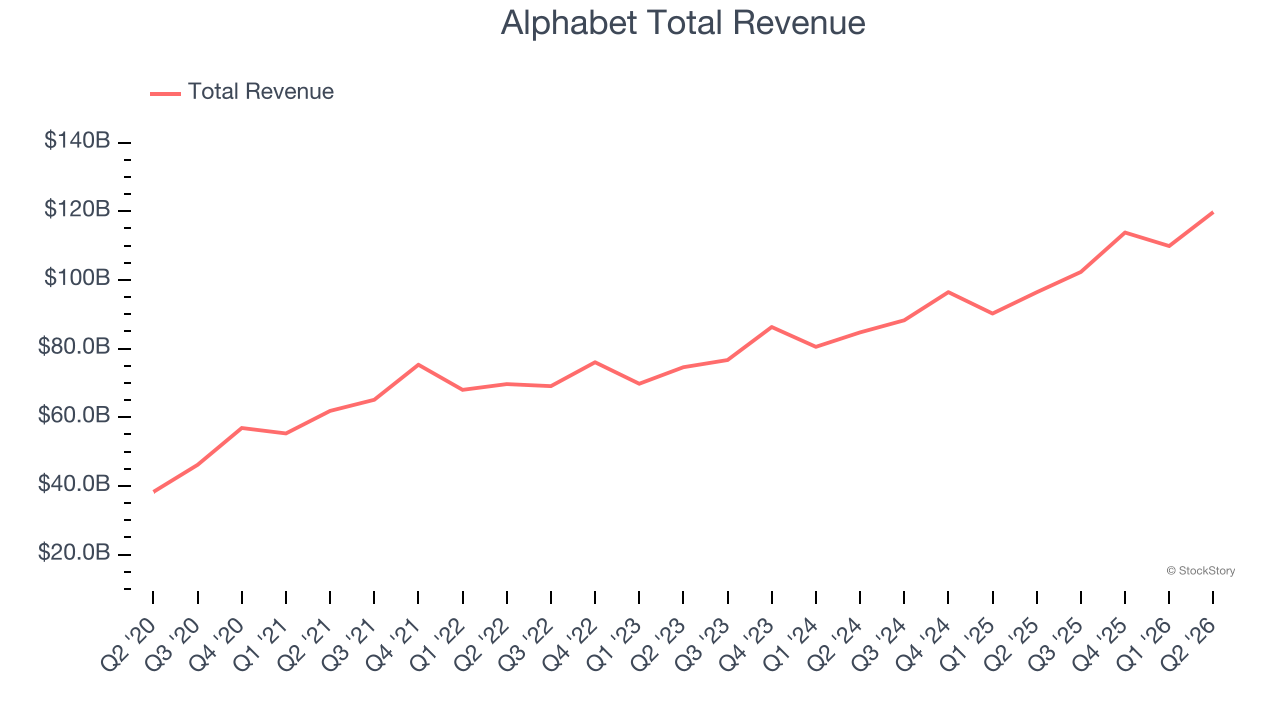
However, the results were likely priced into the stock as it’s traded sideways since reporting. Shares currently sit at $340.83.
Is now the time to buy Alphabet? Access our full analysis of the earnings results here, it’s free.
Weakest Q2: Coinbase (NASDAQ: COIN)
Widely regarded as the face of crypto, Coinbase (NASDAQ: COIN) is a blockchain infrastructure company updating the financial system with its trading, staking, stablecoin, and other payment solutions.
Coinbase reported revenues of $1.22 billion, down 18.5% year on year, falling short of analysts’ expectations by 5.9%. It was a disappointing quarter as it posted a significant miss of analysts’ EBITDA estimates.
Interestingly, the stock is up 5.5% since the results and currently trades at $172.63.
Read our full analysis of Coinbase’s results here.
MercadoLibre (NASDAQ: MELI)
Originally started as an online auction platform, MercadoLibre (NASDAQ: MELI) is a one-stop e-commerce marketplace and fintech platform in Latin America.
MercadoLibre reported revenues of $10.17 billion, up 49.8% year on year. This number beat analysts’ expectations by 4.5%. It was an exceptional quarter as it also logged a solid beat of analysts’ EBITDA estimates and impressive growth in its users.
The company reported 89 million daily active users, up 25.4% year on year. The stock is flat since reporting and currently trades at $1,920.
Read our full, actionable report on MercadoLibre here, it’s free.
Snap (NYSE: SNAP)
Founded by Stanford University students Evan Spiegel, Reggie Brown, and Bobby Murphy, and originally called Picaboo, Snapchat (NYSE: SNAP) is an image centric social media network.
Snap reported revenues of $1.60 billion, up 18.9% year on year. This print topped analysts’ expectations by 3.8%. Overall, it was an exceptional quarter as it also produced a solid beat of analysts’ EBITDA estimates.
The stock is up 3.6% since reporting and currently trades at $5.22.
Read our full, actionable report on Snap here, it’s free.
Market Update
Over the past year, investors have been forced to repeatedly answer the same question: what is the market’s biggest risk? The answer has changed several times, and each shift has reshaped market leadership.
Late in 2025 and early 2026, artificial intelligence became the market’s primary uncertainty. Investors questioned whether AI would erode software pricing power and weaken competitive moats as AI made it easier to replicate once-differentiated products.
By the spring, technology took a back seat to geopolitics. The U.S. conflict with Iran briefly became the market’s dominant narrative, raising concerns about oil prices, inflation, and global growth. But as energy markets remained orderly and fears of a prolonged supply disruption faded, investors quickly turned their focus back to fundamentals.
Want to invest in winners with rock-solid fundamentals? Check out our Top 5 Quality Compounder Stocks and add them to your watchlist. These companies are poised for growth regardless of the political or macroeconomic climate.