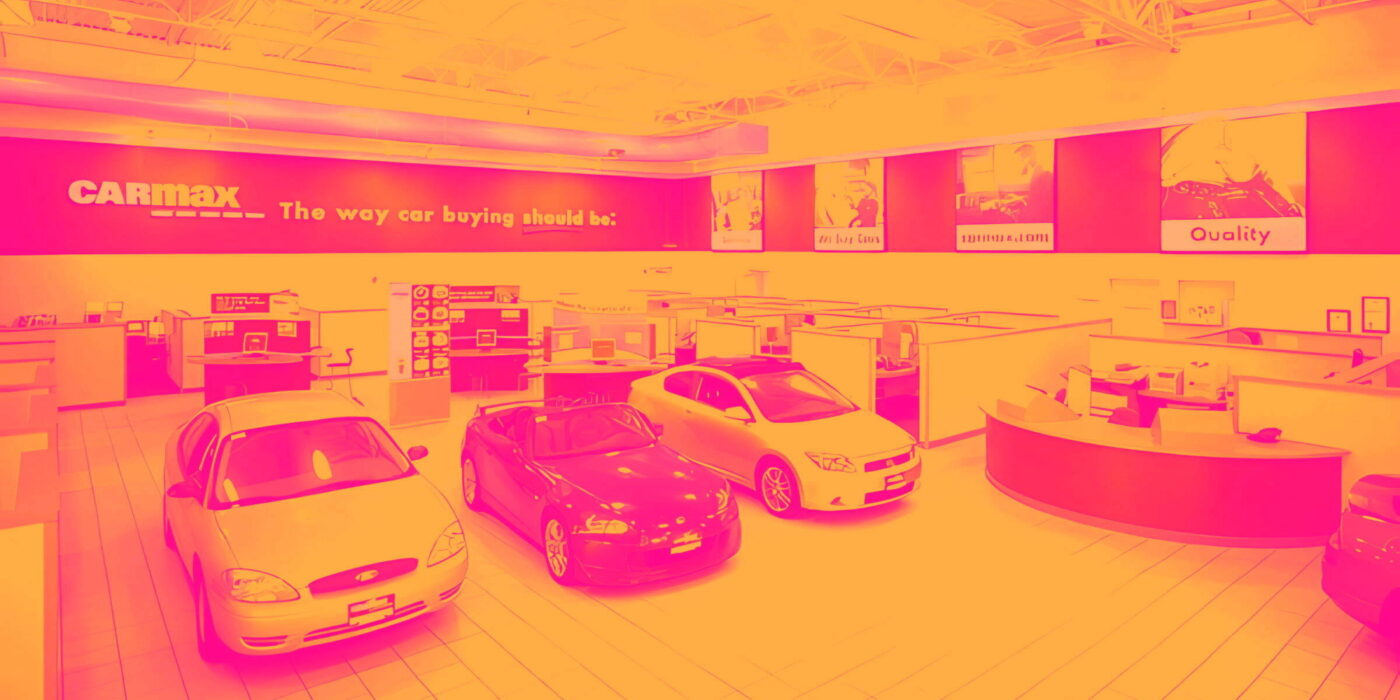
Used automotive vehicle retailer Carmax (NYSE: KMX) announced better-than-expected revenue in Q2 CY2026, with sales up 6.2% year on year to $8.01 billion. Its GAAP profit of $1.31 per share was 38.3% above analysts’ consensus estimates.
Is now the time to buy KMX? Find out in our full research report (it’s free for active Edge members).
CarMax (KMX) Q2 CY2026 Highlights:
- Revenue: $8.01 billion vs analyst estimates of $7.41 billion (6.2% year-on-year growth, 8.2% beat)
- EPS (GAAP): $1.31 vs analyst estimates of $0.94 (38.3% beat)
- Operating Margin: 3.6%, in line with the same quarter last year
- Locations: 255 at quarter end, up from 250 in the same quarter last year
- Same-Store Sales rose 3.8% year on year (6.6% in the same quarter last year)
- Market Capitalization: $7.32 billion
StockStory’s Take
CarMax’s second quarter results were met with a negative market reaction despite the company exceeding Wall Street’s revenue and profit expectations. Management attributed the disconnect to a combination of operational friction in the customer journey and ongoing cost pressures. CEO Keith Barr highlighted areas for improvement, noting, "Our core operations are not yet fast and efficient enough. Retail prices and selection must continue to improve, and our costs remain too high." The company also acknowledged that complexity in the digital experience and in-store processes limited conversion rates, offsetting gains from recent pricing and marketing initiatives.
Looking ahead, CarMax’s forward strategy centers on four key pillars: competitive pricing, seamless digital and in-store experiences, enhanced value per transaction, and a leaner cost structure. Management aims to drive unit growth through better integration of online and physical channels and improved inventory and logistics management. CFO Enrique Mayor-Mora emphasized, “We continue to be focused on SG&A efficiency opportunities along the way,” while President and CEO Keith Barr stated, “We are moving at pace with this strategy.” The company expects these changes to enable sustained market share growth, although management remains cautious about ongoing margin variability and operational headwinds.
Key Insights from Management’s Remarks
Management pointed to improvements in competitive pricing, marketing, and cost initiatives as primary drivers of the quarter, but acknowledged operational friction and digital complexity continued to impact sales conversion and margin.
-
Dynamic Pricing Approach: The company enhanced its pricing algorithms with more granular and localized competitive data, aiming to improve both price competitiveness and sales momentum. Management believes this flexibility allowed CarMax to outperform broader market trends but noted that further tweaks may be needed as demand cycles fluctuate.
-
Digital and Store Integration: CarMax continued investing in its digital and in-store experiences, seeking to simplify communication, reduce customer friction, and streamline the transition from online browsing to in-person purchasing. Barr described the current digital experience as “too complex and not seamlessly connected to the in-person experience,” impacting conversion rates.
-
SG&A Optimization: During the quarter, CarMax reduced selling, general, and administrative (SG&A) expenses through headcount and overhead cuts while increasing targeted marketing spend to boost sales. Management stated it remains on track for its $200 million annualized cost savings target and intends to self-fund further strategic investments via ongoing efficiency gains.
-
Logistics Network Overhaul: Leadership identified unproductive vehicle transfers as a source of unnecessary complexity and cost. The company has begun a comprehensive review of its logistics network to ensure cars are moved more efficiently to the right locations, with the goal of lowering logistics costs and improving inventory availability.
-
Finance and Protection Product Growth: CarMax Auto Finance (CAF) increased its penetration rate and expanded into more credit segments, while redesigned extended protection plans (EPP) drove incremental margin improvement. Management expects these product enhancements to support long-term profitability and customer retention.
Drivers of Future Performance
CarMax’s forward outlook is shaped by efforts to balance competitive pricing with cost discipline and digital transformation, while navigating variable consumer demand and the evolving auto retail landscape.
-
Continued Pricing Flexibility: Management emphasized that pricing will remain dynamic, with ongoing adjustments in gross profit per unit (GPU) to maximize sales volume while maintaining profitability. CEO Keith Barr noted that “there will be more dynamic movement in our pricing and how we maximize sales and profitability going forward,” reflecting a willingness to adapt margins to market conditions.
-
Cost Structure and Efficiency Initiatives: The company is prioritizing operational efficiency through logistics optimization, automation in reconditioning, and SG&A reductions. These measures are intended to offset inflationary pressures and fund investments in customer experience improvements, though management acknowledged that some cost savings may take time to materialize fully.
-
Digital Experience Revamp: CarMax is investing in digital tools—including AI-powered online assistants and enhanced prequalification processes—to reduce friction and better connect online shoppers with in-store associates. Management believes that improving the digital-to-physical handoff will be critical for boosting sales conversion and customer satisfaction amid changing consumer expectations.
Catalysts in Upcoming Quarters
In the coming quarters, our analysts will monitor (1) the pace and effectiveness of CarMax’s digital transformation and its impact on sales conversion, (2) progress on logistics and inventory management reforms aimed at reducing costs and boosting inventory availability, and (3) evidence that dynamic pricing and cost discipline are delivering sustained margin and market share gains. Execution against these operational milestones will be central to evaluating CarMax’s ability to adapt in a competitive, evolving retail environment.
CarMax currently trades at $47.60, down from $52.11 just before the earnings. At this price, is it a buy or sell? See for yourself in our full research report (it’s free).
Stocks That Trumped Tariffs
ONE MORE THING: Top 5 Growth Stocks. The biggest stock winners almost always had one thing in common before they ran. Revenue growing like crazy. Meta. CrowdStrike. Broadcom. Our AI flagged all three. They returned 315%, 314%, and 455%, respectively.
Find out which 5 stocks it’s flagging this month — FREE. Get Our Top 5 Growth Stocks for Free HERE.
Stocks that have made our list include now familiar names such as Nvidia (+1,326% between June 2020 and June 2025) as well as under-the-radar businesses like the once-micro-cap company Kadant (+351% five-year return). Find your next big winner with StockStory today.