Technology distribution company ScanSource (NASDAQ: SCSC) reported revenue ahead of Wall Street’s expectations in Q1 CY2026, with sales up 8.8% year on year to $766.8 million. The company expects the full year’s revenue to be around $3.05 billion, close to analysts’ estimates. Its non-GAAP profit of $0.94 per share was 1.8% above analysts’ consensus estimates.
Is now the time to buy ScanSource? Find out by accessing our full research report, it’s free.
ScanSource (SCSC) Q1 CY2026 Highlights:
- Revenue: $766.8 million vs analyst estimates of $722.9 million (8.8% year-on-year growth, 6.1% beat)
- Adjusted EPS: $0.94 vs analyst estimates of $0.92 (1.8% beat)
- Adjusted EBITDA: $35.62 million vs analyst estimates of $33.23 million (4.6% margin, 7.2% beat)
- The company reconfirmed its revenue guidance for the full year of $3.05 billion at the midpoint
- EBITDA guidance for the full year is $145 million at the midpoint, above analyst estimates of $141.9 million
- Operating Margin: 3%, in line with the same quarter last year
- Free Cash Flow Margin: 9%, similar to the same quarter last year
- Market Capitalization: $879.2 million
“The ScanSource team delivered strong third quarter results,” said Mike Baur, Chair and CEO, ScanSource, Inc.
Company Overview
Operating as a crucial link in the technology supply chain since 1992, ScanSource (NASDAQ: SCSC) is a hybrid distributor that connects hardware, software, and cloud services from technology suppliers to resellers and business customers.
Revenue Growth
A company’s long-term sales performance is one signal of its overall quality. Even a bad business can shine for one or two quarters, but a top-tier one grows for years.
With $3.09 billion in revenue over the past 12 months, ScanSource is a mid-sized business services company, which sometimes brings disadvantages compared to larger competitors benefiting from better economies of scale.
As you can see below, ScanSource’s sales grew at a sluggish 1% compounded annual growth rate over the last five years. This shows it failed to generate demand in any major way and is a rough starting point for our analysis.
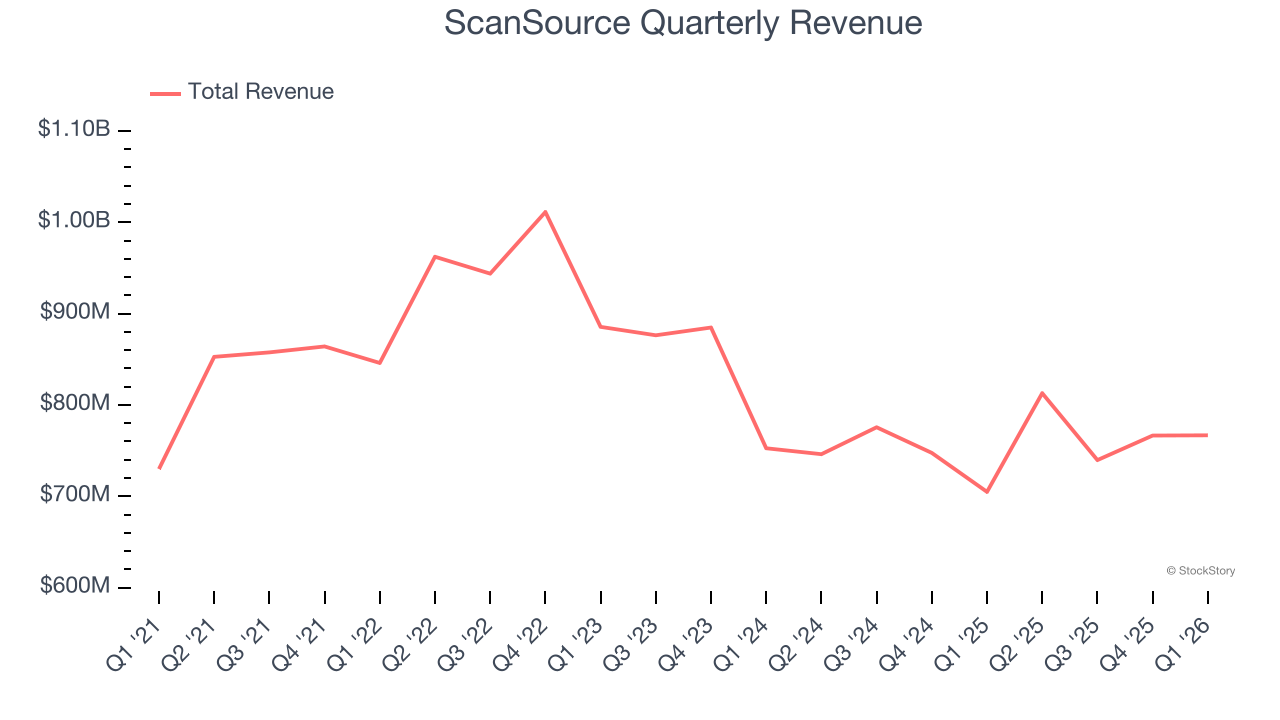
We at StockStory place the most emphasis on long-term growth, but within business services, a half-decade historical view may miss recent innovations or disruptive industry trends. ScanSource’s performance shows it grew in the past but relinquished its gains over the last two years, as its revenue fell by 4.9% annually. 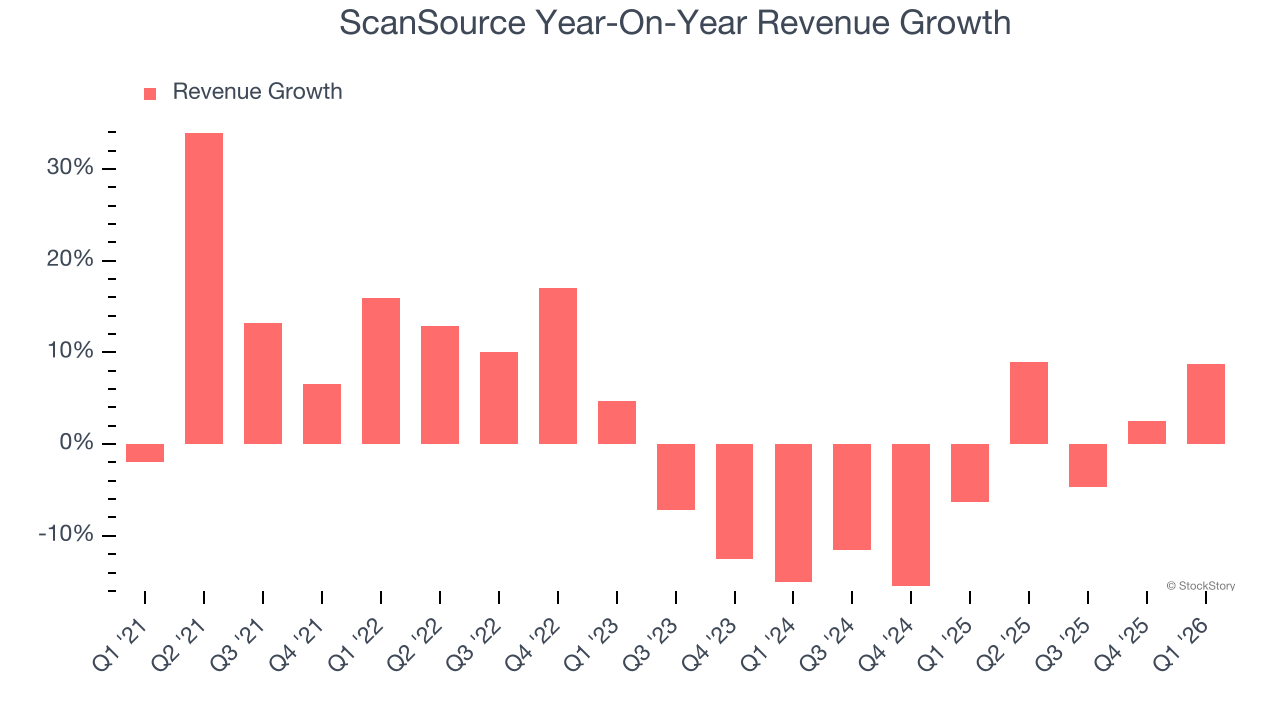
This quarter, ScanSource reported year-on-year revenue growth of 8.8%, and its $766.8 million of revenue exceeded Wall Street’s estimates by 6.1%.
Looking ahead, sell-side analysts expect revenue to grow 2% over the next 12 months. Although this projection indicates its newer products and services will spur better top-line performance, it is still below the sector average.
ALSO WORTH WATCHING: Nvidia’s Quiet Partner. Nvidia’s chips cost a hundred grand. The connectors that make them work cost even more. One company makes them all.
Every AI server needs specialized infrastructure the chip companies don’t make. High-speed cables. Power connectors. Thermal sensors. This 90-year-old company built a monopoly on it. The AI boom just started. This stock is still flying under the radar. Claim The Stock Ticker Here for FREE.
Adjusted Operating Margin
Adjusted operating margin is an important measure of profitability as it shows the portion of revenue left after accounting for all core expenses – everything from the cost of goods sold to advertising and wages. It’s also useful for comparing profitability across companies because it excludes non-recurring expenses, interest on debt, and taxes.
ScanSource’s adjusted operating margin has generally stayed the same over the last 12 months, averaging 3.6% over the last five years. This profitability was lousy for a business services business and caused by its suboptimal cost structure.
Looking at the trend in its profitability, ScanSource’s adjusted operating margin might fluctuated slightly but has generally stayed the same over the last five years. This raises questions about the company’s expense base because its revenue growth should have given it leverage on its fixed costs, resulting in better economies of scale and profitability.
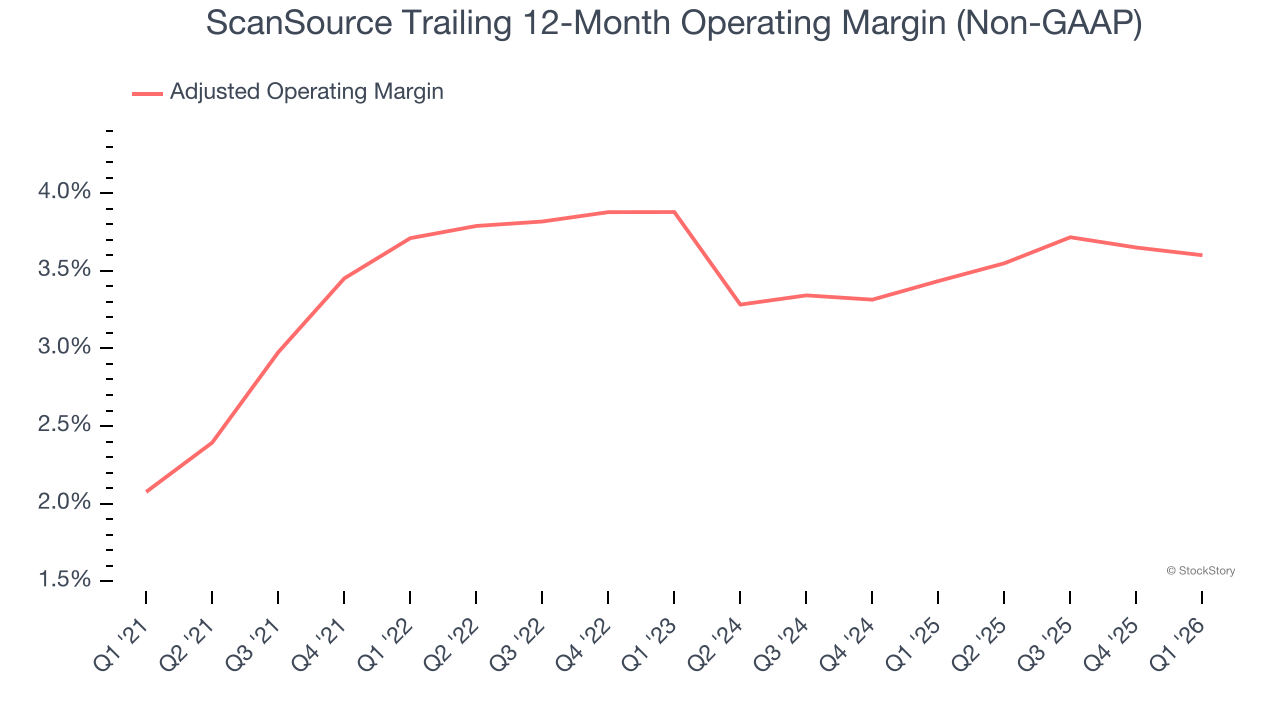
In Q1, ScanSource generated an adjusted operating margin profit margin of 3.5%, in line with the same quarter last year. This indicates the company’s overall cost structure has been relatively stable.
Earnings Per Share
We track the long-term change in earnings per share (EPS) for the same reason as long-term revenue growth. Compared to revenue, however, EPS highlights whether a company’s growth is profitable.
ScanSource’s EPS grew at 14.2% compounded annual growth rate over the last five years, higher than its 1% annualized revenue growth. However, this alone doesn’t tell us much about its business quality because its adjusted operating margin didn’t improve.
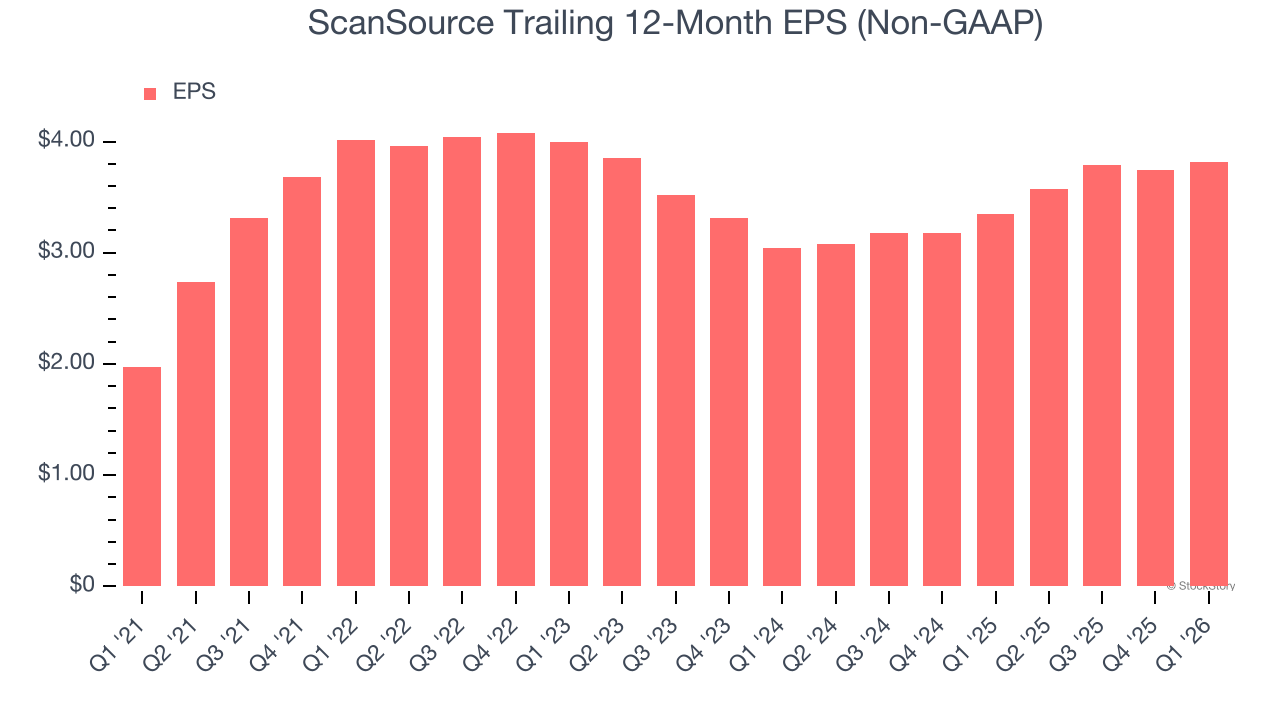
Like with revenue, we analyze EPS over a more recent period because it can provide insight into an emerging theme or development for the business.
For ScanSource, its two-year annual EPS growth of 12.1% was lower than its five-year trend. We still think its growth was good and hope it can accelerate in the future.
In Q1, ScanSource reported adjusted EPS of $0.94, up from $0.86 in the same quarter last year. This print beat analysts’ estimates by 1.8%. Over the next 12 months, Wall Street expects ScanSource’s full-year EPS of $3.82 to grow 14.4%.
Key Takeaways from ScanSource’s Q1 Results
We were impressed by how significantly ScanSource blew past analysts’ revenue expectations this quarter. We were also glad its EPS outperformed Wall Street’s estimates. On the other hand, its full-year revenue guidance was in line. Overall, this print had some key positives. The stock remained flat at $40.93 immediately after reporting.
Should you buy the stock or not? When making that decision, it’s important to consider its valuation, business qualities, as well as what has happened in the latest quarter. We cover that in our actionable full research report which you can read here (it’s free).