West Texas landowner Texas Pacific Land (NYSE: TPL) fell short of the market’s revenue expectations in Q1 CY2026, but sales rose 20.8% year on year to $236.8 million. Its GAAP profit of $2.07 per share was 2.5% above analysts’ consensus estimates.
Is now the time to buy Texas Pacific Land? Find out by accessing our full research report, it’s free.
Texas Pacific Land (TPL) Q1 CY2026 Highlights:
- Revenue: $236.8 million vs analyst estimates of $238.6 million (20.8% year-on-year growth, 0.8% miss)
- EPS (GAAP): $2.07 vs analyst estimates of $2.02 (2.5% beat)
- Adjusted EBITDA: $181.4 million vs analyst estimates of $204 million (76.6% margin, 11.1% miss)
- Operating Margin: 77%, in line with the same quarter last year
- Free Cash Flow Margin: 57.6%, down from 75.4% in the same quarter last year
- Market Capitalization: $29.68 billion
“For the first quarter of 2026, TPL’s core business performance remained strong, and we are closing in on significant milestones in our emerging opportunities in produced water desalination and land opportunities involving data centers and power generation,” said Tyler Glover, Chief Executive Officer of the Company.
Company Overview
One of America's largest private landowners with roughly 868,000 acres in the Permian Basin, Texas Pacific Land (NYSE: TPL) owns land in West Texas and earns revenue from oil and gas royalties, water services, and land leases.
Revenue Growth
Cyclical industries such as Energy can make mediocre companies look great for a time, but a long-term view reveals which businesses can actually withstand and adapt to changing conditions. Thankfully, Texas Pacific Land’s 23.7% annualized revenue growth over the last five years was exceptional. Its growth surpassed the average energy upstream and integrated energy company and shows its offerings resonate with customers, a great starting point for our analysis.
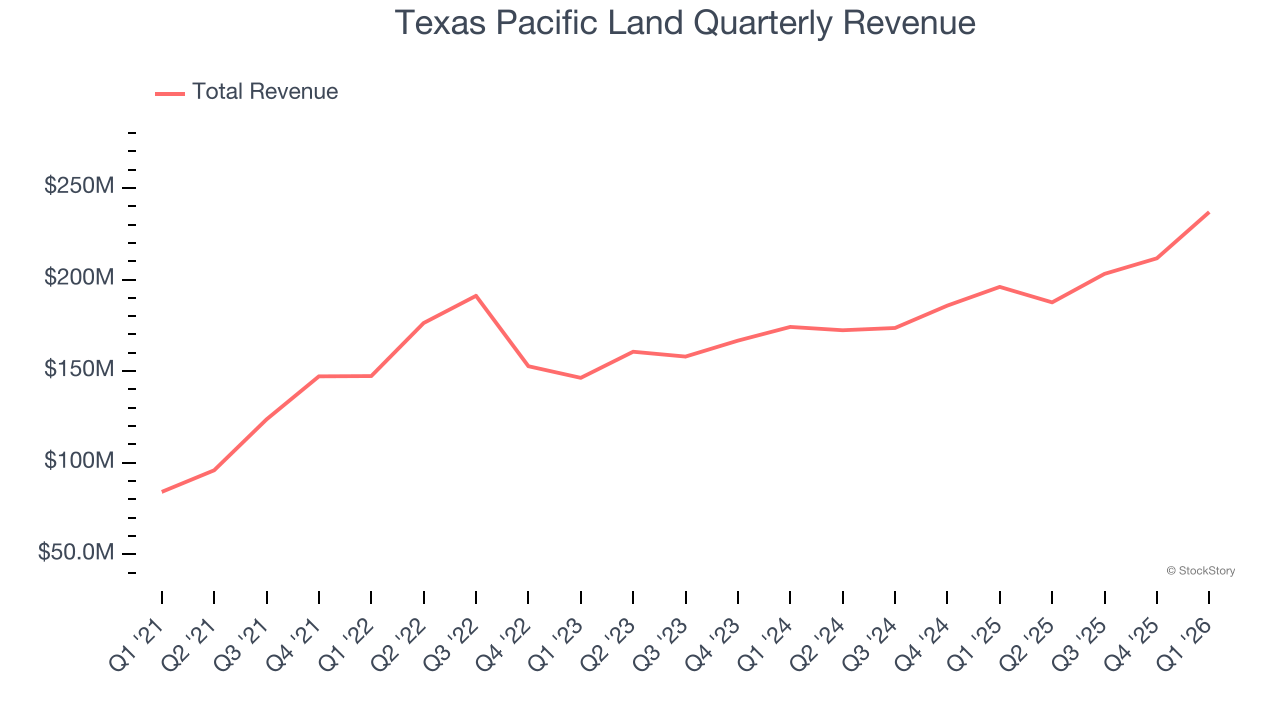
Within Energy, a singular timeframe, even if it’s quite long-term, only sheds light on how well a company rode the last commodity cycle. To better assess whether a company compounds through cycles, we validate our view with an even longer, ten-year view. Texas Pacific Land’s annualized revenue growth of 31.3% over the last ten years is above its five-year trend.
This quarter, Texas Pacific Land generated an excellent 20.8% year-on-year revenue growth rate, but its $236.8 million of revenue fell short of Wall Street’s high expectations.
ONE MORE THING: 3 Hidden Platforms Growing 3X Faster than Amazon, Google, and PayPal. Amazon, Google, and Meta all followed the same playbook: Dominate an ignored market. Build an unbeatable moat. Scale until you’re unstoppable.
These three platforms are running that exact playbook right now. The early investors in Amazon made fortunes. The early investors in these could do the same. Get All 3 Stocks Here for FREE.
Adjusted EBITDA Margin
Adjusted EBITDA margin strips out accounting distortions tied to depletion and historical drilling spend, providing a clearer view of the cash-generating power of the underlying asset base before financing and reinvestment decisions.
Texas Pacific Land has been a well-oiled machine over the last five years. It demonstrated elite profitability for an upstream and integrated energy business, boasting an average EBITDA margin of 86%.
Looking at the trend in its profitability, Texas Pacific Land’s EBITDA margin decreased by 3.7 percentage points over the last year. This raises questions about the company’s expense base because its revenue growth should have given it leverage on its fixed costs, resulting in better economies of scale and profitability.
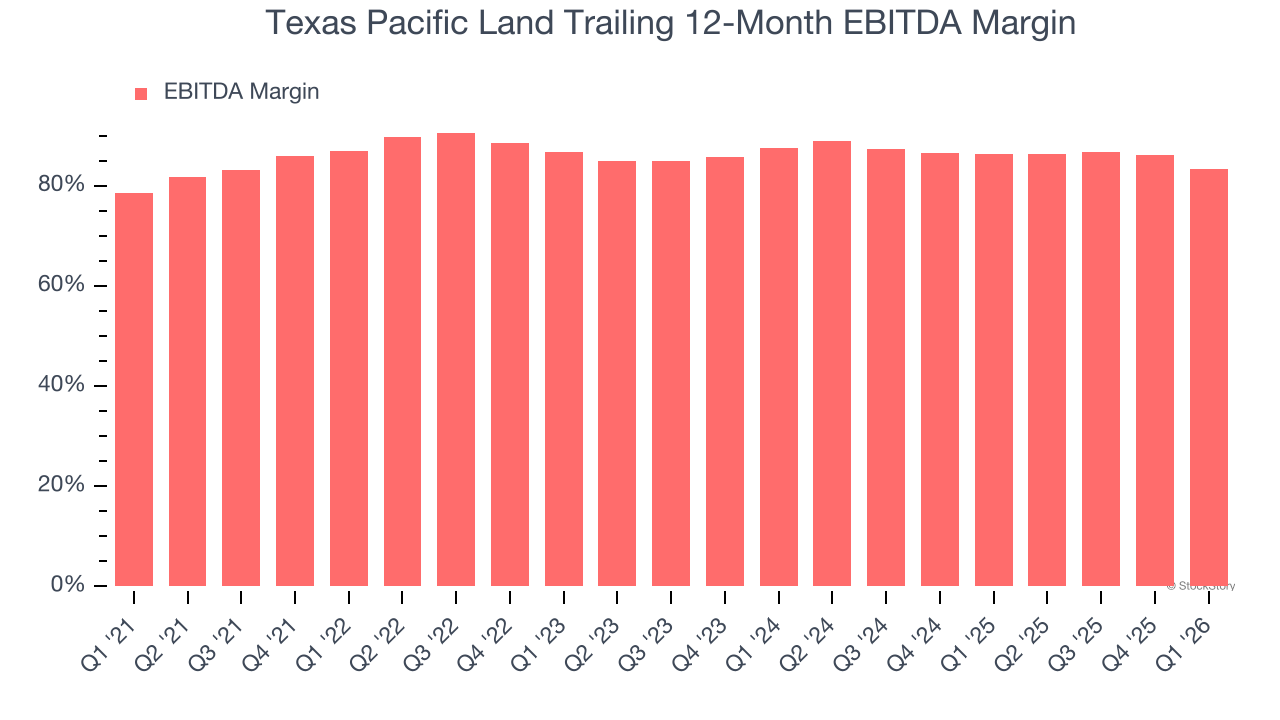
In Q1, Texas Pacific Land generated an EBITDA margin profit margin of 76.6%, down 9.8 percentage points year on year. This contraction shows it was less efficient because its expenses grew faster than its revenue. This adjusted EBITDA fell short of Wall Street’s estimates.
Cash Is King
Adjusted EBITDA shows how profitable a company’s existing “rock” is before financing and reinvestment, while free cash flow shows how much value remains after paying to replace those wells. Because production declines over time, strong EBITDA can coexist with weak FCF if drilling is expensive or declines are steep. FCF therefore captures both operating efficiency and the cost of sustaining production.
Texas Pacific Land has shown terrific cash profitability, driven by its lucrative business model that enables it to reinvest, return capital to investors, and stay ahead of the competition. The company’s free cash flow margin was among the best in the energy upstream and integrated energy sector, averaging an eye-popping 62% over the last five years.
Absolute FCF margin levels matter but so does stability of free cash flow. All else equal, we’d prefer a 25.0% average free cash flow margin that is quite steady no matter how commodity prices behave rather than extremely high margins when times are good and negative ones when they’re tough.
Texas Pacific Land’s ratio of quarterly free cash flow volatility to WTI Crude price volatility over the past five years was 1.7 (lower is better), indicating unusually strong insulation from commodity swings. This stability supports superior capital access in downturns and positions Texas Pacific Land to act as a consolidator when weaker peers are forced to retrench.
You may be asking why we wait until the free cash flow line to perform this stability analysis versus commodity prices. Why not compare revenue or EBITDA to WTI in the case of Texas Pacific Land? Because what ultimately matters is not how much revenue or profit you earn when prices are high but how much cash you can generate when prices are low. Free cash flow is the superior metric because it includes everything from hedging prowess to growth and maintenance capex to management behavior during good times and bad.
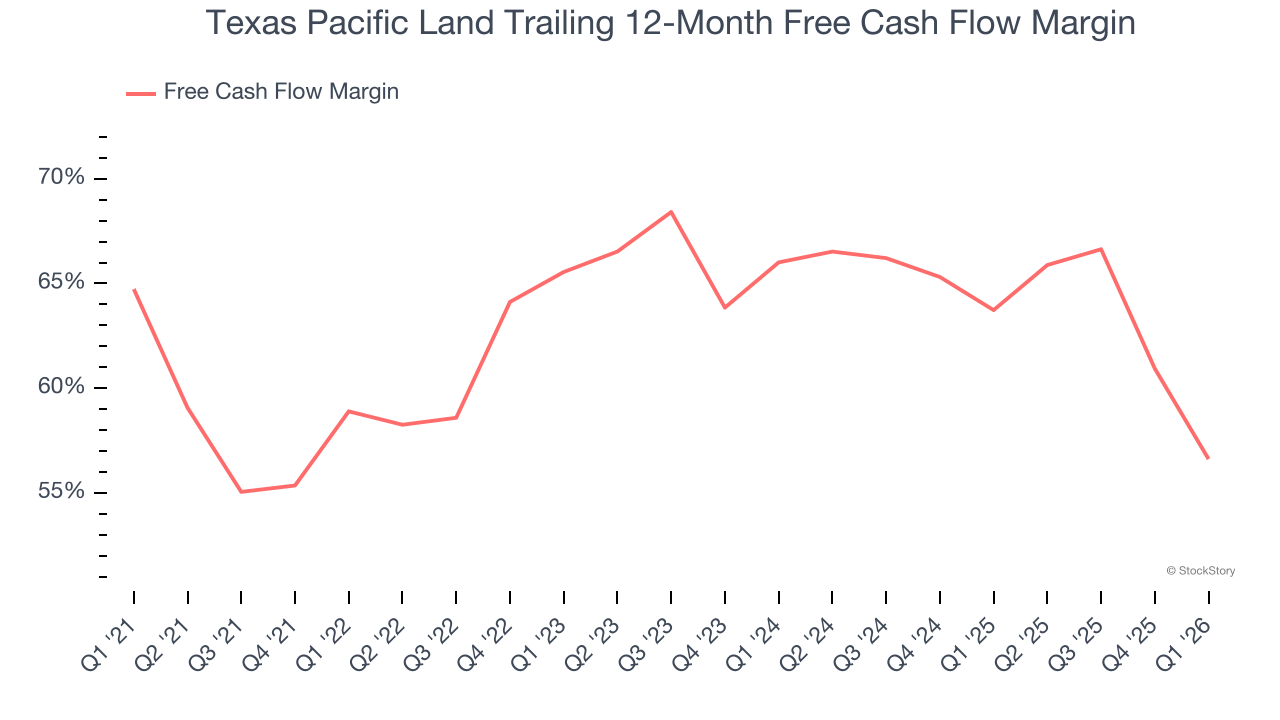
Texas Pacific Land’s free cash flow clocked in at $136.4 million in Q1, equivalent to a 57.6% margin. The company’s cash profitability regressed as it was 17.8 percentage points lower than in the same quarter last year, which isn’t ideal considering its longer-term trend.
Key Takeaways from Texas Pacific Land’s Q1 Results
It was good to see Texas Pacific Land beat analysts’ EPS expectations this quarter. On the other hand, its EBITDA missed and its revenue fell slightly short of Wall Street’s estimates. Overall, this was a softer quarter. The stock remained flat at $419.23 immediately after reporting.
Texas Pacific Land underperformed this quarter, but does that create an opportunity to invest right now? What happened in the latest quarter matters, but not as much as longer-term business quality and valuation, when deciding whether to invest in this stock. We cover that in our actionable full research report which you can read here (it’s free).