Oil and gas producer HighPeak Energy (NASDAQ: HPK) announced better-than-expected revenue in Q1 CY2026, but sales fell by 16.1% year on year to $215.9 million. Its non-GAAP loss of $0.02 per share was in line with analysts’ consensus estimates.
Is now the time to buy HighPeak Energy? Find out by accessing our full research report, it’s free.
HighPeak Energy (HPK) Q1 CY2026 Highlights:
- Revenue: $215.9 million vs analyst estimates of $213.2 million (16.1% year-on-year decline, 1.3% beat)
- Adjusted EPS: -$0.02 vs analyst estimates of -$0.02 (in line)
- Adjusted EBITDA: $149.9 million vs analyst estimates of $139.6 million (69.4% margin, 7.4% beat)
- Operating Margin: 16.7%, down from 35.1% in the same quarter last year
- Free Cash Flow was -$24.58 million compared to -$25.28 million in the same quarter last year
- Market Capitalization: $858 million
Company Overview
Operating in the oil-rich northeastern corner of the Midland Basin where Howard and Borden counties meet, HighPeak Energy (NASDAQ: HPK) explores for, develops, and produces crude oil, natural gas liquids, and natural gas.
Revenue Growth
Cyclical sectors like Energy often flatter weaker operators during favorable price environments, but a longer-term lens separates those from businesses that can consistently perform across market cycles. Thankfully, HighPeak Energy’s 78.2% annualized revenue growth over the last five years was incredible. Its growth beat the average energy upstream and integrated energy company and shows its offerings resonate with customers.
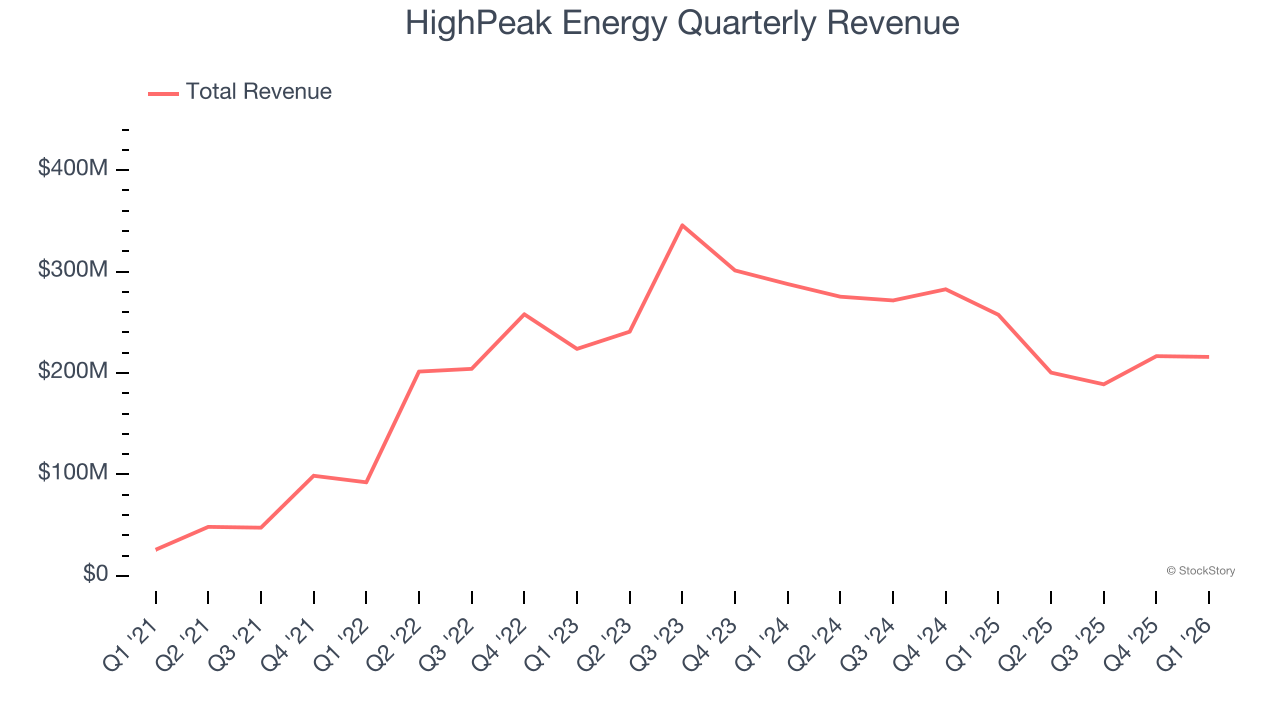
This quarter, HighPeak Energy’s revenue fell by 16.1% year on year to $215.9 million but beat Wall Street’s estimates by 1.3%.
ONE MORE THING: 3 Hidden Platforms Growing 3X Faster than Amazon, Google, and PayPal. Amazon, Google, and Meta all followed the same playbook: Dominate an ignored market. Build an unbeatable moat. Scale until you’re unstoppable.
These three platforms are running that exact playbook right now. The early investors in Amazon made fortunes. The early investors in these could do the same. Get All 3 Stocks Here for FREE.
Adjusted EBITDA Margin
Adjusted EBITDA margin strips out accounting distortions tied to depletion and historical drilling spend, providing a clearer view of the cash-generating power of the underlying asset base before financing and reinvestment decisions.
HighPeak Energy has been a well-oiled machine over the last five years. It demonstrated elite profitability for an upstream and integrated energy business, boasting an average EBITDA margin of 76.2%.
Looking at the trend in its profitability, HighPeak Energy’s EBITDA margin rose by 7 percentage points over the last year, showing its efficiency has improved.
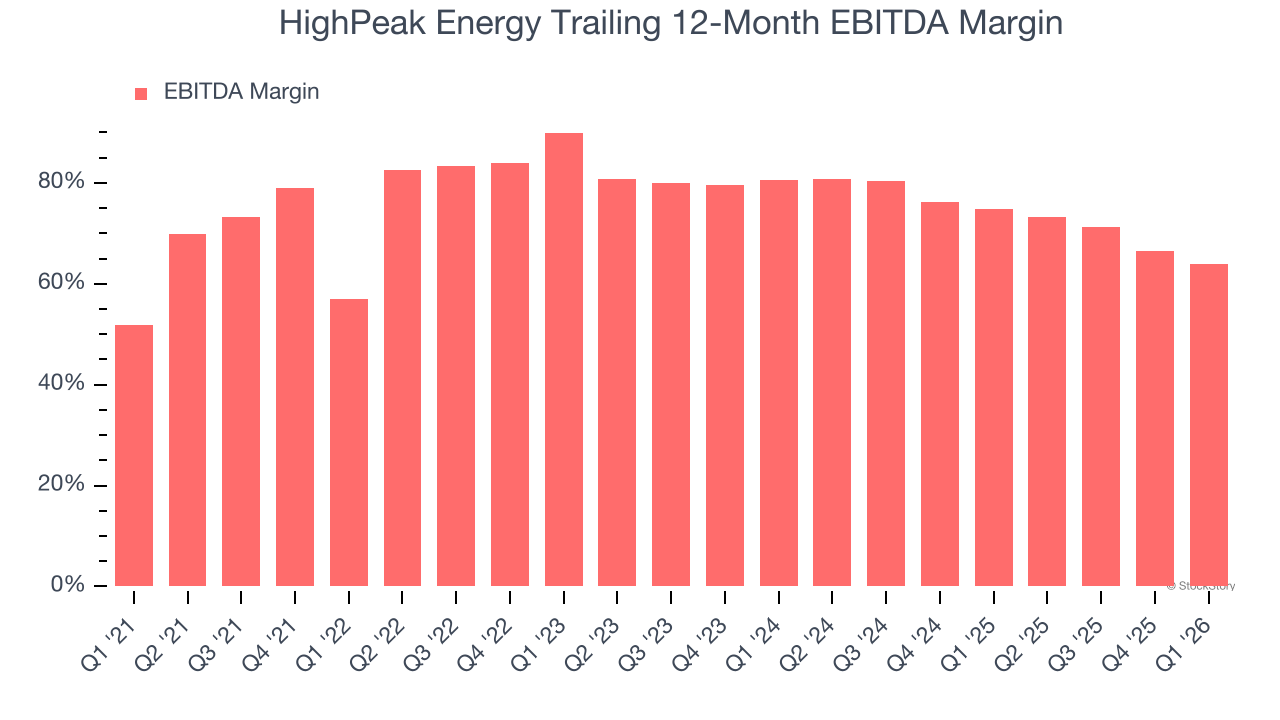
In Q1, HighPeak Energy generated an EBITDA margin profit margin of 69.4%, down 8.2 percentage points year on year. This contraction shows it was less efficient because its expenses increased relative to its revenue. This adjusted EBITDA beat Wall Street’s estimates by 7.4%.
Cash Is King
Adjusted EBITDA shows how profitable a company’s existing wells are before financing and reinvestment decisions, but free cash flow shows how much value remains after paying the cost of replacing those wells. In upstream energy, production naturally declines over time, so companies must continuously reinvest just to stand still. A producer can report strong EBITDA margins yet generate little or no free cash flow if its wells decline quickly or if new drilling is expensive. Free cash flow therefore captures not only how efficiently a company produces hydrocarbons today, but also how costly it is to sustain that production into the future.
HighPeak Energy’s demanding reinvestments have drained its resources over the last five years, putting it in a pinch and limiting its ability to return capital to investors. Its free cash flow margin averaged negative 27.7%, meaning it lit $27.72 of cash on fire for every $100 in revenue.
Absolute FCF margin levels matter but so does stability of free cash flow. All else equal, we’d prefer a 25.0% average free cash flow margin that is quite steady no matter how commodity prices behave rather than extremely high margins when times are good and negative ones when they’re tough.
HighPeak Energy’s ratio of quarterly free cash flow volatility to WTI crude price volatility over the past five years was 11.9 (lower is better), indicating that its cash generation is far more sensitive to commodity-price swings than most peers. This elevated volatility limits its access to capital in downturns and makes it unlikely to act as a consolidator when weaker competitors come under pressure.
You may be asking why we wait until the free cash flow line to perform this stability analysis versus commodity prices. Why not compare revenue or EBITDA to WTI Crude prices in the case of HighPeak Energy? Because what ultimately matters is not how much revenue or profit you earn when prices are high but how much cash you can generate when prices are low. Free cash flow is the superior metric because it includes everything from hedging prowess to growth and maintenance capex to management behavior during good times and bad.
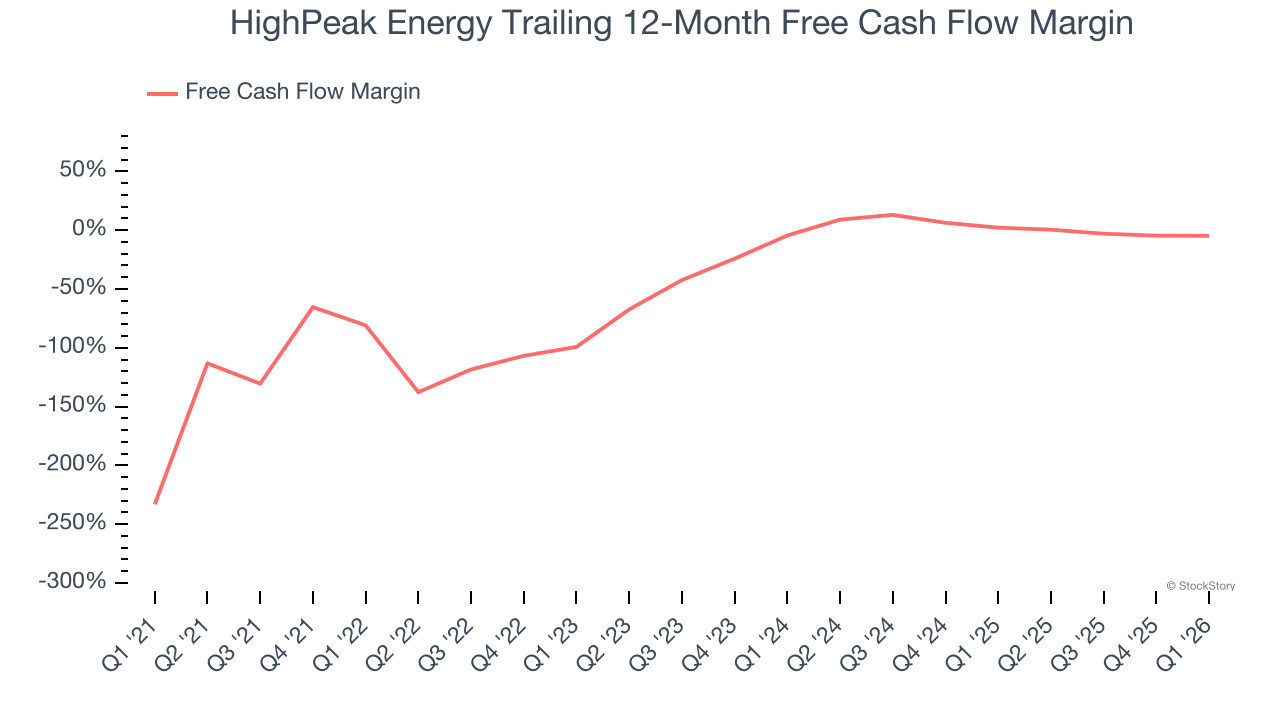
HighPeak Energy burned through $24.58 million of cash in Q1, equivalent to a negative 11.4% margin. The company’s cash burn was similar to its $25.28 million of lost cash in the same quarter last year.
Key Takeaways from HighPeak Energy’s Q1 Results
It was encouraging to see HighPeak Energy beat analysts’ EBITDA expectations this quarter. We were also happy its revenue narrowly outperformed Wall Street’s estimates. Overall, we think this was a solid quarter with some key areas of upside. Investors were likely hoping for more, and shares traded down 8.3% to $5.68 immediately after reporting.
Is HighPeak Energy an attractive investment opportunity right now? We think that the latest quarter is only one piece of the longer-term business quality puzzle. Quality, when combined with valuation, can help determine if the stock is a buy. We cover that in our actionable full research report which you can read here (it’s free).