
The end of the earnings season is always a good time to take a step back and see who shined (and who not so much). Let’s take a look at how regional banks stocks fared in Q3, starting with First Bancorp (NASDAQ: FBNC).
Regional banks, financial institutions operating within specific geographic areas, serve as intermediaries between local depositors and borrowers. They benefit from rising interest rates that improve net interest margins (the difference between loan yields and deposit costs), digital transformation reducing operational expenses, and local economic growth driving loan demand. However, these banks face headwinds from fintech competition, deposit outflows to higher-yielding alternatives, credit deterioration (increasing loan defaults) during economic slowdowns, and regulatory compliance costs. Recent concerns about regional bank stability following high-profile failures and significant commercial real estate exposure present additional challenges.
The 98 regional banks stocks we track reported a mixed Q3. As a group, revenues were in line with analysts’ consensus estimates.
While some regional banks stocks have fared somewhat better than others, they have collectively declined. On average, share prices are down 1.2% since the latest earnings results.
First Bancorp (NASDAQ: FBNC)
Founded during the Great Depression in 1934 and originally known as Montgomery Bancorp, First Bancorp (NASDAQ: FBNC) is a community-oriented commercial bank providing a wide range of financial services to businesses and individuals in North and South Carolina.
First Bancorp reported revenues of $117.9 million, up 21.1% year on year. This print exceeded analysts’ expectations by 3.6%. Overall, it was a very strong quarter for the company with an impressive beat of analysts’ revenue and net interest income estimates.
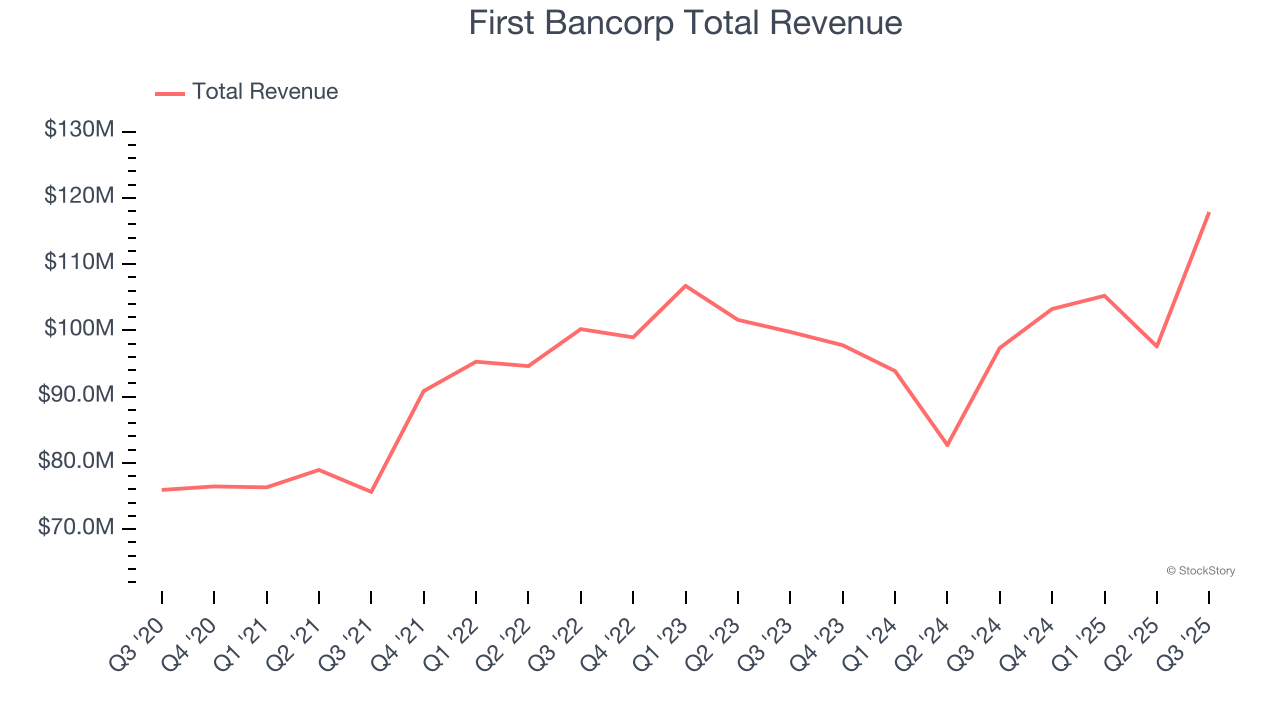
Interestingly, the stock is up 18% since reporting and currently trades at $57.37.
Is now the time to buy First Bancorp? Access our full analysis of the earnings results here, it’s free.
Best Q3: UMB Financial (NASDAQ: UMBF)
With roots dating back to 1913 and a name derived from "United Missouri Bank," UMB Financial (NASDAQ: UMBF) is a financial holding company that provides banking, asset management, and fund services to commercial, institutional, and individual customers.
UMB Financial reported revenues of $744.8 million, up 29.3% year on year, outperforming analysts’ expectations by 5.4%. The business had an exceptional quarter with a beat of analysts’ EPS and net interest income estimates.
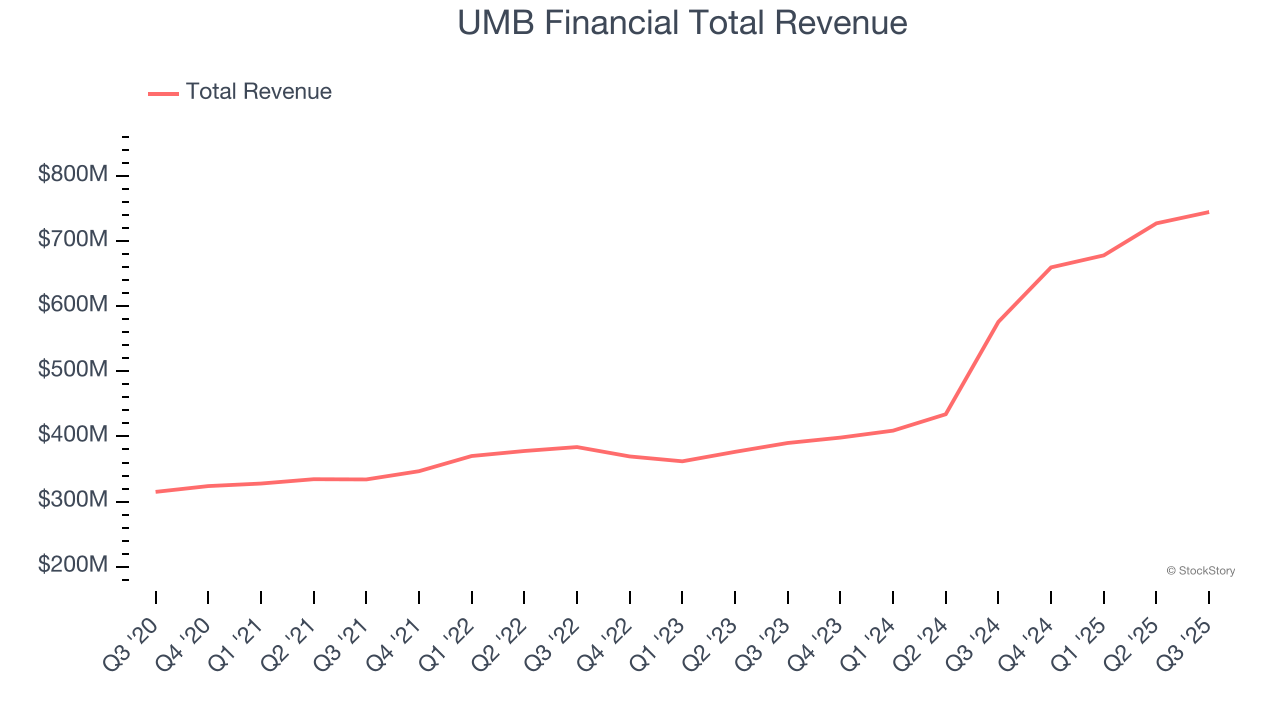
UMB Financial pulled off the biggest analyst estimates beat among its peers. The market seems content with the results as the stock is up 3.3% since reporting. It currently trades at $129.47.
Is now the time to buy UMB Financial? Access our full analysis of the earnings results here, it’s free.
Weakest Q3: BankUnited (NYSE: BKU)
Born from the ashes of a failed Florida thrift during the 2009 financial crisis, BankUnited (NYSE: BKU) is a regional bank that provides commercial lending, deposit services, and treasury solutions to businesses and consumers primarily in Florida and the New York metropolitan area.
BankUnited reported revenues of $273.8 million, up 6.1% year on year, falling short of analysts’ expectations by 5.1%. It was a disappointing quarter as it posted a significant miss of analysts’ revenue and net interest income estimates.
As expected, the stock is down 1.3% since the results and currently trades at $46.17.
Read our full analysis of BankUnited’s results here.
SouthState (NYSE: SSB)
With roots dating back to the Great Depression era of 1933, SouthState (NYSE: SSB) is a financial holding company that provides banking services, wealth management, and correspondent banking services across six southeastern states.
SouthState reported revenues of $661.7 million, up 5% year on year. This result lagged analysts' expectations by 0.7%. It was a slower quarter as it also produced a miss of analysts’ net interest income and revenue estimates.
The stock is down 1.6% since reporting and currently trades at $96.48.
Read our full, actionable report on SouthState here, it’s free.
Enterprise Financial Services (NASDAQ: EFSC)
Starting as a single bank in Missouri in 1988 and expanding through strategic growth, Enterprise Financial Services (NASDAQ: EFSC) is a financial holding company that offers banking, lending, and wealth management services to businesses and individuals across seven states.
Enterprise Financial Services reported revenues of $188.9 million, up 12.2% year on year. This print surpassed analysts’ expectations by 1.3%. Taking a step back, it was a slower quarter as it produced a miss of analysts’ tangible book value per share estimates and a narrow beat of analysts’ EPS estimates.
The stock is flat since reporting and currently trades at $58.14.
Read our full, actionable report on Enterprise Financial Services here, it’s free.
Market Update
Late in 2025 into early 2026, there was hand wringing around artificial intelligence. For software companies, the fear was that AI would erode pricing power and compress margins as new tools made it easier to replicate what once required expensive enterprise platforms. Crypto investors had their own version of the same anxiety: if AI agents could trade, allocate capital, and manage wallets autonomously, what exactly was the long-term value of today’s crypto infrastructure?
These concerns triggered a noticeable rotation away from these sectors and into safer havens. But markets rarely dwell on one narrative for long. Spring 2026 came, and the focus shifted abruptly from technological disruption to geopolitical risk. The US’ conflict with Iran became the dominant driver of market psychology, and when geopolitics takes center stage, the script changes quickly. Investors stop debating growth rates and start worrying about oil supply, inflation, and global stability.
Want to invest in winners with rock-solid fundamentals? Check out our Hidden Gem Stocks and add them to your watchlist. These companies are poised for growth regardless of the political or macroeconomic climate.
StockStory’s analyst team — all seasoned professional investors — uses quantitative analysis and automation to deliver market-beating insights faster and with higher quality.