
Merck has had an impressive run over the past six months as its shares have beaten the S&P 500 by 6.8%. The stock now trades at $113.99, marking a 20% gain. This was partly thanks to its solid quarterly results, and the performance may have investors wondering how to approach the situation.
Is it too late to buy MRK? Find out in our full research report, it’s free.
Why Does MRK Stock Spark Debate?
With roots dating back to 1891 and a portfolio that includes the blockbuster cancer immunotherapy Keytruda, Merck (NYSE: MRK) develops and sells prescription medicines, vaccines, and animal health products across oncology, infectious diseases, cardiovascular, and other therapeutic areas.
Two Positive Attributes:
1. Economies of Scale Give It Negotiating Leverage with Suppliers
Larger companies benefit from economies of scale, where fixed costs like infrastructure, technology, and administration are spread over a higher volume of goods or services, reducing the cost per unit. Scale can also lead to bargaining power with suppliers, greater brand recognition, and more investment firepower. A virtuous cycle can ensue if a scaled company plays its cards right.
With $65.77 billion in revenue over the past 12 months, Merck is one of the most scaled enterprises in healthcare. This is particularly important because branded pharmaceuticals companies are volume-driven businesses due to their low margins.
2. Adjusted Operating Margin Rising, Profits Up
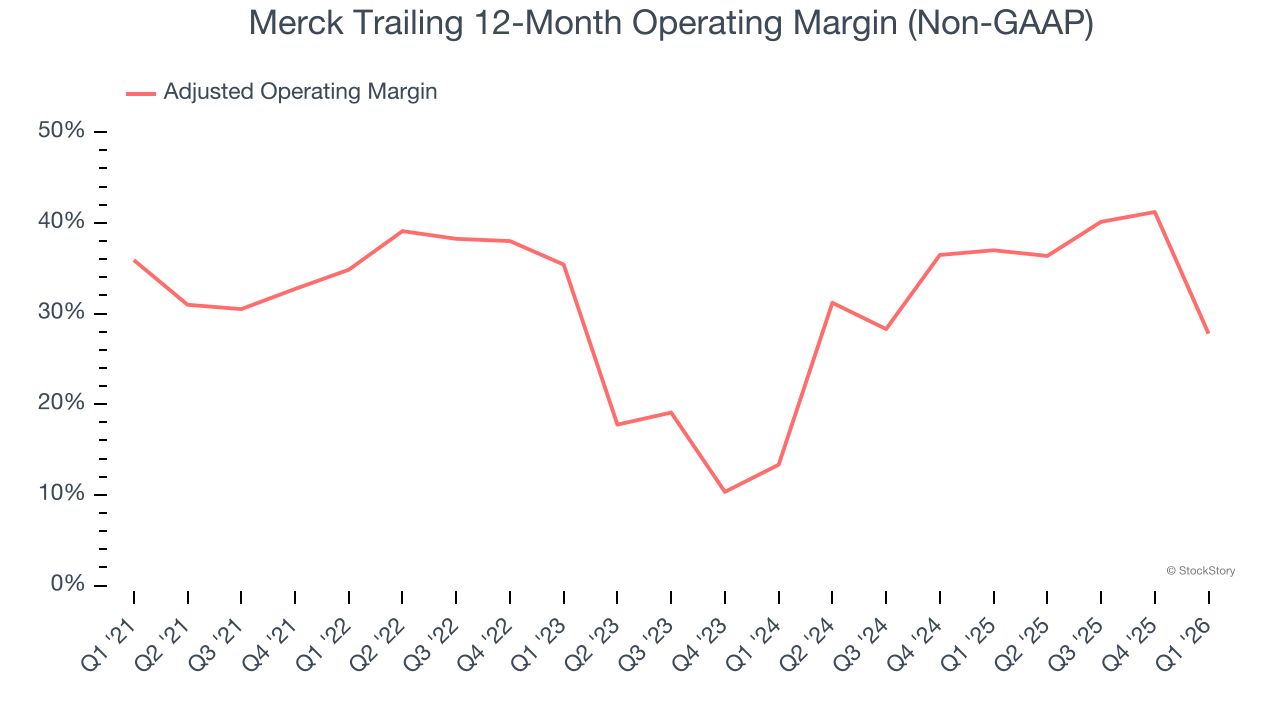
Adjusted operating margin is an important measure of profitability as it shows the portion of revenue left after accounting for all core expenses – everything from the cost of goods sold to advertising and wages. It’s also useful for comparing profitability across companies because it excludes non-recurring expenses, interest on debt, and taxes.
Analyzing the trend in its profitability, Merck’s adjusted operating margin rose by 14.5 percentage points over the last two years, as its sales growth gave it operating leverage. Its adjusted operating margin for the trailing 12 months was 27.8%.
One Reason to be Careful:
Weak Constant Currency Growth Points to Soft Demand
Investors interested in Branded Pharmaceuticals companies should track constant currency revenue in addition to reported revenue. This metric excludes currency movements, which are outside of Merck’s control and are not indicative of underlying demand.
Over the last two years, Merck’s constant currency revenue averaged 4.6% year-on-year growth. This performance slightly lagged the sector and suggests it might have to lower prices or invest in product improvements to accelerate growth, factors that can hinder near-term profitability. 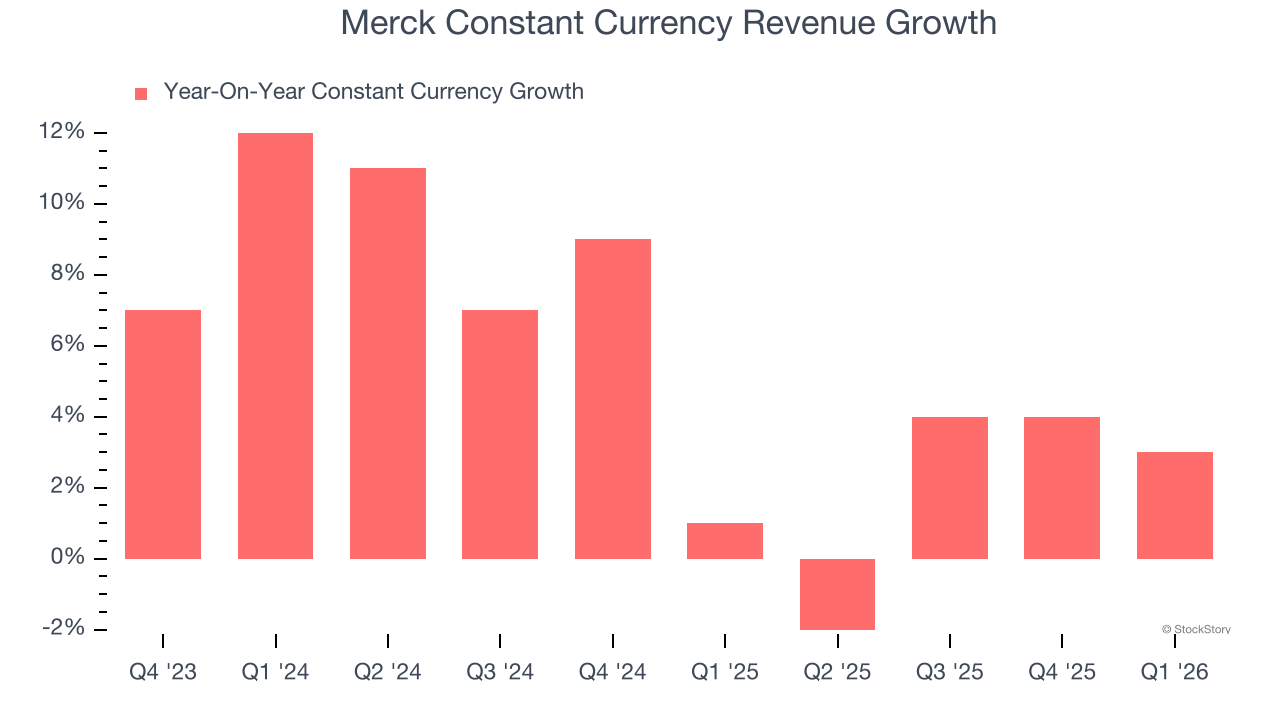
Final Judgment
Merck has huge potential even though it has some open questions, and with its shares outperforming the market lately, the stock trades at 18.2× forward P/E (or $113.99 per share). Is now a good time to buy? See for yourself in our full research report, it’s free.
Stocks We Like Even More Than Merck
ONE MORE THING: Top 5 Growth Stocks. The biggest stock winners almost always had one thing in common before they ran. Revenue growing like crazy. Meta. CrowdStrike. Broadcom. Our AI flagged all three. They returned 315%, 314%, and 455%, respectively.
Find out which 5 stocks it's flagging for this month - FREE. Get Our Top 5 Growth Stocks for Free HERE.
Stocks that have made our list include now familiar names such as Nvidia (+1,326% between June 2020 and June 2025) as well as under-the-radar businesses like the once-small-cap company Comfort Systems (+782% five-year return). Find your next big winner with StockStory today.