Looking back on processors and graphics chips stocks’ Q4 earnings, we examine this quarter’s best and worst performers, including Lattice Semiconductor (NASDAQ: LSCC) and its peers.
The biggest demand drivers for processors (CPUs) and graphics chips at the moment are secular trends related to 5G and Internet of Things, autonomous driving, and high performance computing in the data center space, specifically around AI and machine learning. Like all semiconductor companies, digital chip makers exhibit a degree of cyclicality, driven by supply and demand imbalances and exposure to PC and Smartphone product cycles.
The 9 processors and graphics chips stocks we track reported a very strong Q4. As a group, revenues beat analysts’ consensus estimates by 2.1% while next quarter’s revenue guidance was above.
Amidst this news, share prices of the companies have had a rough stretch. On average, they are down 16.1% since the latest earnings results.
Lattice Semiconductor (NASDAQ: LSCC)
A global leader in its category, Lattice Semiconductor (NASDAQ: LSCC) is a semiconductor designer specializing in customer-programmable chips that enhance CPU performance for intensive tasks such as machine learning.
Lattice Semiconductor reported revenues of $145.8 million, up 24.2% year on year. This print exceeded analysts’ expectations by 1.8%. Overall, it was a very strong quarter for the company with revenue guidance for next quarter exceeding analysts’ expectations and a significant improvement in its inventory levels.
Ford Tamer, Chief Executive Officer, said, "2025 was a pivotal year where we delivered on what we said we would do: stabilized revenue, normalized channel inventories, and drove exceptional data center growth, with server revenues up approximately 85% year over year. We advanced our leadership product roadmap, strengthened our software and solutions, and secured design wins across all our segments to fuel production ramps. We finished the year with strong momentum led by accelerating growth in AI and datacenters, higher Lattice FPGA attach rates per system and increasing ASPs as diversified customers move to our newer product platforms and solutions. When taken together, we believe we are positioned for higher growth in 2026 and beyond."
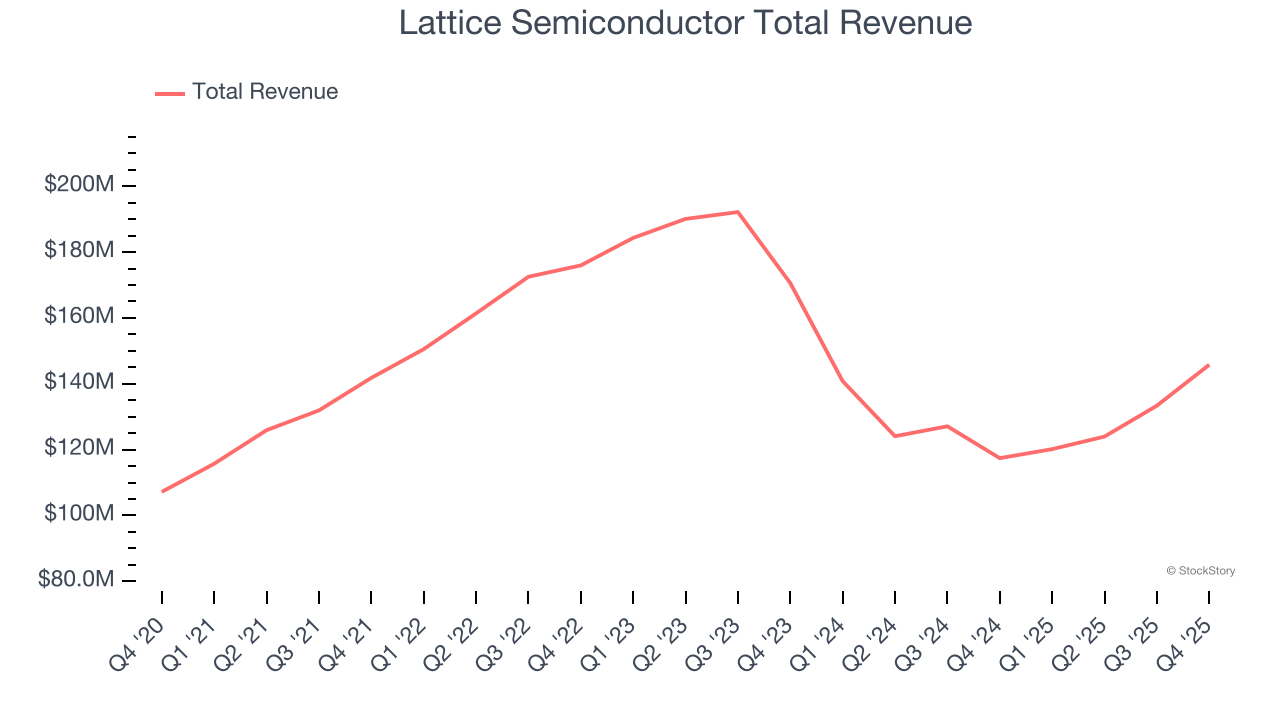
Unsurprisingly, the stock is down 6.7% since reporting and currently trades at $84.87.
Is now the time to buy Lattice Semiconductor? Access our full analysis of the earnings results here, it’s free.
Best Q4: Qorvo (NASDAQ: QRVO)
Formed by the merger of TriQuint and RF Micro Devices, Qorvo (NASDAQ: QRVO) is a designer and manufacturer of RF chips used in almost all smartphones globally, along with a variety of chips used in networking equipment and infrastructure.
Qorvo reported revenues of $993 million, up 8.4% year on year, in line with analysts’ expectations. The business had an exceptional quarter with a beat of analysts’ EPS and adjusted operating income estimates.
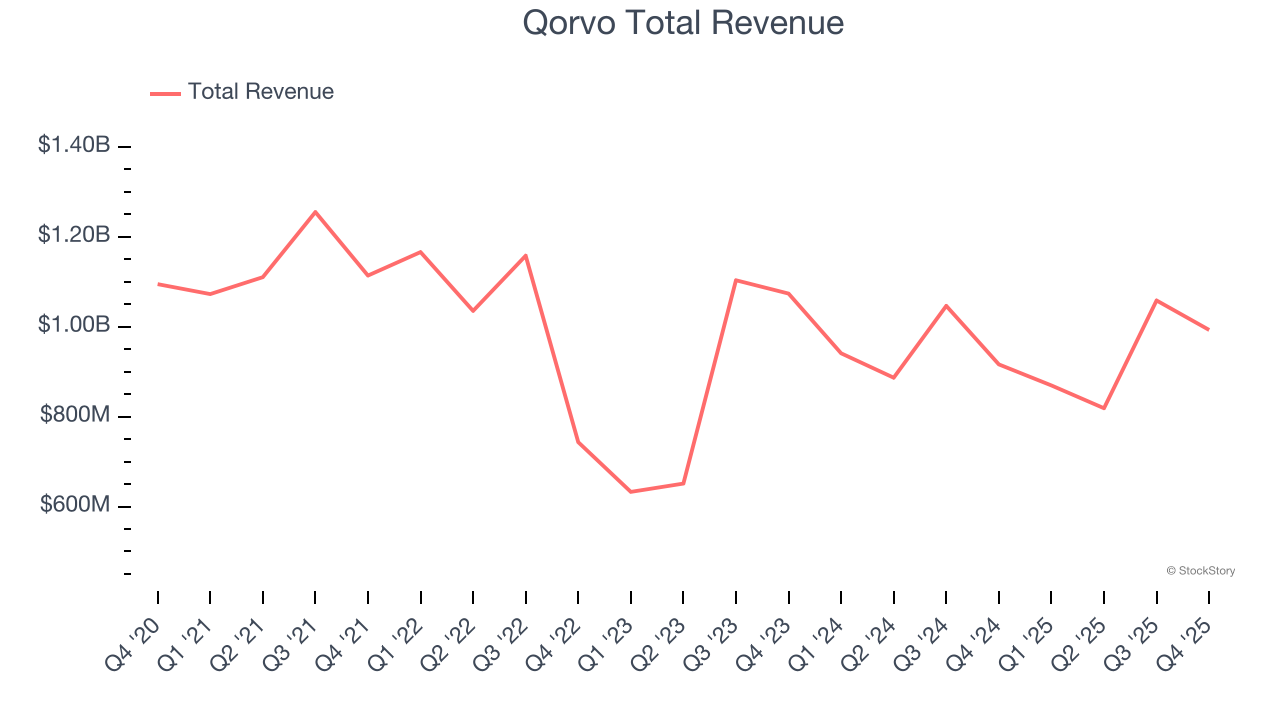
Although it had a fine quarter compared its peers, the market seems unhappy with the results as the stock is down 8.7% since reporting. It currently trades at $75.62.
Is now the time to buy Qorvo? Access our full analysis of the earnings results here, it’s free.
Weakest Q4: Qualcomm (NASDAQ: QCOM)
Having been at the forefront of developing the standards for cellular connectivity for over four decades, Qualcomm (NASDAQ: QCOM) is a leading innovator and a fabless manufacturer of wireless technology chips used in smartphones, autos and internet of things appliances.
Qualcomm reported revenues of $12.25 billion, up 5% year on year, in line with analysts’ expectations. It was a mixed quarter as it posted a significant improvement in its inventory levels but revenue guidance for next quarter missing analysts’ expectations significantly.
Qualcomm delivered the weakest performance against analyst estimates in the group. As expected, the stock is down 15% since the results and currently trades at $126.50.
Read our full analysis of Qualcomm’s results here.
Nvidia (NASDAQ: NVDA)
Founded in 1993 by Jensen Huang and two former Sun Microsystems engineers, Nvidia (NASDAQ: NVDA) is a leading fabless designer of chips used in gaming, PCs, data centers, automotive, and a variety of end markets.
Nvidia reported revenues of $68.13 billion, up 73.2% year on year. This number surpassed analysts’ expectations by 2.9%. It was a very strong quarter as it also logged revenue guidance for next quarter exceeding analysts’ expectations and a beat of analysts’ EPS estimates.
Nvidia pulled off the fastest revenue growth among its peers. The stock is down 16.4% since reporting and currently trades at $163.52.
Read our full, actionable report on Nvidia here, it’s free.
AMD (NASDAQ: AMD)
Founded in 1969 by a group of former Fairchild semiconductor executives led by Jerry Sanders, Advanced Micro Devices (NASDAQ: AMD) is one of the leading designers of computer processors and graphics chips used in PCs and data centers.
AMD reported revenues of $10.27 billion, up 34.1% year on year. This print beat analysts’ expectations by 6%. Overall, it was an exceptional quarter as it also put up a beat of analysts’ EPS estimates and a solid beat of analysts’ adjusted operating income estimates.
AMD scored the biggest analyst estimates beat among its peers. The stock is down 20% since reporting and currently trades at $193.80.
Read our full, actionable report on AMD here, it’s free.
Market Update
Late in 2025 into early 2026, there was hand wringing around artificial intelligence. For software companies, the fear was that AI would erode pricing power and compress margins as new tools made it easier to replicate what once required expensive enterprise platforms. Crypto investors had their own version of the same anxiety: if AI agents could trade, allocate capital, and manage wallets autonomously, what exactly was the long-term value of today’s crypto infrastructure?
These concerns triggered a noticeable rotation away from these sectors and into safer havens. But markets rarely dwell on one narrative for long. Spring 2026 came, and the focus shifted abruptly from technological disruption to geopolitical risk. The US’ conflict with Iran became the dominant driver of market psychology, and when geopolitics takes center stage, the script changes quickly. Investors stop debating growth rates and start worrying about oil supply, inflation, and global stability.
Want to invest in winners with rock-solid fundamentals? Check out our Top 5 Quality Compounder Stocks and add them to your watchlist. These companies are poised for growth regardless of the political or macroeconomic climate.
StockStory’s analyst team — all seasoned professional investors — uses quantitative analysis and automation to deliver market-beating insights faster and with higher quality.