
Healthcare diagnostics company QuidelOrtho (NASDAQ: QDEL) reported Q4 CY2025 results beating Wall Street’s revenue expectations, with sales up 2.2% year on year to $723.6 million. The company’s full-year revenue guidance of $2.8 billion at the midpoint came in 1.1% above analysts’ estimates. Its non-GAAP profit of $0.46 per share was 8.8% above analysts’ consensus estimates.
Is now the time to buy QuidelOrtho? Find out by accessing our full research report, it’s free.
QuidelOrtho (QDEL) Q4 CY2025 Highlights:
- Revenue: $723.6 million vs analyst estimates of $701.2 million (2.2% year-on-year growth, 3.2% beat)
- Adjusted EPS: $0.46 vs analyst estimates of $0.42 (8.8% beat)
- Adjusted EBITDA: $153.3 million vs analyst estimates of $151.6 million (21.2% margin, 1.1% beat)
- Adjusted EPS guidance for the upcoming financial year 2026 is $2.21 at the midpoint, missing analyst estimates by 11.1%
- EBITDA guidance for the upcoming financial year 2026 is $650 million at the midpoint, below analyst estimates of $655 million
- Operating Margin: -9.2%, up from -14.2% in the same quarter last year
- Constant Currency Revenue rose 1.1% year on year (-4.4% in the same quarter last year)
- Market Capitalization: $1.98 billion
Company Overview
Born from the 2022 merger of Quidel and Ortho Clinical Diagnostics, QuidelOrtho (NASDAQ: QDEL) develops and manufactures diagnostic testing solutions for healthcare providers, from rapid point-of-care tests to complex laboratory instruments and systems.
Revenue Growth
Examining a company’s long-term performance can provide clues about its quality. Even a bad business can shine for one or two quarters, but a top-tier one grows for years. Over the last five years, QuidelOrtho’s demand was weak and its revenue declined by 4.4% per year. This wasn’t a great result and is a sign of poor business quality.
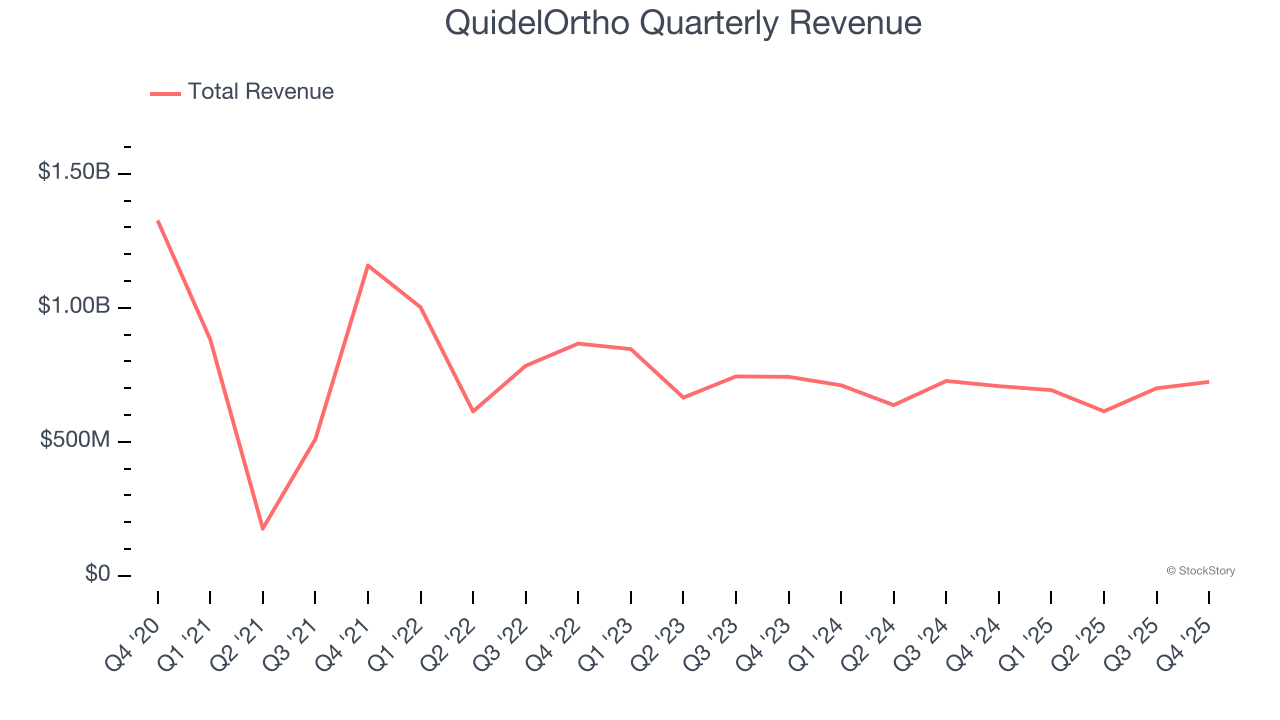
We at StockStory place the most emphasis on long-term growth, but within healthcare, a half-decade historical view may miss recent innovations or disruptive industry trends. QuidelOrtho’s annualized revenue declines of 4.6% over the last two years align with its five-year trend, suggesting its demand has consistently shrunk. 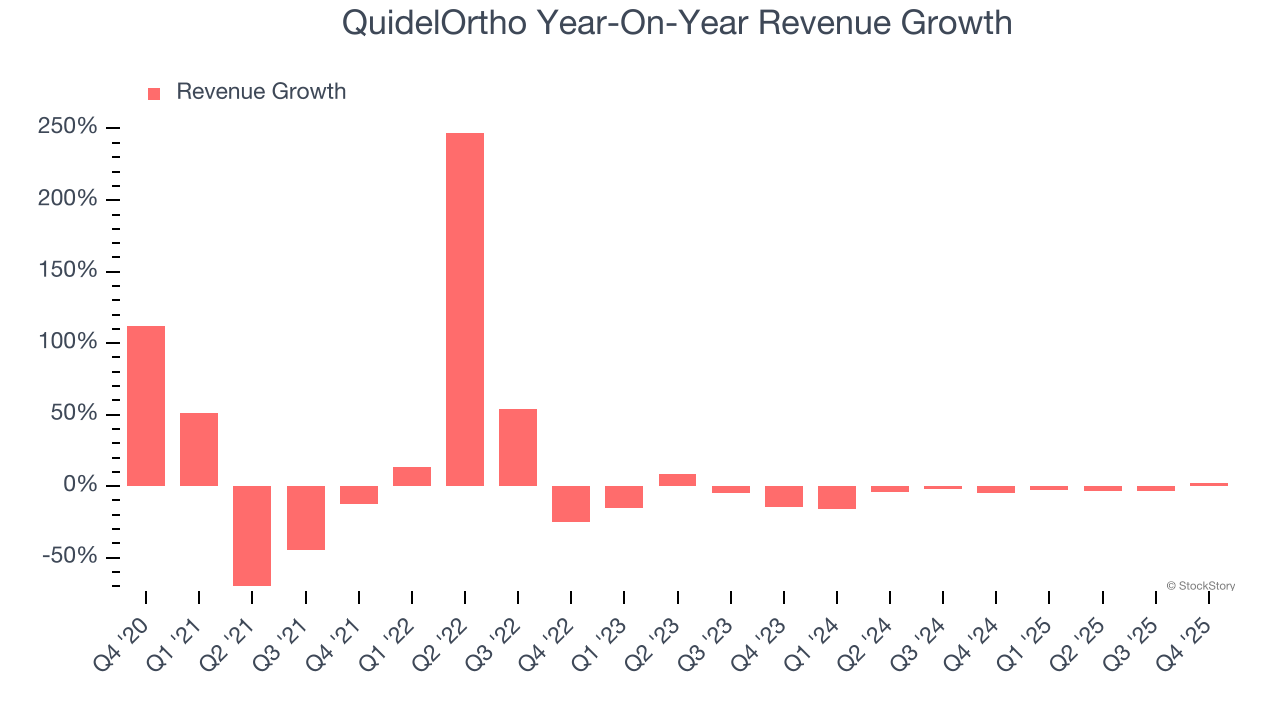
QuidelOrtho also reports sales performance excluding currency movements, which are outside the company’s control and not indicative of demand. Over the last two years, its constant currency sales averaged 3.8% year-on-year declines. Because this number aligns with its normal revenue growth, we can see that QuidelOrtho has properly hedged its foreign currency exposure. 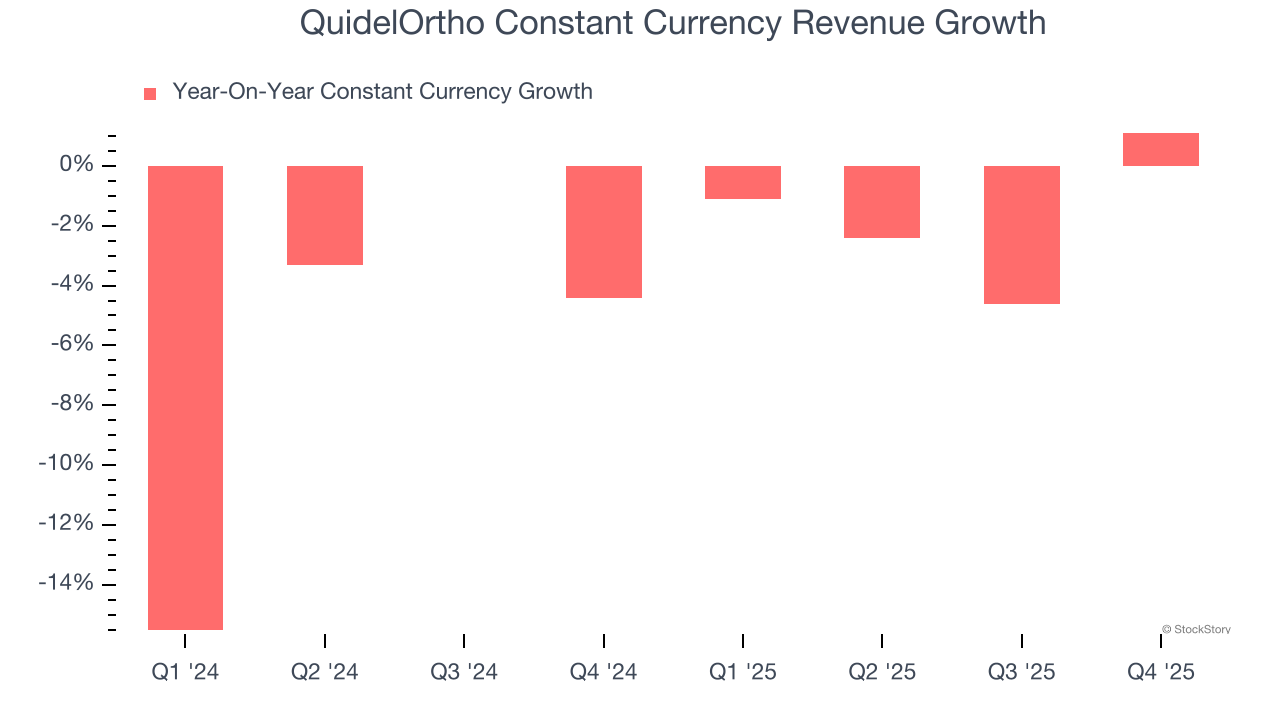
This quarter, QuidelOrtho reported modest year-on-year revenue growth of 2.2% but beat Wall Street’s estimates by 3.2%.
Looking ahead, sell-side analysts expect revenue to grow 1.3% over the next 12 months. Although this projection indicates its newer products and services will spur better top-line performance, it is still below the sector average.
The 1999 book Gorilla Game predicted Microsoft and Apple would dominate tech before it happened. Its thesis? Identify the platform winners early. Today, enterprise software companies embedding generative AI are becoming the new gorillas. a profitable, fast-growing enterprise software stock that is already riding the automation wave and looking to catch the generative AI next.
Operating Margin
QuidelOrtho’s high expenses have contributed to an average operating margin of negative 6.2% over the last five years. Unprofitable healthcare companies require extra attention because they could get caught swimming naked when the tide goes out. It’s hard to trust that the business can endure a full cycle.
Looking at the trend in its profitability, QuidelOrtho’s operating margin decreased by 70.1 percentage points over the last five years. The company’s two-year trajectory also shows it failed to get its profitability back to the peak as its margin fell by 38.3 percentage points. This performance was poor no matter how you look at it - it shows its expenses were rising and it couldn’t pass those costs onto its customers.
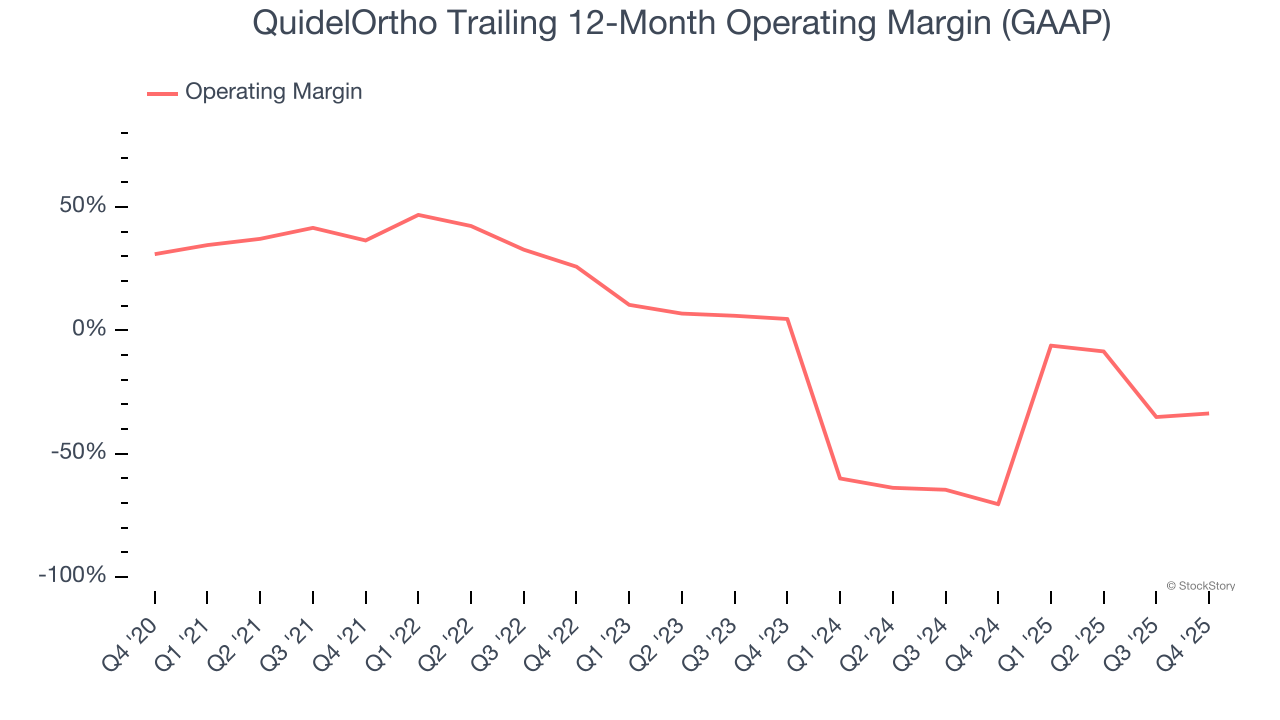
In Q4, QuidelOrtho generated a negative 9.2% operating margin. The company's consistent lack of profits raise a flag.
Earnings Per Share
Revenue trends explain a company’s historical growth, but the long-term change in earnings per share (EPS) points to the profitability of that growth – for example, a company could inflate its sales through excessive spending on advertising and promotions.
Sadly for QuidelOrtho, its EPS declined by 36.1% annually over the last five years, more than its revenue. This tells us the company struggled because its fixed cost base made it difficult to adjust to shrinking demand.
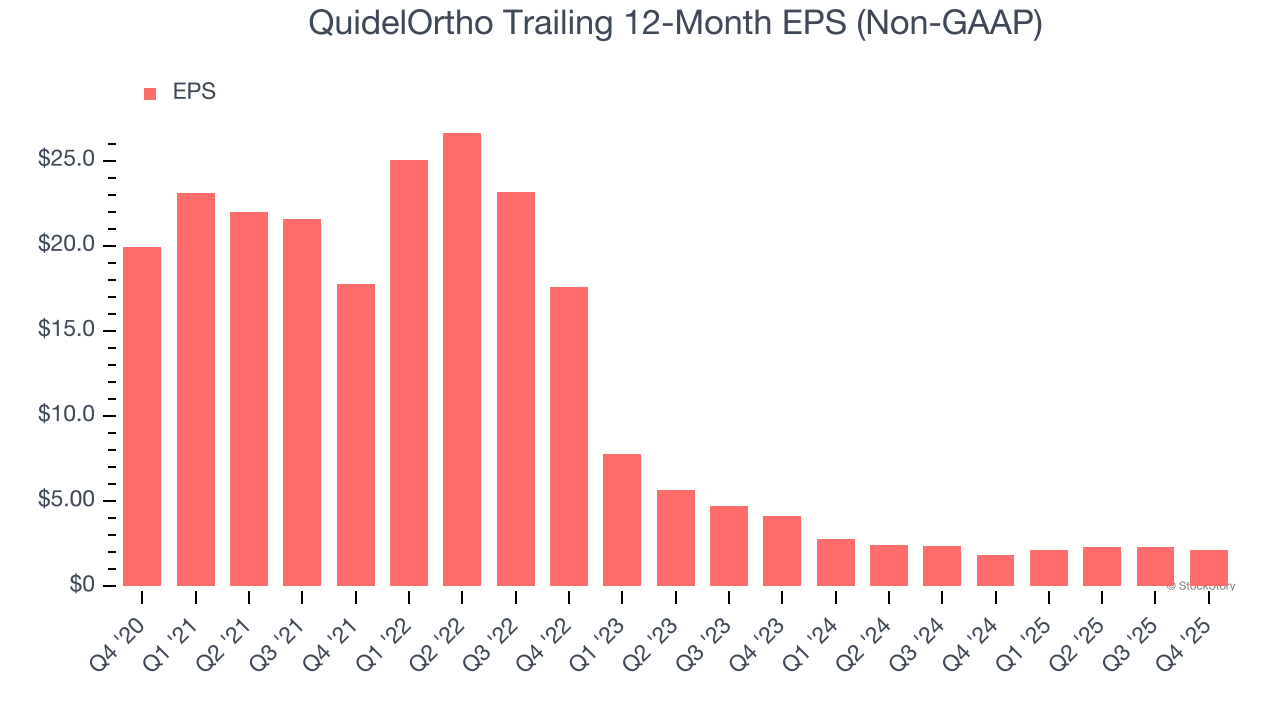
We can take a deeper look into QuidelOrtho’s earnings to better understand the drivers of its performance. As we mentioned earlier, QuidelOrtho’s operating margin expanded this quarter but declined by 70.1 percentage points over the last five years. Its share count also grew by 55.9%, meaning the company not only became less efficient with its operating expenses but also diluted its shareholders. 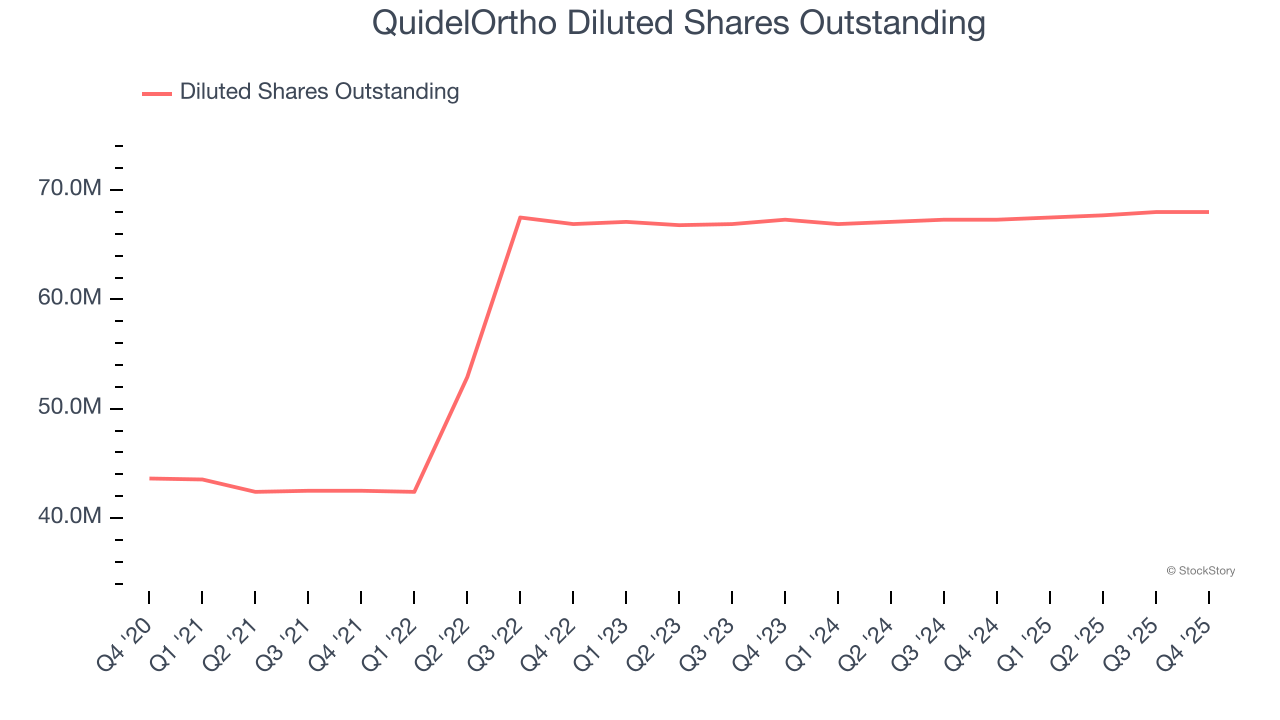
In Q4, QuidelOrtho reported adjusted EPS of $0.46, down from $0.63 in the same quarter last year. Despite falling year on year, this print beat analysts’ estimates by 8.8%. Over the next 12 months, Wall Street expects QuidelOrtho’s full-year EPS of $2.12 to grow 18.3%.
Key Takeaways from QuidelOrtho’s Q4 Results
We enjoyed seeing QuidelOrtho beat analysts’ revenue expectations this quarter. We were also glad its full-year revenue guidance slightly exceeded Wall Street’s estimates. On the other hand, its full-year EPS guidance missed. Zooming out, we think this was a mixed quarter. The market seemed to be hoping for more, and the stock traded down 2.6% to $28.05 immediately after reporting.
Is QuidelOrtho an attractive investment opportunity at the current price? The latest quarter does matter, but not nearly as much as longer-term fundamentals and valuation, when deciding if the stock is a buy. We cover that in our actionable full research report which you can read here (it’s free).