Software supply chain platform JFrog (NASDAQ: FROG) reported Q3 2026 results topping the market’s revenue expectations, with revenue up 30.9% year on year to $179.2 million. In addition, next quarter’s revenue guidance ($184 million at the midpoint) was surprisingly strong and 9.3% above analysts’ consensus estimates. Its non-GAAP profit of $0.32 per share was 37.8% above analysts’ consensus estimates.
For more on JFrog, read our free full research report.
JFrog (FROG) Q3 2026 highlights:
- Revenue $179.2 million vs S&P analysts’ consensus estimates of $165.9 million (30.9% year-on-year growth, 8% beat)
- Adjusted EPS $0.32 vs S&P analysts’ consensus estimates of $0.23 (37.8% beat)
- Adjusted operating income $40.72 million vs analysts’ consensus estimates of $28.2 million (22.7% margin, 44.4% beat)
- Revenue guidance $184 million at the midpoint for Q4 2026, above analysts’ consensus estimates of $168.4 million
- Adjusted EPS guidance Management raised its full-year adjusted EPS guidance to $1.15 at the midpoint, a 17.3% increase
- Operating margin -1%, up from -15.8% in the same quarter last year
- Free cash flow margin 37.1%, up from 32.8% in the previous quarter
- Customers 1,357 customers paying more than $100,000 annually
- Net revenue retention rate 124%, up from 121% in the previous quarter
- Billings $216 million at quarter end, up 31.9% year on year
- Market capitalization $10.65 billion
"AI agents are writing code faster than any developer can review it. Every output becomes an artifact that must be stored, secured, and governed,” said Shlomi Ben Haim, CEO and co-founder of JFrog. “Speed without trust can't scale. Enterprises are standardizing on the JFrog Platform as a system of record for their software supply chain; a control plane that gives users both, under one Platform. Our Q3 performance reflects this momentum.”
Revenue growth
Reviewing a company’s long-term revenue performance reveals insights into its quality. Any business can deliver a good quarter or two, but the best consistently grow over the long haul. Over the last five years, JFrog grew its revenue at an impressive 27.6% compounded annual growth rate. Its growth surpassed the average software company and shows its offerings resonate with customers.
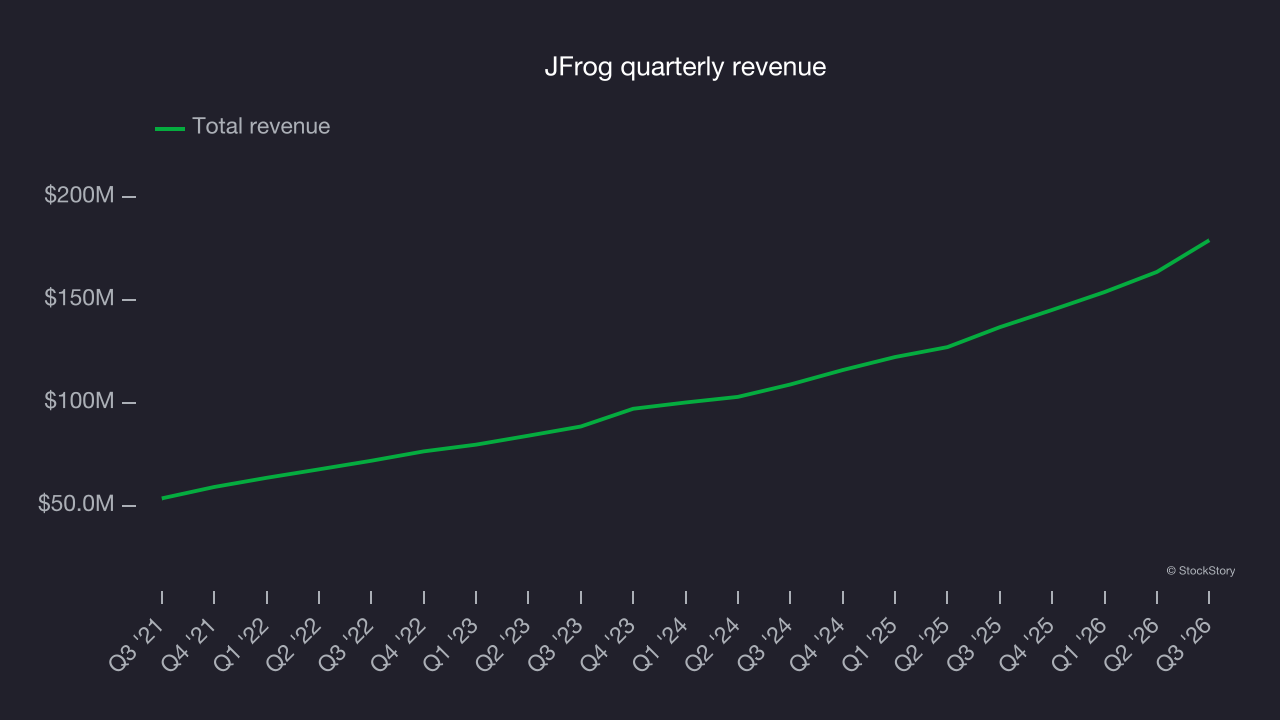
Long-term growth matters the most, but within software, a half-decade historical view may miss recent innovations or disruptive industry trends. JFrog’s annualized revenue growth of 25.2% over the last two years is below its five-year trend, but the results still suggest healthy demand. 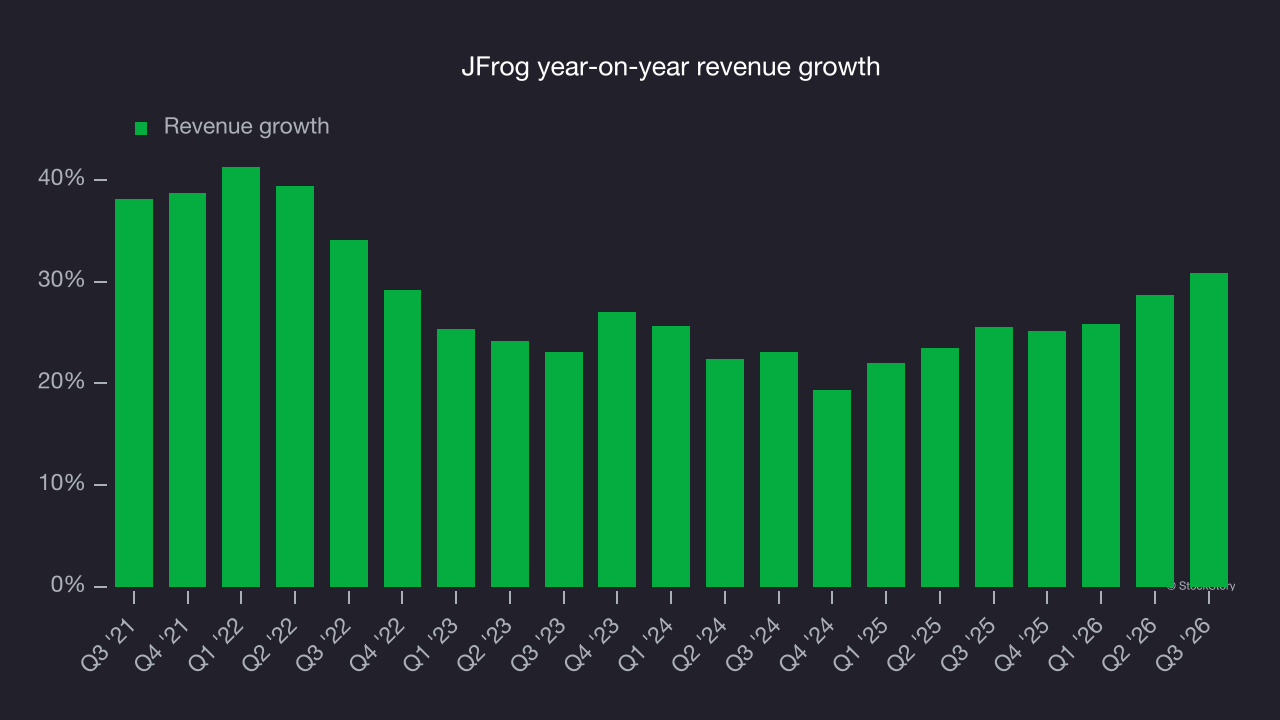
This quarter, JFrog reported strong year-on-year revenue growth of 30.9%, and its $179.2 million of revenue exceeded Wall Street’s consensus estimates by 8%. Management is guiding for a 26.6% year-on-year increase in revenue next quarter.
Looking further ahead, sell-side analysts expect revenue to grow 14.2% over the next 12 months, according to S&P, a deceleration versus the last two years. This underwhelming projection implies its products and services will see some demand headwinds. Still, the company is tracking well in other measures of financial health.
Billings
Billings is a non-GAAP metric that is often called “cash revenue” because it shows how much money the company has collected from customers in a certain period. This is different from revenue, which must be recognized in pieces over the length of a contract.
JFrog’s billings totaled $216 million in Q3, and over the last four quarters, growth was strong, averaging 33.5% year over year. This alternative top-line metric grew faster than total revenue, meaning the company collects cash upfront and then recognizes the revenue over the length of its contracts – a boost for its liquidity and future revenue prospects. 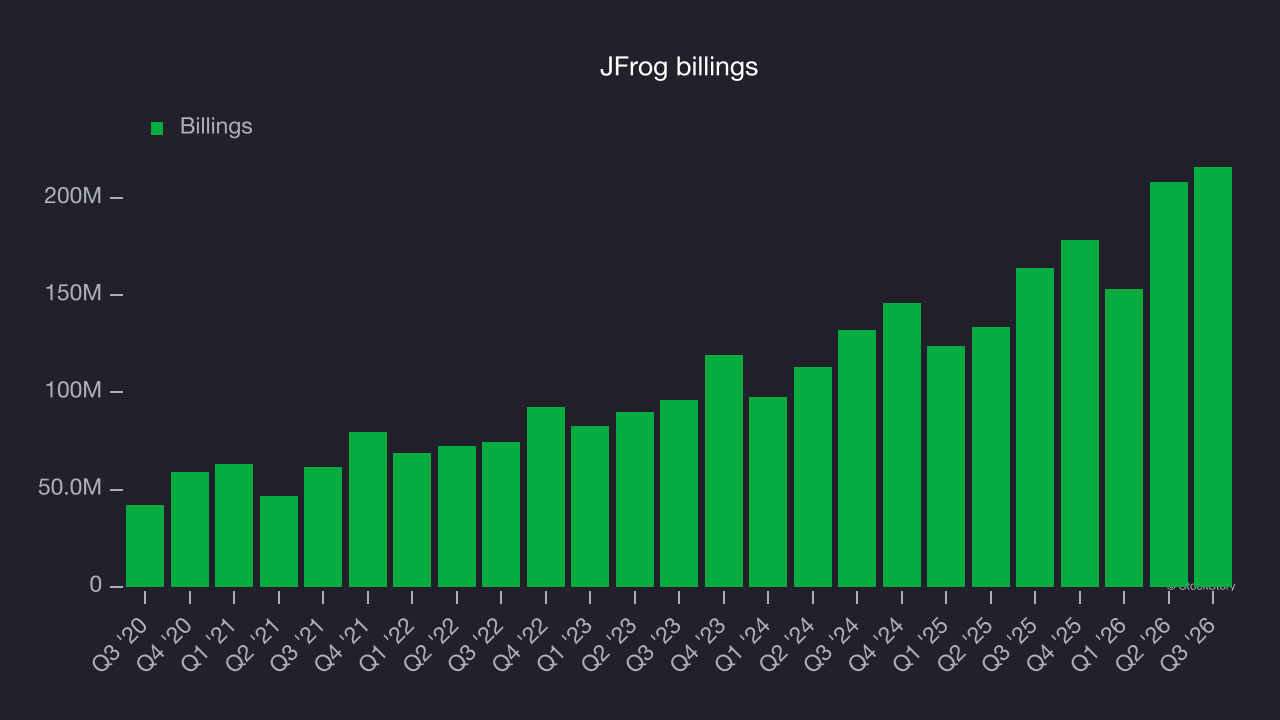
Customer retention
An advantage of the software-as-a-service business model (and a reason software companies trade at high valuation multiples) is that customers typically spend more on a company’s products and services over time.
JFrog’s net revenue retention rate, a key performance metric measuring how much money existing customers from a year ago are spending today, was 124% in Q3. This means JFrog would’ve grown its revenue by 24% even if it didn’t win any new customers over the last 12 months.
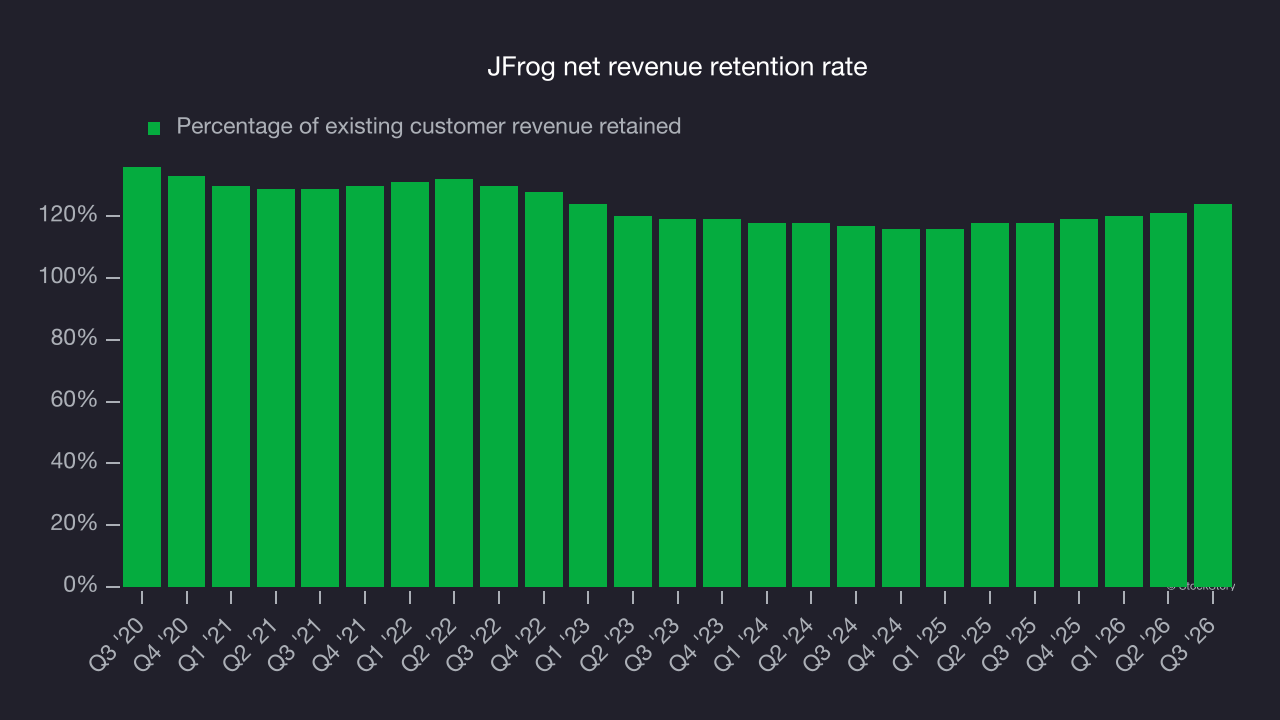
JFrog’s healthy net retention rate rose significantly from the previous quarter, indicating that customers are satisfied with its software and getting more value from it over time.
Key takeaways from JFrog’s Q3 results
JFrog delivered a strong quarter, with billings well ahead of analysts’ consensus estimates and next-quarter EPS guidance above Wall Street’s consensus. Those were key positives in the report. Shares soared 22.5% to $91.49 immediately after the results.
JFrog had a solid quarter, but is the stock a buy? If you’re making that decision, you should consider valuation, business quality and the latest earnings. For more on JFrog, read the full research report here (it’s free).