Online real estate marketplace Zillow (NASDAQ: ZG) fell short of the market’s revenue expectations in Q3 2026, but revenue rose 7.1% year on year to $724 million. Its GAAP loss of $0.70 per share was significantly below analysts’ consensus estimates.
For more on Zillow, read the full research report for free.
Zillow (ZG) Q3 2026 highlights:
- Revenue $724 million vs S&P analysts’ consensus estimates of $752.6 million (7.1% year-on-year growth, 3.8% miss)
- EPS (GAAP) -$0.70 vs analysts’ consensus estimates of $0.15 (significant miss)
- Adjusted EBITDA $182 million vs analysts’ consensus estimates of $191.5 million (25.1% margin, 5% miss)
- Operating margin -22.2%, down from -0.4% in the same quarter last year
- Free cash flow margin 17.7%, up from 10.8% in the same quarter last year
- Market capitalization $7.65 billion
Revenue growth
A company’s long-term revenue performance is one signal of its overall quality. Even a weak business can perform well for one or two quarters, but a high-quality one grows for years. Zillow’s demand was weak over the last five years as its revenue fell at a 5.9% annual rate. That underwhelming result suggests poor business quality.
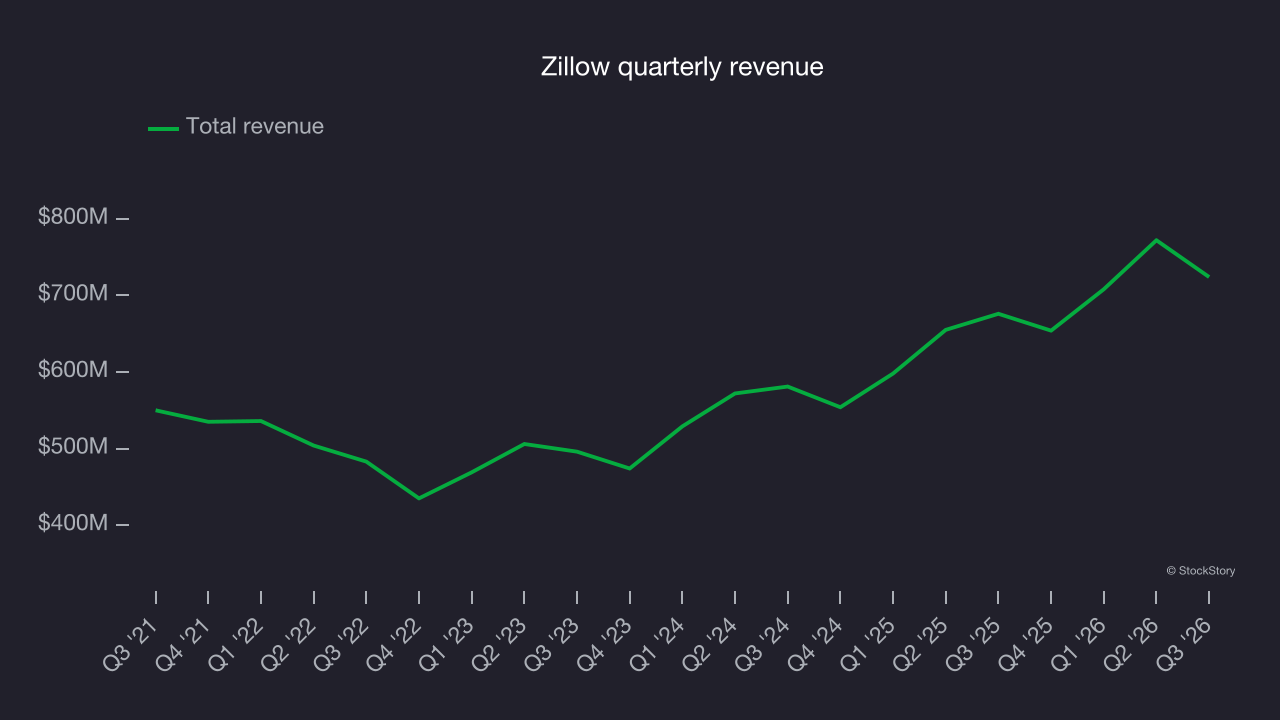
Long-term growth matters most, but within consumer discretionary, a stretched historical view may miss a company riding a successful new product or trend. Zillow’s annualized revenue growth of 15.1% over the last two years is above its five-year trend, a positive sign. 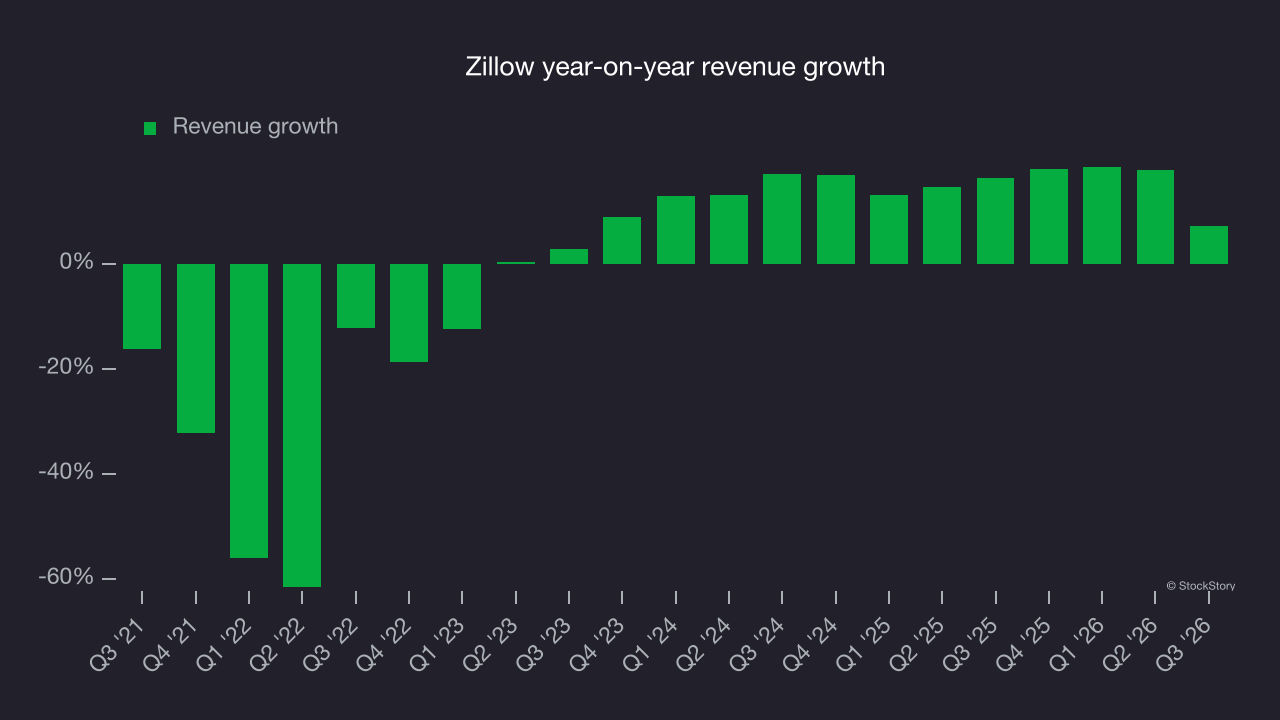
This quarter, Zillow’s revenue grew by 7.1% year on year to $724 million, missing Wall Street’s consensus estimates.
Looking ahead, sell-side analysts expect revenue to grow 11.2% over the next 12 months, according to S&P, a deceleration versus the last two years. This underwhelming projection indicates its products and services will see some demand headwinds.
Operating margin
Zillow’s operating margin has shrunk over the last 12 months and averaged negative 4.5% over the last two years. Unprofitable consumer discretionary companies with falling margins deserve extra scrutiny because they’re spending heavily to stay relevant, an unsustainable practice.
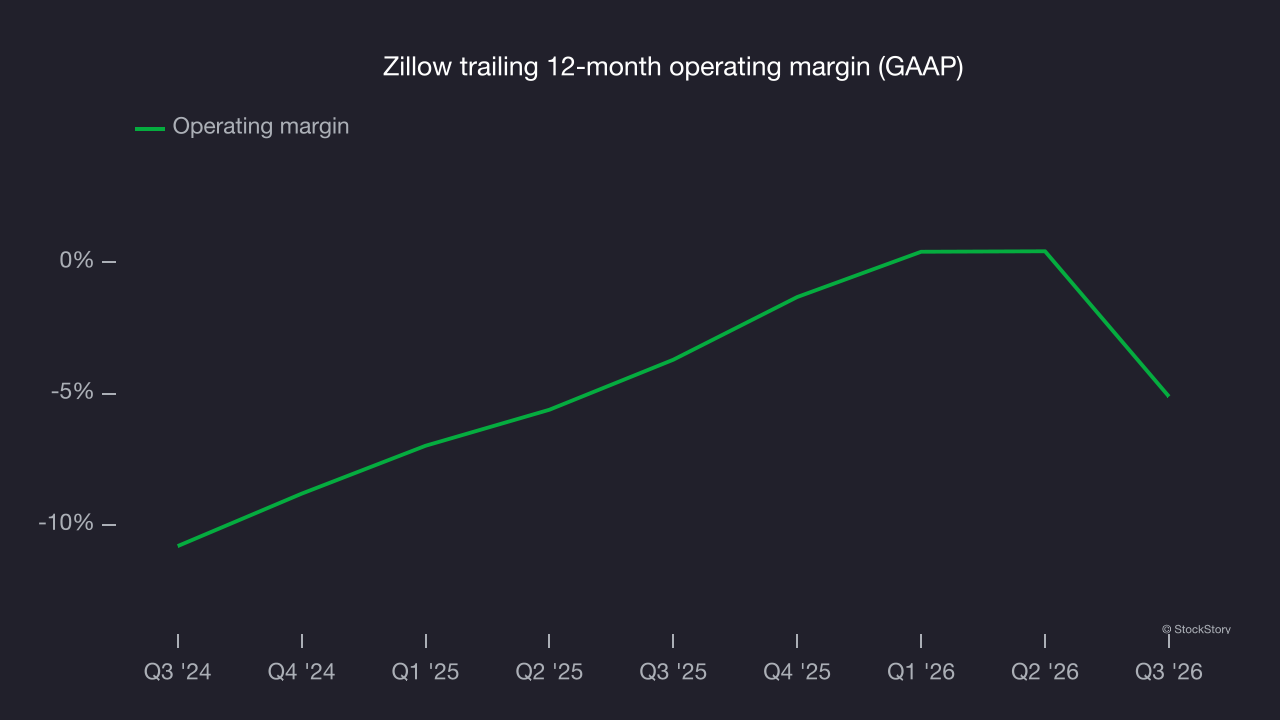
Zillow’s operating margin was negative 22.2% this quarter. The company’s consistent lack of profits raises concerns.
Earnings per share
Long-term growth in earnings per share, or EPS, matters for the same reason as long-term revenue growth. Compared to revenue, however, EPS highlights whether a company’s growth is profitable.
Although Zillow’s full-year earnings are still negative, it reduced its losses and improved its EPS by 10.1% annually over the last five years. The next few quarters will be critical for assessing its long-term profitability.
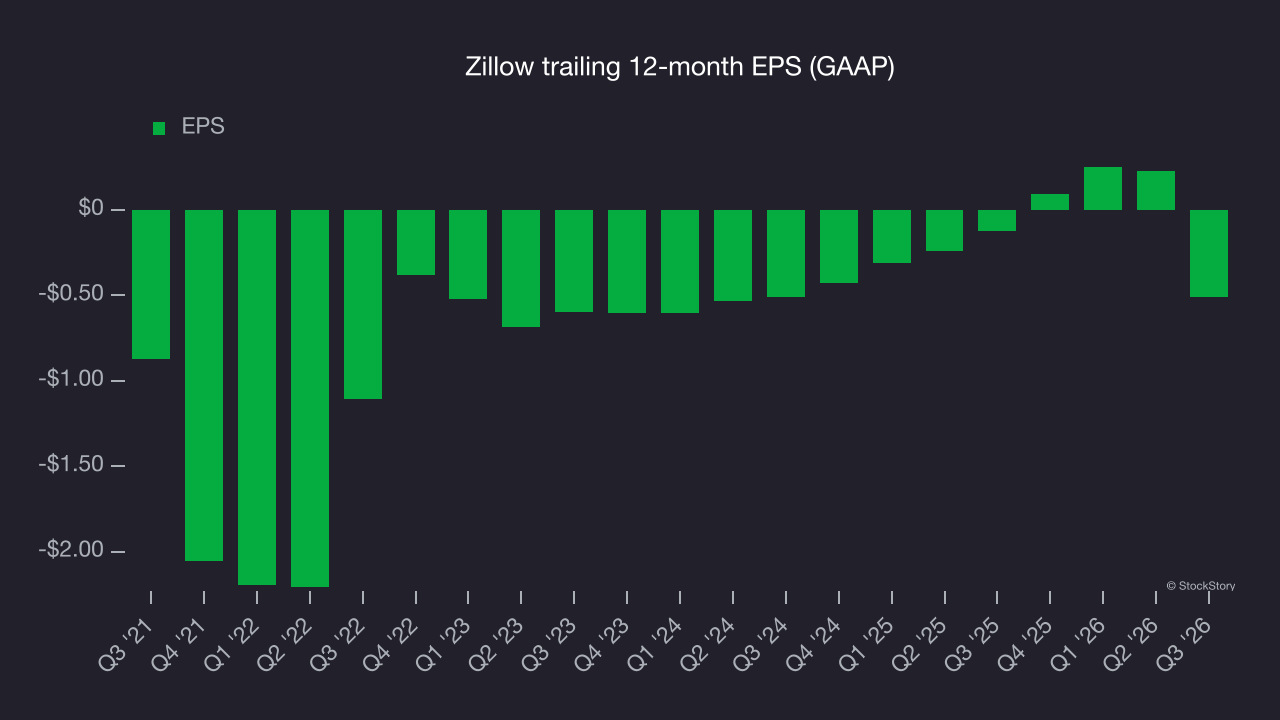
In Q3, Zillow reported EPS of negative $0.70, down from $0.04 in the same quarter last year. This result missed analysts’ consensus estimates. Wall Street expects earnings to improve over the next 12 months. Analysts forecast Zillow’s full-year EPS will turn positive, rising from negative $0.51 to positive $1.23, according to S&P.
Key takeaways from Zillow’s Q3 results
Zillow’s Q3 results offered few positives: Both EPS and revenue fell short of Wall Street’s consensus estimates, making this a softer quarter. Shares plunged 15.6% to $29.06 immediately after the release.
Zillow underperformed this quarter. The latest quarter matters, but not as much as longer-term business quality and valuation when deciding whether to invest in the stock. For more on Zillow, read the full research report here (it’s free).