Child care and education company Bright Horizons (NYSE: BFAM) met Wall Street’s revenue expectations in Q3 2026, with revenue rising 4.8% year on year to $841.5 million. On the other hand, the company’s full-year revenue guidance of $3.07 billion at the midpoint came in 0.9% below analysts’ consensus estimates. Its non-GAAP profit of $1.80 per share was 2.4% above analysts’ consensus estimates.
For more on Bright Horizons, read our free full research report.
Bright Horizons (BFAM) Q3 2026 highlights:
- Revenue $841.5 million vs S&P analysts’ consensus estimates of $842.4 million (4.8% year-on-year growth, in line)
- Adjusted EPS $1.80 vs S&P analysts’ consensus estimates of $1.76 (2.4% beat)
- Adjusted EBITDA $163.3 million vs analysts’ consensus estimates of $165.3 million (19.4% margin, 1.2% miss)
- Revenue guidance The company lowered its revenue guidance for the full year to $3.07 billion at the midpoint from $3.1 billion, a 1% decrease
- Adjusted EPS guidance Management lowered its full-year adjusted EPS guidance to $5.01 at the midpoint, a 1.9% decrease
- Operating margin -22.2%, down from 15.1% in the same quarter last year
- Free cash flow -$25.08 million compared to -$42.45 million in the same quarter last year
- Market capitalization $3.37 billion
“Our third quarter results reflect the strength of our diversified portfolio, with revenue up 5%, including 13% growth in back-up care,” said Stephen Kramer, Chief Executive Officer. “This fall, we were proud to celebrate 40 years of partnering with leading employers to support working families. Our commitment to providing safe, nurturing environments and high-quality care and education for the children and families we serve has guided us since our start in 1986, and I am grateful to our global team, whose dedication brings that commitment to life every day.”
Revenue growth
Examining a company’s long-term performance can provide clues about its quality. Any business can have short-term success, but a top-tier one grows for years. Over the last five years, Bright Horizons grew its revenue at a 12.9% compounded annual growth rate. Though this growth is acceptable on an absolute basis, revenue growth alone is not enough to assess the consumer discretionary sector, which can display significant earnings volatility. The bar for the sector is particularly high, reflecting the non-essential and hit-driven nature of the products and services offered. Additionally, the five-year growth period starts around Covid, when revenue was depressed before rebounding.
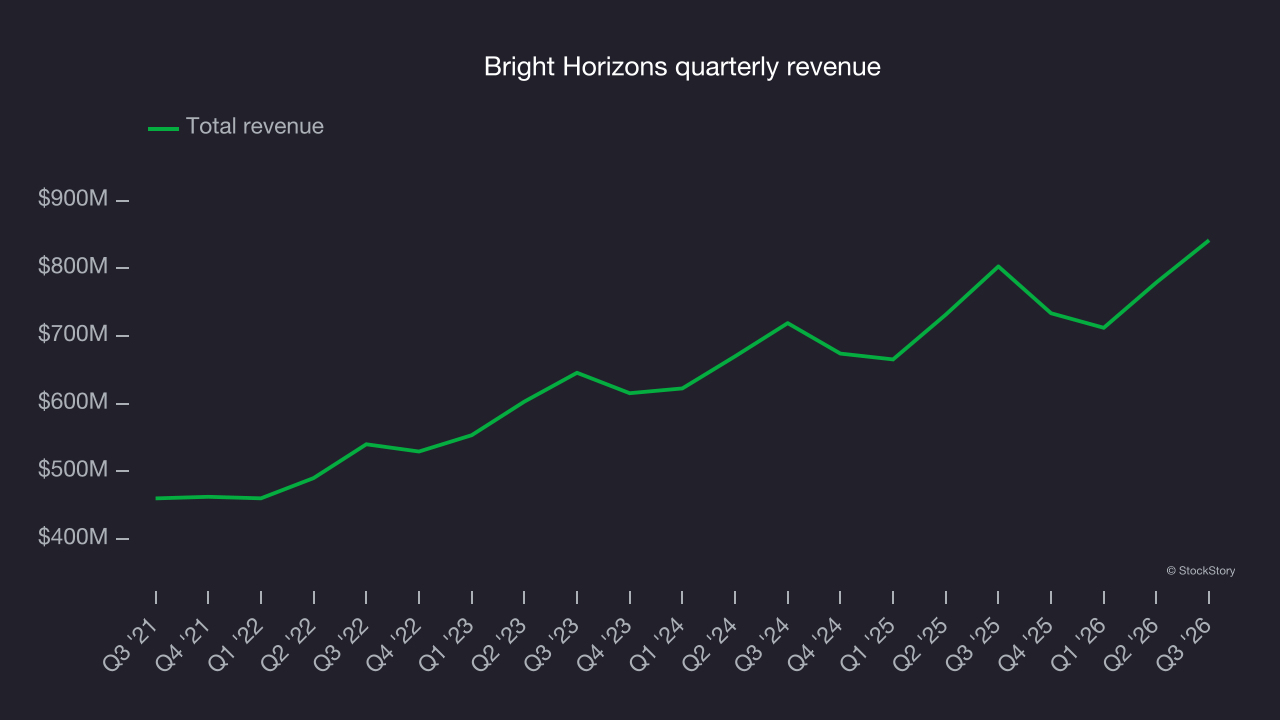
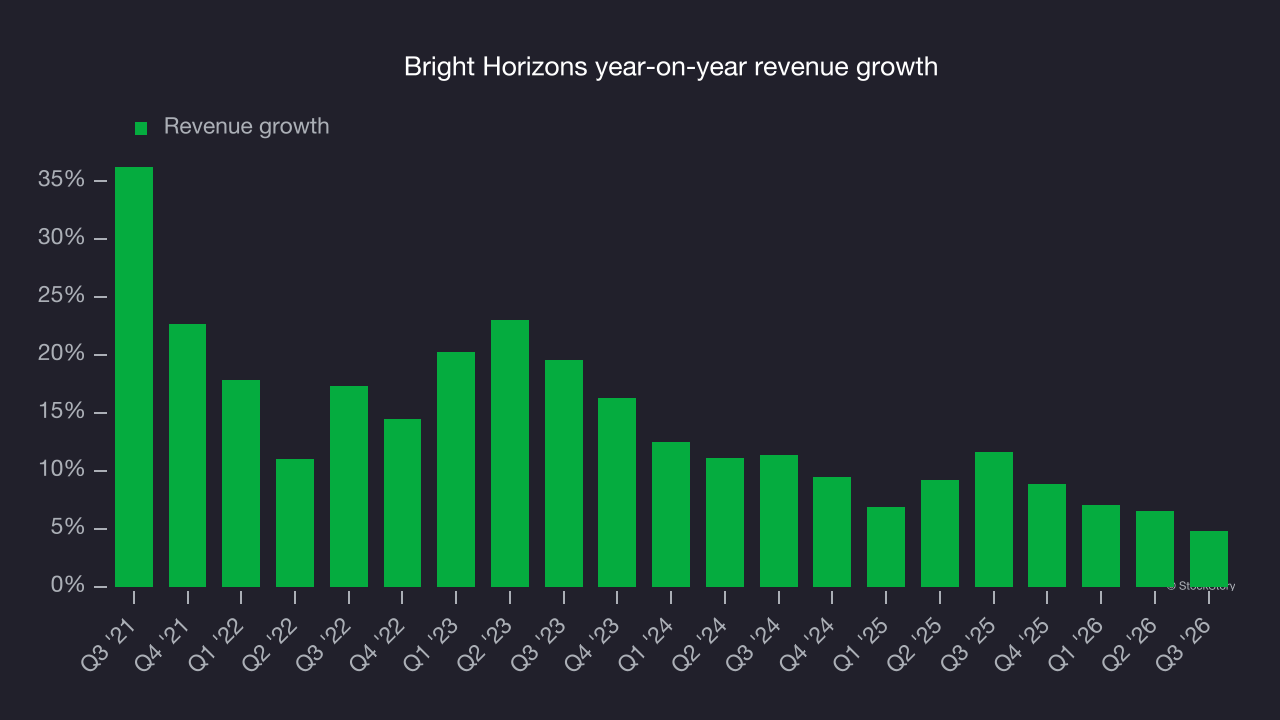
This quarter, Bright Horizons grew its revenue by 4.8% year on year, and its $841.5 million of revenue was in line with Wall Street’s consensus estimates.
Looking ahead, sell-side analysts expect revenue to grow 5% over the next 12 months, according to S&P, a deceleration versus the last two years. This projection is underwhelming and suggests its products and services will see some demand headwinds.
Operating margin
Operating margin is an important measure of profitability as it shows the portion of revenue left after accounting for all core expenses – everything from the cost of goods sold to advertising and wages. It’s also useful for comparing profitability across companies with different levels of debt and tax rates because it excludes interest and taxes.
Bright Horizons’s operating margin has shrunk over the last 12 months and averaged 5.4% over the last two years. The company’s profitability was mediocre for a consumer discretionary business and shows it couldn’t pass its higher operating expenses onto its customers.
In Q3, Bright Horizons generated an operating margin of negative 22.2%, down 37.3 percentage points year on year. This contraction shows it was less efficient because its expenses grew faster than its revenue.
Earnings per share
Revenue trends explain a company’s historical growth, but the long-term change in earnings per share (EPS) points to the profitability of that growth. For example, a company could inflate its revenue through excessive spending on advertising and promotions.
Bright Horizons’s EPS grew at a 24% compounded annual growth rate over the last five years. This performance outpaced its revenue growth but doesn’t tell us much about its business quality because its operating margin improvement was smaller than that of peers.
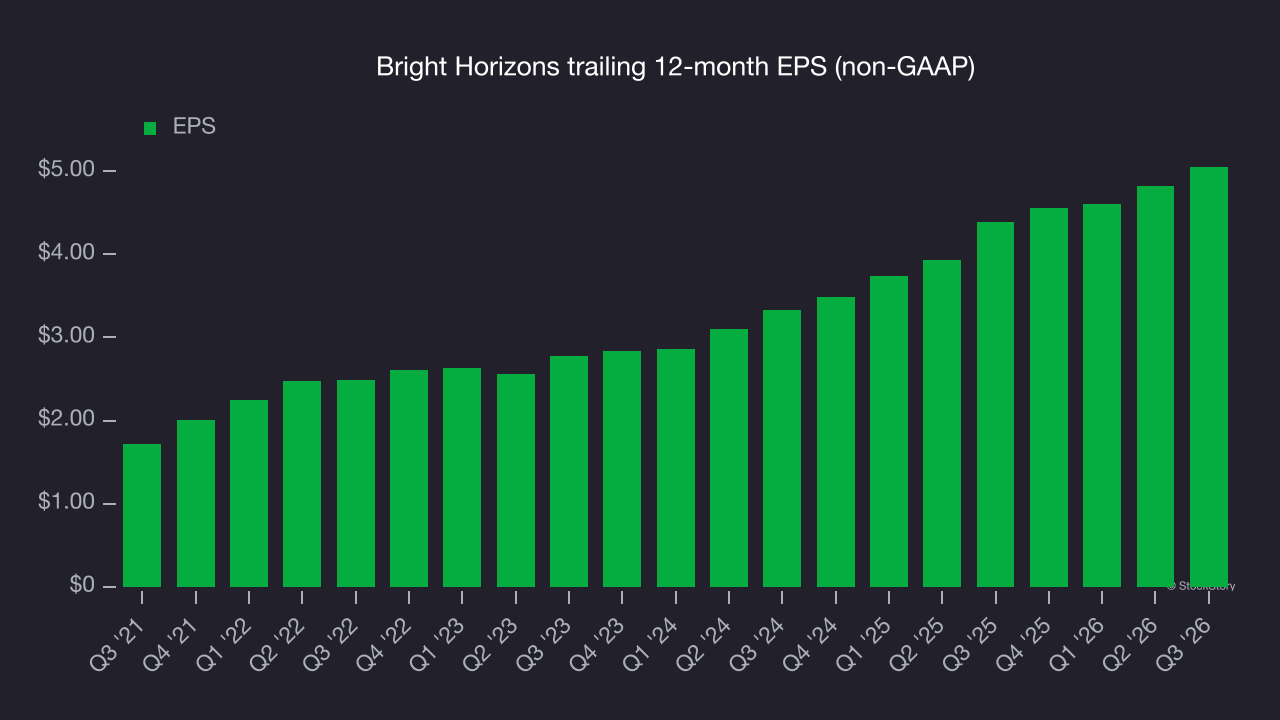
In Q3, Bright Horizons reported adjusted EPS of $1.80, up from $1.57 in the same quarter last year. This result beat analysts’ consensus estimates by 2.4%. Over the next 12 months, Wall Street expects Bright Horizons’s full-year EPS to grow 12.4% from $5.05 to $5.67, according to S&P.
Key takeaways from Bright Horizons’s Q3 results
Bright Horizons offered few positives this quarter: Full-year revenue guidance narrowly missed expectations, and full-year EPS guidance also fell short of Wall Street’s consensus estimates. It was a disappointing quarter overall. Shares tumbled 6.7% to $62.58 immediately after the report.
Bright Horizons’s latest earnings report disappointed. One quarter doesn’t define a company’s quality. The latest quarter is only one part of assessing longer-term business quality, which, combined with valuation, can help determine whether the stock is a buy at the current price. For more on those factors, read our full research report here (it’s free).