As the craze of earnings season draws to a close, here’s a look back at some of the most exciting (and some less so) results from Q2. Today, we are looking at online retail stocks, starting with Chewy (NYSE: CHWY).
Online penetration surged during COVID before normalizing, consumer expectations around convenience, selection, fast delivery, and competitive pricing have remained permanently higher. Retailers have responded by investing in fulfillment networks, automation, omnichannel capabilities, and AI-powered personalization to serve customers more efficiently and improve the shopping experience. Today, ecommerce growth is driven less by first-time online adoption and more by increasing wallet share, higher purchase frequency, and the continued migration of traditionally offline categories online. As logistics networks and AI capabilities continue to improve, leading ecommerce platforms are well positioned to capture a growing share of consumer spending over the coming decade.
The 5 online retail stocks we track reported a strong Q2. As a group, revenues beat analysts’ consensus estimates by 1.8% while next quarter’s revenue guidance was 2.1% below.
While some online retail stocks have fared somewhat better than others, they have collectively declined. On average, share prices are down 2.6% since the latest earnings results.
Chewy (NYSE: CHWY)
Founded by Ryan Cohen, who later became known for his involvement in GameStop, Chewy (NYSE: CHWY) is an online retailer specializing in pet food, supplies, and healthcare services.
Chewy reported revenues of $3.33 billion, up 7.3% year on year. This print was in line with analysts’ expectations, and overall, it was a very strong quarter for the company with a solid beat of analysts’ EBITDA estimates.
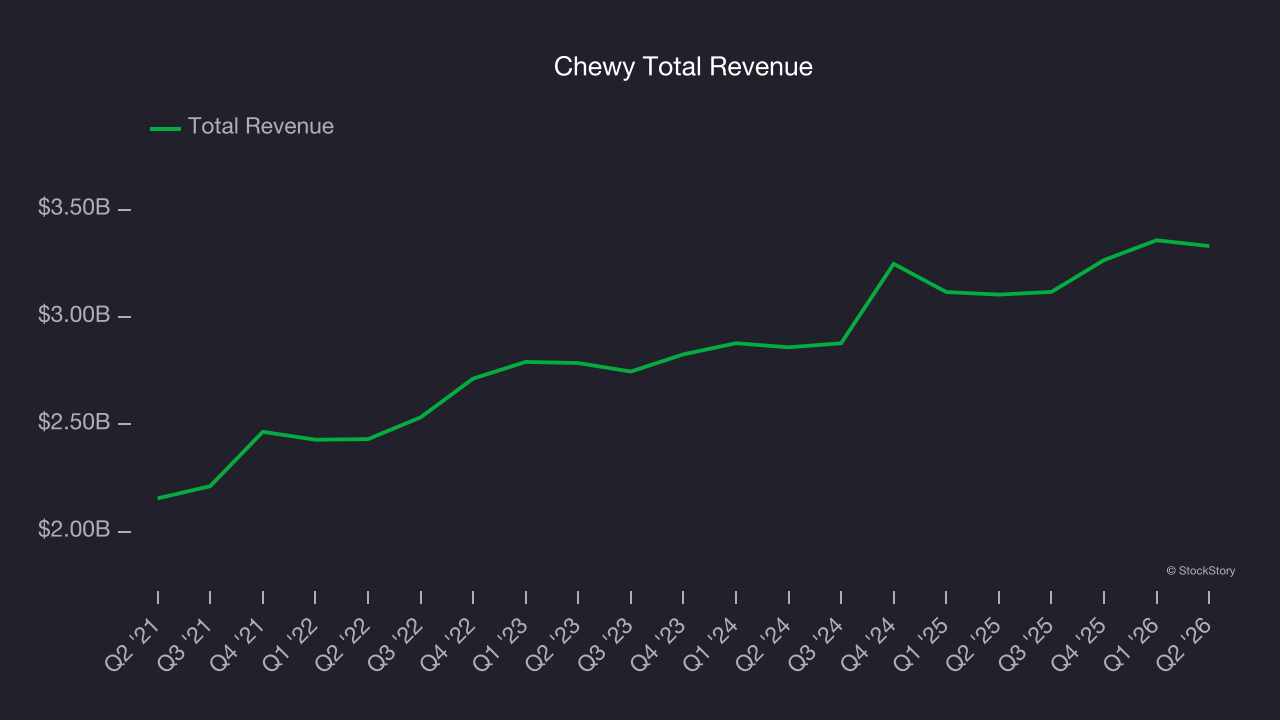
Investor expectations, however, were likely higher than Wall Street’s published projections, leaving some wishing for even better results (analysts’ consensus estimates are those published by big banks and advisory firms, not the investors who make buy and sell decisions). The stock is down 11.8% since reporting and currently trades at $20.53.
Is now the time to buy Chewy? Access our full analysis of the earnings results here, it’s free.
Best Q2: Revolve (NYSE: RVLV)
Launched in 2003 by software engineers Michael Mente and Mike Karanikolas, Revolve (NYSE: RVLV) is a fashion retailer leveraging social media and a community of fashion influencers to drive its merchandising strategy.
Revolve reported revenues of $347.4 million, up 12.4% year on year, outperforming analysts’ expectations by 1.4%. The business had a very strong quarter with an impressive beat of analysts’ EBITDA estimates and solid growth in its buyers.
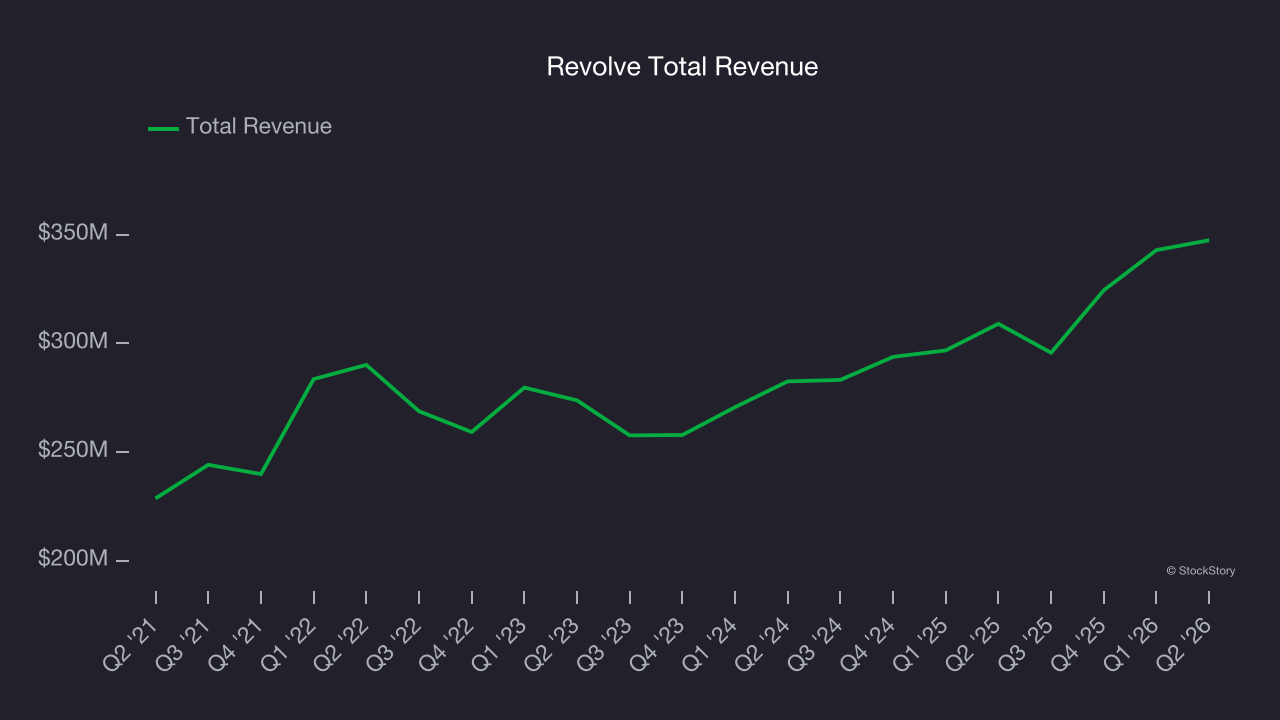
Although it had a fine quarter compared to its peers, the market seems unhappy with the results as the stock is down 15.4% since reporting. It currently trades at $22.31.
Is now the time to buy Revolve? Access our full analysis of the earnings results here, it’s free.
Weakest Q2: Coupang (NYSE: CPNG)
Founded in 2010 by Harvard Business School student Bom Kim, Coupang (NYSE: CPNG) is an e-commerce giant often referred to as the "Amazon of South Korea".
Coupang reported revenues of $8.86 billion, up 3.9% year on year, falling short of analysts’ expectations by 2.2%. It was a mixed quarter as it posted a solid beat of analysts’ EBITDA estimates.
Coupang delivered the weakest performance against analyst estimates and slowest revenue growth of the whole group. The company reported 24.7 million active buyers, up 3.3% year on year. As expected, the stock is down 14.5% since the results and currently trades at $14.35.
Read our full analysis of Coupang’s results here.
Carvana (NYSE: CVNA)
Known for its glass tower car vending machines, Carvana (NYSE: CVNA) provides a convenient automotive shopping experience by offering an online platform for buying and selling used cars.
Carvana reported revenues of $7.38 billion, up 52.4% year on year. This number beat analysts’ expectations by 7.7%. Aside from that, it was a mixed quarter as it also recorded impressive growth in its units but full-year EBITDA guidance missing analysts’ expectations significantly.
Carvana achieved the biggest analyst estimate beat and fastest revenue growth among its peers. The company reported 197,325 units sold, up 37.7% year on year. The stock is down 11.4% since reporting and currently trades at $58.76.
Read our full, actionable report on Carvana here, it’s free.
Wayfair (NYSE: W)
Founded in 2002 by Niraj Shah, Wayfair (NYSE: W) is a leading online retailer of mass-market home goods in the US, UK, Canada, and Germany.
Wayfair reported revenues of $3.52 billion, up 7.5% year on year. This print surpassed analysts’ expectations by 1.4%. Overall, it was a strong quarter as it also logged a solid beat of analysts’ EBITDA estimates.
The company reported 21.7 million active buyers, up 3.3% year on year. The stock is up 25.6% since reporting and currently trades at $112.15.
Read our full, actionable report on Wayfair here, it’s free.
Market Update
Over the past year, investors have been forced to repeatedly answer the same question: what is the market’s biggest risk? The answer has changed several times, and each shift has reshaped market leadership.
Late in 2025 and early 2026, artificial intelligence became the market’s primary uncertainty. Investors questioned whether AI would erode software pricing power and weaken competitive moats as AI made it easier to replicate once-differentiated products.
By the spring, technology took a back seat to geopolitics. The U.S. conflict with Iran briefly became the market’s dominant narrative, raising concerns about oil prices, inflation, and global growth. But as energy markets remained orderly and fears of a prolonged supply disruption faded, investors quickly turned their focus back to fundamentals.
Want to invest in winners with rock-solid fundamentals? Check out our 9 Best Market-Beating Stocks and add them to your watchlist. These companies are poised for growth regardless of the political or macroeconomic climate.