
Financial services giant PNC (NYSE: PNC) fell short of the market’s revenue expectations in Q3 2026, but sales rose 9.7% year on year to $6.56 billion. Its non-GAAP profit of $5.09 per share was 2.2% above analysts’ consensus estimates.
Is now the time to buy PNC Financial Services Group? Find out by accessing our full research report, it’s free.
PNC Financial Services Group (PNC) Q3 2026 Highlights:
- Net Interest Income: $4.21 billion vs analyst estimates of $4.25 billion (15.3% year-on-year growth, 1% miss)
- Net Interest Margin: 2.9% vs analyst estimates of 3% (5.6 basis point miss)
- Revenue: $6.56 billion vs analyst estimates of $6.61 billion (9.7% year-on-year growth, 0.7% miss)
- Efficiency Ratio: 57% vs analyst estimates of 56.9% (13 basis point miss)
- Adjusted EPS: $5.09 vs analyst estimates of $4.98 (2.2% beat)
- Tangible Book Value per Share: $107.64 vs analyst estimates of $112.26 (flat year on year, 4.1% miss)
- Market Capitalization: $86.09 billion
From Bill Demchak, PNC Chairman and Chief Executive Officer:"Our strategy continues to drive growth across our businesses, as we deepen our presence in key markets and expand our reach nationally. During the third quarter, we continued to build on the strong momentum we delivered in the first half of the year, and we generated an 18.3% return on average tangible common equity. We are well positioned, and remain confident in our long-term outlook."
Company Overview
Tracing its roots back to 1852 when Pittsburgh's industrial boom demanded stronger financial institutions, PNC (NYSE: PNC) is a diversified financial institution that provides retail banking, corporate banking, and asset management services through a coast-to-coast branch network.
Sales Growth
From lending activities to service fees, most banks build their revenue model around two income sources. Interest rate spreads between loans and deposits create the first stream, with the second coming from charges on everything from basic bank accounts to complex investment banking transactions. Regrettably, PNC Financial Services Group’s revenue grew at a tepid 6.7% compounded annual growth rate over the last five years. This fell short of our benchmark for the banking sector and is a poor baseline for our analysis.
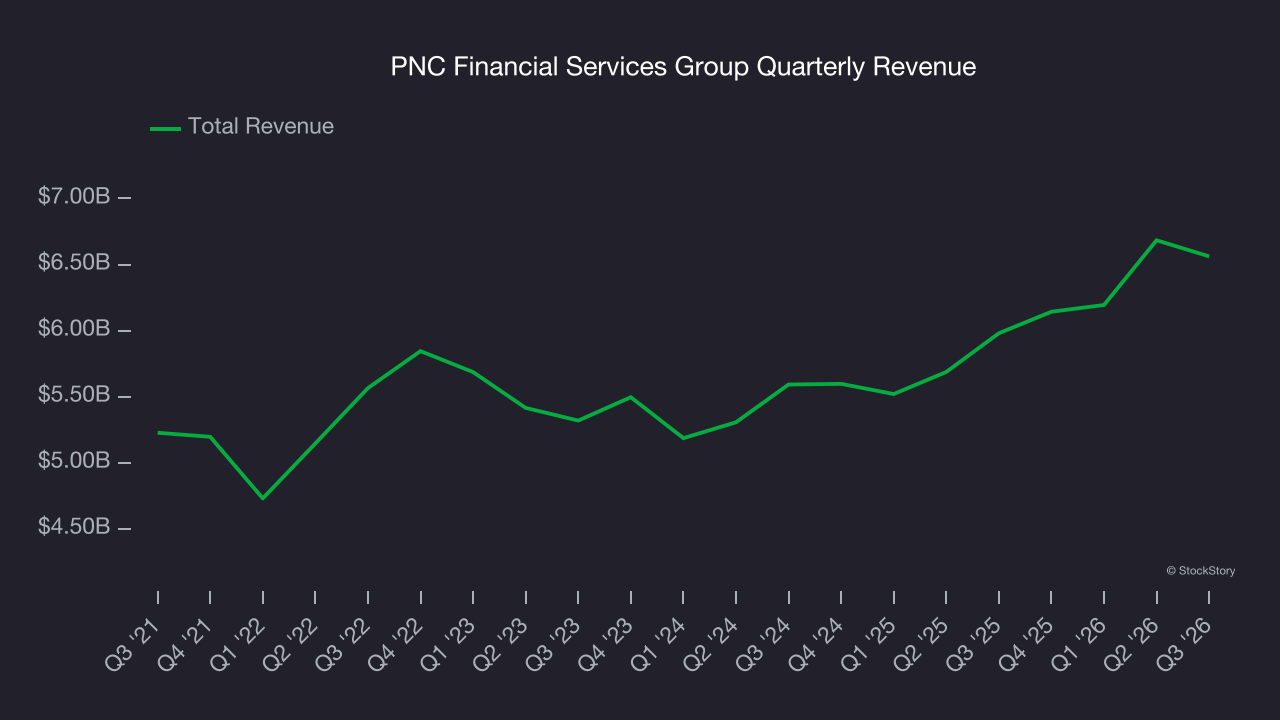
We at StockStory place the most emphasis on long-term growth, but within financials, a half-decade historical view may miss recent interest rate changes, market returns, and industry trends. PNC Financial Services Group’s annualized revenue growth of 8.9% over the last two years is above its five-year trend, which is encouraging. 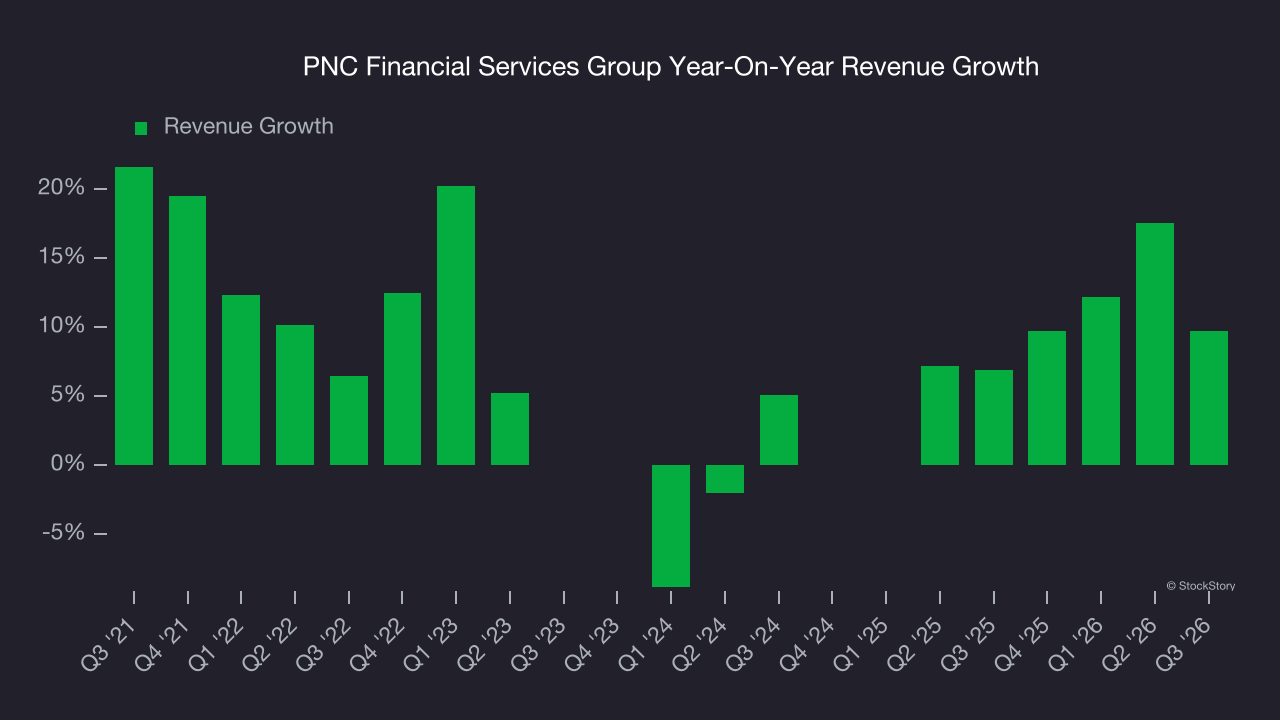 Note: Quarters not shown were determined to be outliers because they were impacted by outsized investment gains/losses that are not indicative of the recurring fundamentals of the business.
This quarter, PNC Financial Services Group’s revenue grew by 9.7% year on year to $6.56 billion, missing Wall Street’s estimates.
Net interest income made up 61.9% of the company’s total revenue during the last five years, meaning lending operations are PNC Financial Services Group’s largest source of revenue.
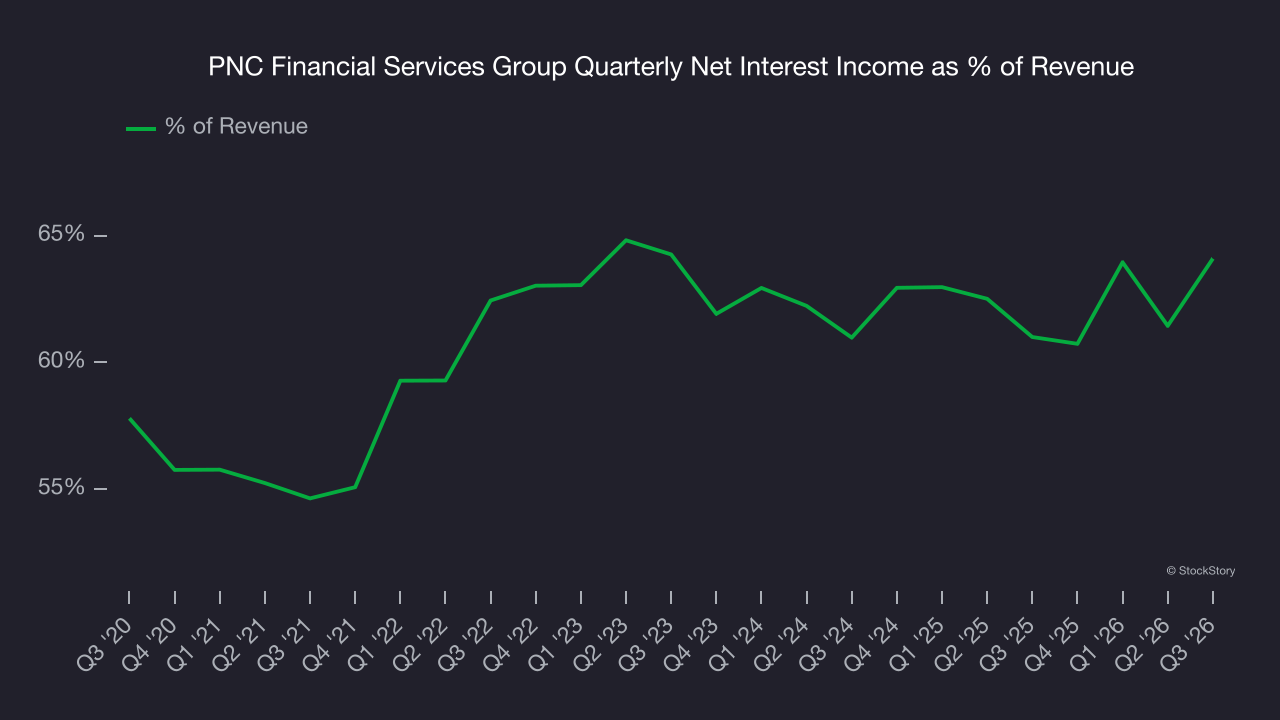
Net interest income commands greater market attention due to its reliability and consistency, whereas non-interest income is often seen as lower-quality revenue that lacks the same dependable characteristics.
ALSO WORTH WATCHING: Nvidia’s Quiet Partner. Nvidia’s chips cost a hundred grand. The connectors that make them work cost even more. One company makes them all.
Every AI server needs specialized infrastructure the chip companies don’t make. High-speed cables. Power connectors. Thermal sensors. This 90-year-old company built a monopoly on it. The AI boom just started. This stock is still flying under the radar. Claim The Stock Ticker Here for FREE.
Tangible Book Value Per Share (TBVPS)
The balance sheet drives banking profitability since earnings flow from the spread between borrowing and lending rates. As such, valuations for these companies concentrate on capital strength and sustainable equity accumulation potential.
This explains why tangible book value per share (TBVPS) stands as the premier banking metric. TBVPS strips away questionable intangible assets, revealing concrete per-share net worth that investors can trust. Traditional metrics like EPS are helpful but face distortion from M&A activity and loan loss accounting rules.
PNC Financial Services Group’s TBVPS grew at a sluggish 2.4% annual clip over the last five years. However, TBVPS growth has accelerated recently, growing by 5.3% annually over the last two years from $97.02 to $107.64 per share.
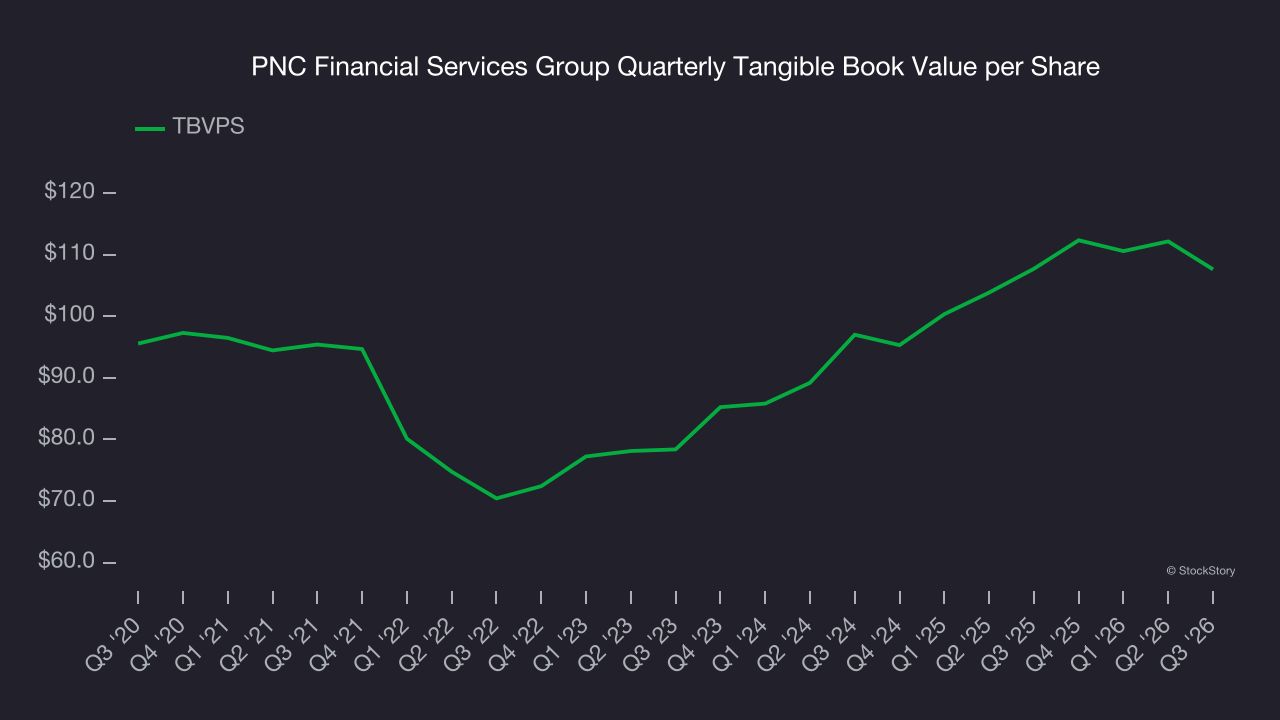
Over the next 12 months, Consensus estimates call for PNC Financial Services Group’s TBVPS to grow by 13% to $121.65, decent growth rate.
Key Takeaways from PNC Financial Services Group’s Q3 Results
PNC's tangible book value per share missed and its net interest income fell slightly short of Wall Street’s estimates. Overall, this was a softer quarter. The stock traded down 1% to $213.60 immediately after reporting.
PNC Financial Services Group may have had a tough quarter, but does that actually create an opportunity to invest right now? We think that the latest quarter is only one piece of the longer-term business quality puzzle. Quality, when combined with valuation, can help determine if the stock is a buy. We cover that in our actionable full research report which you can read here (it’s free).