News Source: Save Long Beach Island (Save LBI)
Lawsuit seeks to compel NOAA to act on a year-old petition to designate the whale's migration path a 'critical habitat' to ensure its survival
LONG BEACH ISLAND, N.J., May 7, 2026 (SEND2PRESS NEWSWIRE) — Save Long Beach Island (Save LBI), a nonprofit, non-partisan organization dedicated to protecting our oceans from needless industrialization, along with other concerned parties, filed suit against the National Oceanic and Atmospheric Administration (NOAA) to compel the agency to act on a 2025 petition intended to protect the critically endangered North Atlantic right whale (NARW).
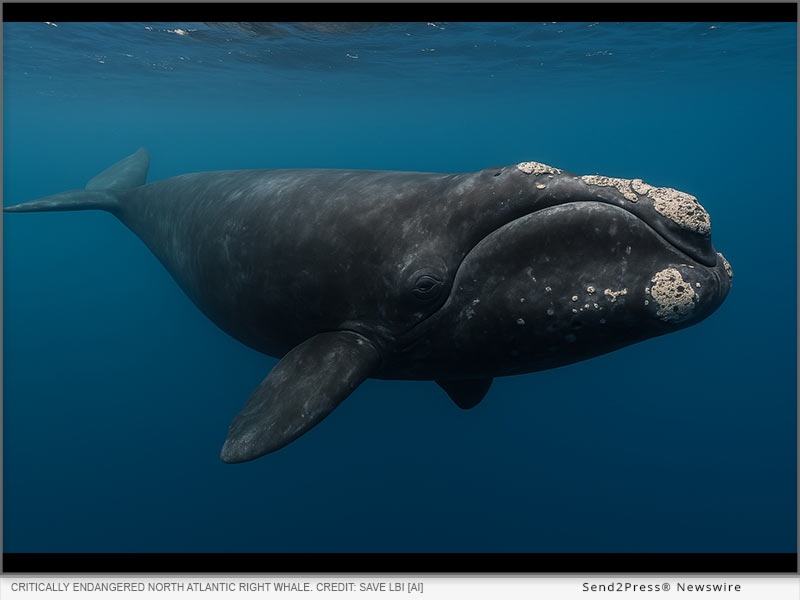
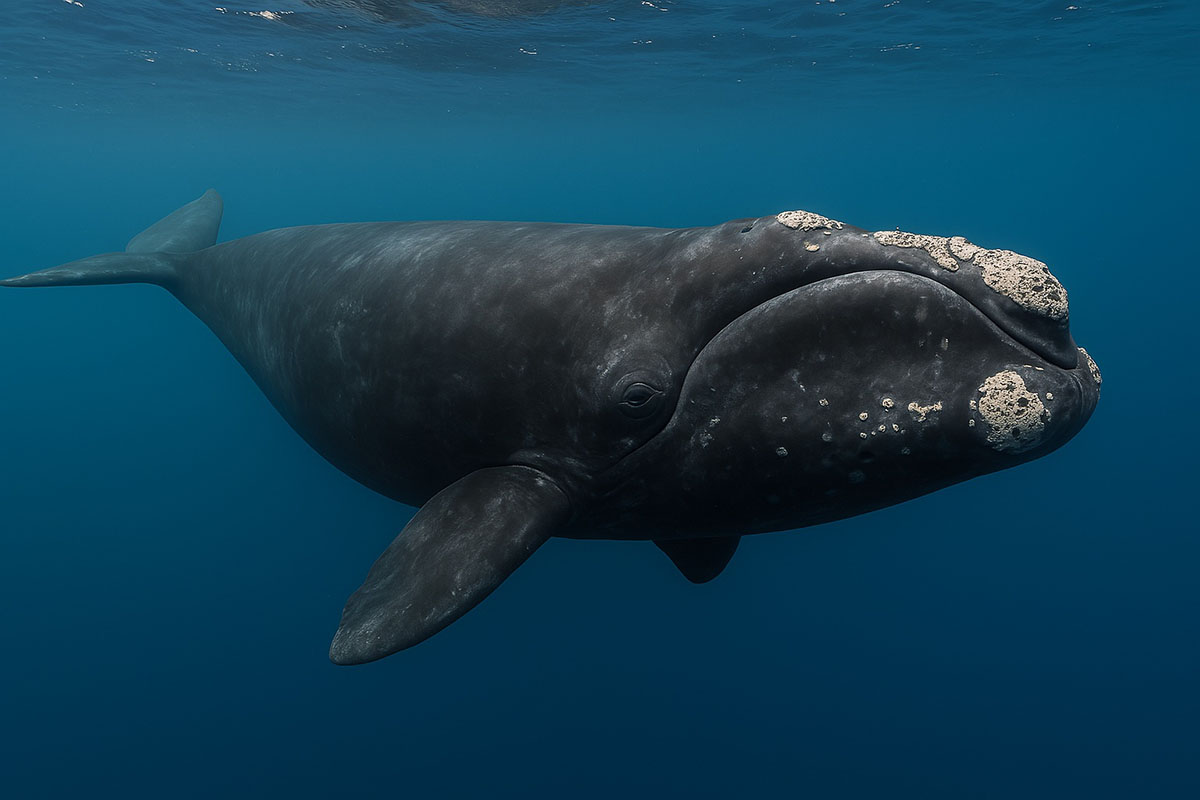
Image caption: The critically endangered North Atlantic right whale. Credit: Save LBI (generated with AI tools).
With a population that has dwindled dramatically in recent years, the magnificent right whale is inching perilously close to extinction as it faces a number of ongoing threats. Save LBI filed the petition a year ago on March 31, 2025 requesting NOAA to designate the whale’s primary historic migration corridor a “critical habitat” under the Endangered Species Act (ESA). The corridor identified in the Petition [media.fisheries.noaa.gov/2025-05/NARW-Petition-March-31-2025-508-.pdf] is based on the observation of historical whale migration and the location of its prey.
Notwithstanding multiple follow-up letters, NOAA has not acted on the request, despite the mandated 90-day deadline for doing so. “The deadline for response from the Agency has long since passed so we must go to court,” said Thomas Stavola, Jr., attorney handling the action. “This lawsuit compels NOAA to fulfill its legal duty to consider Save Long Beach Island’s critical habitat petition.”
The primary historic migration corridor designation would require federal agencies to ensure that actions they authorize, fund, or carry out are not likely to destroy or adversely modify the corridor, which is essential to the whale’s migration and survival. It would, in effect, create a vital “missing link” between critical habitats NOAA designated in 1994, and later expanded, to protect the right whale’s feeding grounds off the coast of Maine (and New England) and its calving and nursery grounds off the coast of Georgia and South Carolina. No habitat protections currently exist between these areas in the far north and south, putting the whale’s survival at great risk.
“Only about 380 North Atlantic right whales are believed to remain, which means every preventable impact matters,” explained Denise Boccia, Save LBI Board Member and the primary architect of the petition. “Protecting their connected and continuous primary migration corridor as critical habitat is the most direct, science-based tool we have to keep this species from sliding into extinction.”
WHAT A CRITICAL HABITAT DESIGNATION WOULD DO
If NOAA designates the NARW’s primary historic migration corridor as critical habitat, federal agencies would be required to:
- Evaluate impacts of major projects—such as large-scale offshore industrial development—on the miles-wide corridor itself.
- Avoid actions that are likely to destroy or appreciably degrade the whale’s migratory corridor, including activities that create wide-ranging elevated levels of underwater noise across the corridor or appreciably alter the availability of its prey.
A critical habitat designation would deter wind-energy development in lease areas—such as the Atlantic Shores South and North areas off the coast of southern New Jersey—that were unwisely positioned in the whale’s primary migration corridor. Save LBI’s detailed analysis of operational noise from wind-energy complexes (summarized in the Addendum below) reveals that noise from operating wind turbines extends for miles where it remains above levels that disturb the whale’s behavior. “Consequently, those projects could adversely and appreciably affect the miles-wide migration corridor itself and not only seriously impair, but potentially block, the whale’s essential annual migration,” said Save LBI President Bob Stern, a Ph.D. scientist and former manager of the Office of National Environmental Policy Act Affairs for the U.S. Department of Energy.
WHAT THE DESIGNATION WOULD NOT DO
Despite what NOAA has said regarding prior, similar designations, a critical habitat designation for the NARW migration corridor would not:
- Regulate or restrict vessel traffic: The areas NOAA designates for lower vessel speeds are governed through separate authorities and processes and based on the presence of whales. Whether those areas are labeled critical habitat or not has no bearing on those restrictions.
- Regulate or restrict commercial or recreational fishing: The designation has no effect on private or state-sanctioned fishing. Federal fishing gear regulations and related measures are governed through separate authorities and processes based on perceived impacts to the whale itself. Any additional measures based on the critical habitat designation would require a separate determination that fishing is likely to destroy or adversely and appreciably modify the miles-wide migration corridor itself, which is not a plausible argument.
ABOUT SAVE LONG BEACH ISLAND, INC.
Save Long Beach Island, Inc. (Save LBI) is a non-profit, non-partisan organization dedicated to protecting the marine environment, coastal ecosystems, and quality of life for residents and visitors of Long Beach Island and the surrounding region. The organization advocates for science‑based, balanced policies that safeguard wildlife, preserve local economies, and promote responsible stewardship of ocean resources. Visit SaveLBI.org for more information.
Contact: https://www.savelbi.org/contact
For more information click here: https://www.savelbi.org
—ADDENDUM: SAVE LBI ESTIMATED NOISE RANGES—
Summary: The Extent of Behavior-Disturbing Noise from Offshore Wind Energy Complexes
Save LBI’s calculations of the noise from wind-turbine complexes proposed in the New York Bight (an area that extends from the southern tip of Cape May, New Jersey, to the southeastern coast of New York’s Long Island) showed that sound levels exceeding the whale’s behavioral disturbance threshold, represented by the red lines in the illustration, extend through the wind complex and for miles from its perimeter (the green line represents all known migration paths, which is wider than the closer-to-shore primary historic migration corridor identified in the petition).
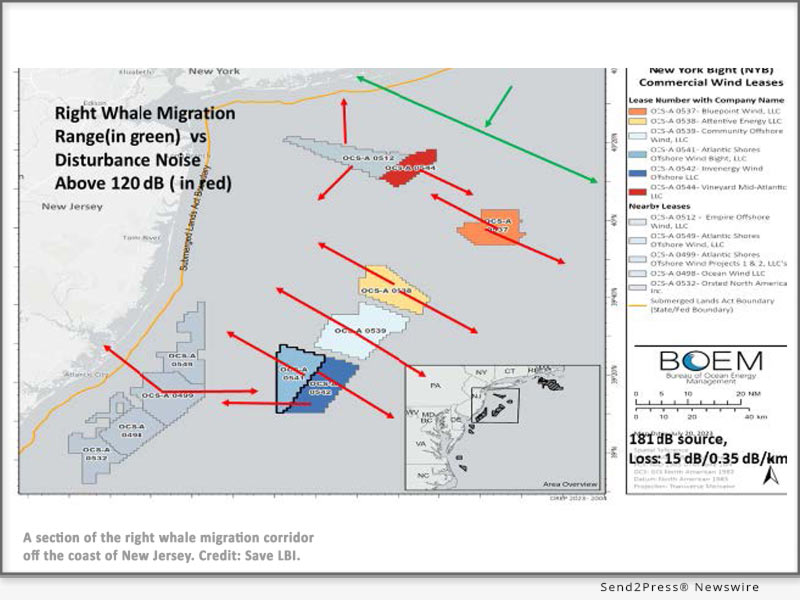
Image caption: A section of the right whale migration corridor off the coast of New Jersey. Credit: Save LBI.
Some straight-forward math leads to the same conclusion. During wind-turbine construction, noise source levels from pile driving are on the order of 240 decibels (dB). A significant reduction of about 80 dB is necessary to reduce those noise levels to NOAA’s “impulsive-noise behavioral disturbance threshold” of 160 dB. For turbine operation, the aggregate noise source level from a typical complex is about 200 dB, which would also have to be reduced by around 80 dB to meet NOAA’s lower “continuous-noise behavioral disturbance threshold” of 120 dB.
Because both cases require essentially the same 80 dB reduction in noise level, the distances over which sound must travel to drop to acceptable behavioral thresholds is similar. Numerous acoustic analyses conducted by the wind-energy projects have shown that pile-driving noise remains above the acceptable impulsive noise levels for a number of miles beyond the source. So those same multiple-mile ranges are needed to reduce the continuous operational noise generated by the wind complex to the acceptable continuous level, as shown by the red lines in the illustration. Such long distances of elevated noise level create a noise barrier to migration and degrade the viability of the migration corridor itself.
MULTIMEDIA:
IMAGE link for media: https://www.Send2Press.com/300dpi/25-0407-s2p-savelbi-whale-300dpi.jpg
Image caption: The critically endangered North Atlantic right whale. Credit: Save LBI (generated with AI tools).
This press release was issued on behalf of the news source (Save Long Beach Island (Save LBI)), who is solely responsible for its accuracy, by Send2Press Newswire.
To view the original story, visit: https://www.send2press.com/wire/new-jerseys-save-long-beach-island-sues-noaa-for-failure-to-protect-migration-corridor-of-critically-endangered-north-atlantic-right-whale/
Copr. © 2026 Send2Press® Newswire, Calif., USA. -- REF: S2P STORY ID: S2P135209 FCN26-4A
INFORMATION BELOW THIS PAGE, IF ANY, IS UNRELATED TO THIS PRESS RELEASE.