Magnet Rare Earth Targets in the East, Western Gallium Targets and a Southern Lithium Target in Brazil's Lithium Valley
Vancouver, British Columbia--(Newsfile Corp. - September 21, 2026) - Atlantico Energy Metals Corp. (CSE: ATLA) (FSE: 1CJ1) ("Atlantico" or the "Company") reports that its March 2026 integrated exploration review identified overlapping rare earth indicators in the east, gallium in weathered granite at Rio Bravo, and a southern lithium target supported by geochemical anomalies and an approximately five-kilometre magnetic feature.
"Twelve rare earth-led target areas, alongside gallium targets and a lithium target give us several compelling avenues to pursue," said Bonn Smith, President and CEO of Atlantico. "I am proud of our team's hard work bringing this multi-element critical minerals project into sharper focus, especially when securing diverse supplies has become a global priority. With over 243 square kilometres of contiguous claims in Brazil's critical minerals heartland, we see significant potential for multiple discoveries at our flagship Novo Cruzeiro Project."
Integrated Report Identifies Magnet Rare Earth, Gallium, and Lithium Targets
The review combined geochemical results, reconnaissance mapping, satellite imagery and regional geophysics to focus exploration across the Company's flagship Novo Cruzeiro Project. Figure 1 shows the 12 rare-earth-led target areas, with callouts highlighting northeastern and southeastern magnet rare earth targets, gallium at Rio Bravo in the west, and the southern lithium target.
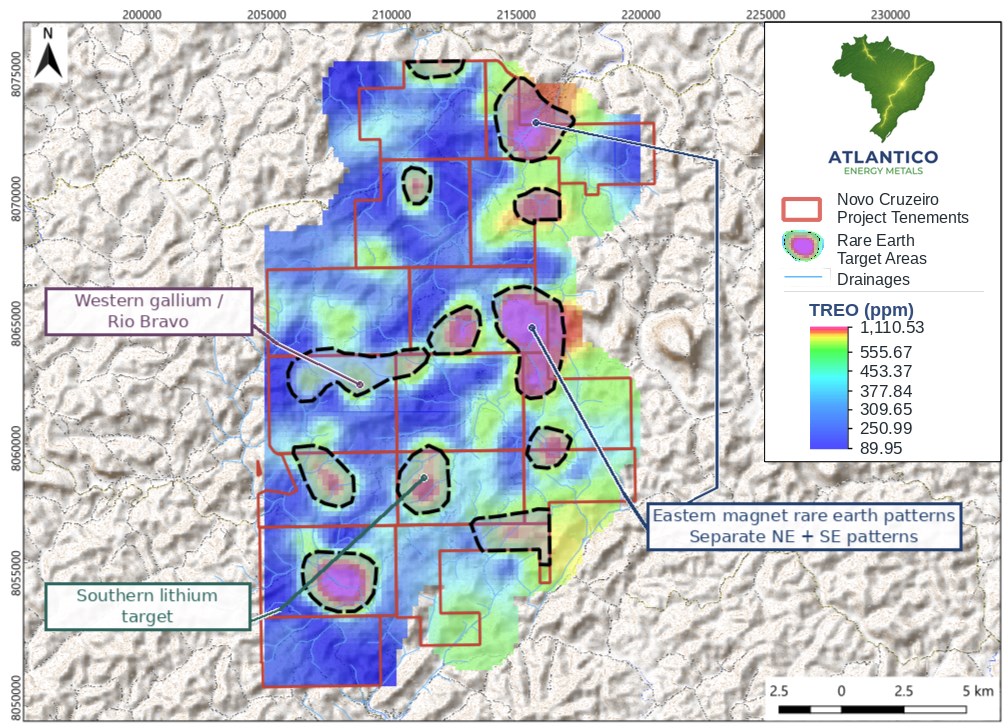
Figure 1. Twelve rare earth-led exploration target areas on the March TREO map at Novo Cruzeiro. Black dashed outlines delimit the interpreted areas; red outlines show project tenements and blue lines show drainage. Gallium and lithium opportunities are interpreted separately and are not assigned to these outlines. Target outlines do not establish mineralised boundaries.
To view an enhanced version of this graphic, please visit:
https://images.newsfilecorp.com/files/4290/315132_1fb8110ef45cda5c_001full.jpg
Magnet Rare Earth Results Strengthen Eastern Targets
The eastern Novo Cruzeiro targets are supported by neodymium and praseodymium anomalies, alongside dysprosium and terbium indicators. These rare earths are used in powerful permanent magnets for electric vehicle motors, wind turbine generators, industrial robots, and aerospace and defence systems. Neodymium and praseodymium provide magnetic strength, while dysprosium and terbium can help magnets retain their performance at high temperatures.
In the northeast, stream-sediment results help direct exploration toward potential upstream sources. Stream sample NCZ-SS-0147 returned 1,427.05 ppm TREO (calculated total rare earth oxides), including 284.40 ppm MREO (calculated magnet rare earth oxides), providing a specific drainage catchment for follow-up.
The magnet rare earth results extend beyond the eastern targets. In the predominantly western follow-up program, 96 of 114 surface samples contained calculated MREO representing at least 15% of TREO. Near the western boundary, five sand- and silt-rich samples (NCZ-CR-0080 through NCZ-CR-0084) each exceeded 500 ppm TREO across sample locations spanning approximately 100 metres.
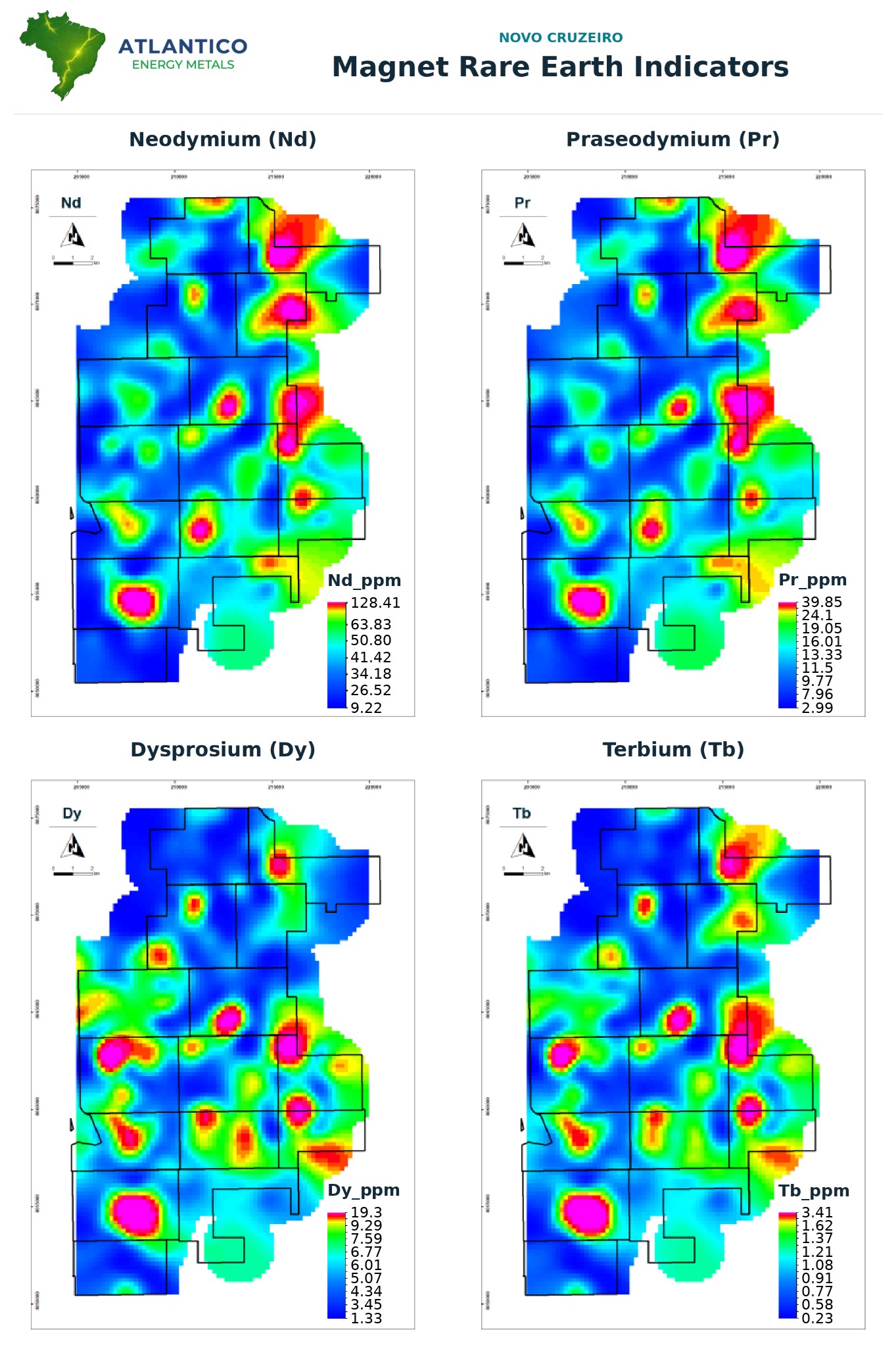
Figure 2. Magnet rare earth indicators at Novo Cruzeiro: neodymium (upper left), praseodymium (upper right), dysprosium (lower left) and terbium (lower right). Adapted from the March 2026 ioGAS interpretation, the maps show geochemical patterns that help guide follow-up exploration. Colours are specific to each element and should not be compared directly between maps; contours do not define mineralised boundaries.
To view an enhanced version of this graphic, please visit:
https://images.newsfilecorp.com/files/4290/315132_1fb8110ef45cda5c_002full.jpg
Gallium in 100% of Follow-Up Samples: A Critical New Focus Emerges at Rio Bravo Area
All 114 follow-up surface samples returned 16–72 ppm gallium, with the highest result equivalent to 96.8 g/t Ga₂O₃ (calculated gallium oxide). The samples covered varied materials, including soils, weathered granite and pegmatites, rather than a single rock type.
At Rio Bravo, the March review linked elevated gallium mainly to saprolite, material formed as granite breaks down through weathering. This geological setting lies near boundaries with schist, a layered rock formed by heat and pressure, belonging to the Ribeirão da Folha Formation. This pattern provides a focus for targeted mapping and sampling to test whether elevated gallium continues through the weathered material into the rock below, and to identify the minerals that carry it.
Gallium-based semiconductors play an important role in advanced defence and aerospace systems, including radar and drone communications, as well as satellite communications, 5G networks, smartphones, computers, and high-efficiency power supplies for AI data centres.
Gallium's uses extend to lasers and medical imaging. Gallium compounds are used in semiconductor laser diodes, while gallium nitride has been used to develop amplifiers for MRI systems. Separately, the radioactive isotope gallium-68 is used in certain PET scans to help doctors detect and locate cancer.
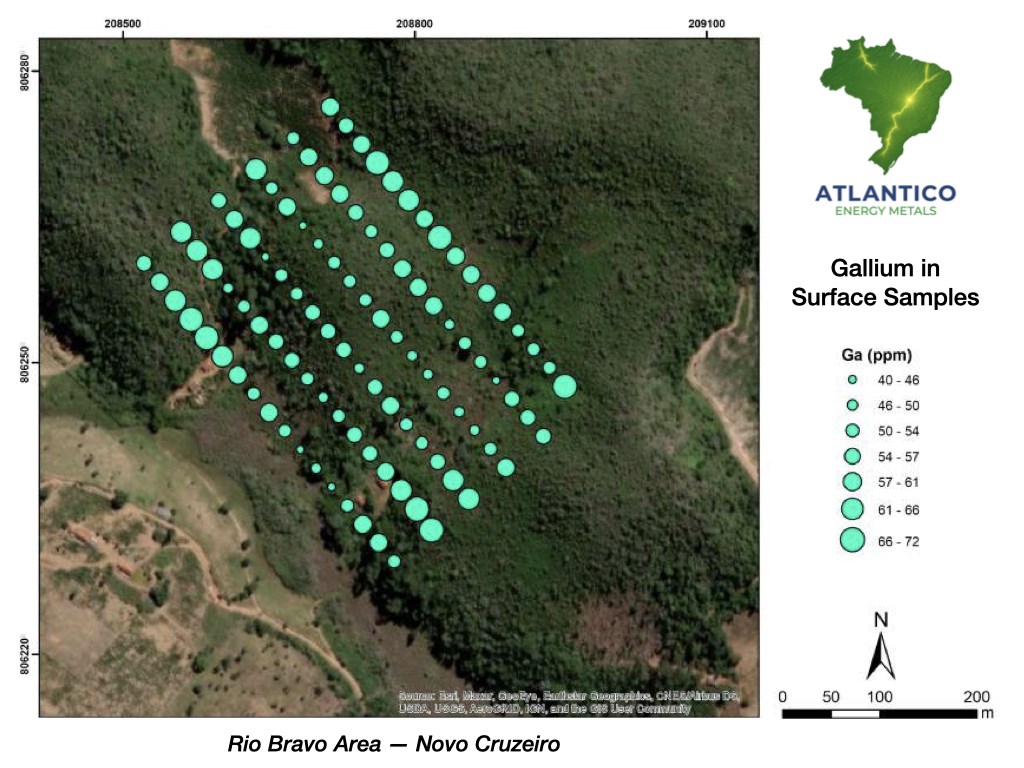
Figure 3. Additional gallium opportunity at Rio Bravo: elemental gallium concentrations in surface samples, shown over satellite imagery. Larger circles indicate higher elemental gallium concentrations, reported in parts per million (ppm), rather than calculated gallium oxide (Ga₂O₃) equivalents.
To view an enhanced version of this graphic, please visit:
https://images.newsfilecorp.com/files/4290/315132_1fb8110ef45cda5c_003full.jpg
China's Grip on Gallium and Magnet Rare Earths Highlights the Need for Alternative Sources
Gallium production is highly concentrated. According to the U.S. Geological Survey's February 2026 Mineral Commodity Summaries (https://pubs.usgs.gov/periodicals/mcs2026/mcs2026-gallium.pdf), China accounted for approximately 99% of worldwide primary low-purity gallium production in 2025. This concentration underscores the strategic importance of diversifying gallium supply chains for industries that depend on reliable access to the metal.
China's use of export controls on gallium and rare-earth materials containing dysprosium and terbium adds a geopolitical dimension to the supply-security challenge. The U.S. Geological Survey's Mineral Commodity Summaries 2026 documents the rare-earth controls (https://pubs.usgs.gov/periodicals/mcs2026/mcs2026-rare-earths.pdf). These same metals feature in Novo Cruzeiro's exploration results, reinforcing the strategic relevance of testing the project's gallium and magnet rare earth targets.
Southern Lithium Target Combines Geochemical and Geophysical Evidence
The southern lithium target has a prominent geophysical clue: an approximately five-kilometre magnetic feature that the March report describes as coincident with a lithium-anomalous zone. Its high–low–high, or "railway-track", response was interpreted as potentially reflecting geological contacts or alteration around a pegmatitic system.
The ioGAS review identifies moderate lithium relationships with caesium and rubidium and potassium-to-rubidium patterns interpreted to reflect more evolved granitic material. A southern first-pass sample, NCZ-CR-0016, was described as a pegmatite vein with biotite in pink saprolite and returned 108 ppm lithium, 12.4 ppm caesium and 249 ppm rubidium. The assays are modest, but the observed pegmatite vein gives the southern target a field-based geological context.
The broader 114-sample follow-up dataset, concentrated in western Novo Cruzeiro, also returned modest lithium results: 77 were below the 10 ppm reporting limit, and the maximum was 71 ppm in NCZ-CR-0068. The southern target remains a geological and geophysical interpretation to test, not a claim of strong lithium grades.
From Target Areas to Focused Fieldwork
The March report recommends detailed geological mapping, infill sampling, source-rock and weathering studies, and field geophysics to test the targets and guide further exploration. For rare earths, this includes examining the full weathering profile rather than surface material alone.
These recommendations do not constitute a newly approved exploration program.
Consolidated Assay Schedule
The consolidated 345-sample assay schedule (PDF) brings together selected results for all 231 first-pass samples and 114 March 2026 follow-up samples, including calculated rare earth oxides, gallium, lithium and associated pathfinders.
The schedule distinguishes the two sampling populations and includes sample coordinates, source-reported sample types, analytical qualifications and calculation notes. Samples repeat across panels to show different analytical fields, not additional results. The selected fields are not the full laboratory analytical suite and should be read with the sampling and QA/QC qualifications described in this release.
Sampling and Analytical Context
This release draws on the March 2026 report and associated assay data, not subsequent sampling. The evidence base comprises 231 first-pass samples (170 stream sediments and 61 samples recorded as rock chips) and 114 follow-up surface samples with laboratory results issued in March 2026. These are distinct populations, not one dataset used in every map or interpretation. First-pass results were discussed in the August 20, 2026 release and follow-up assays in the September 11, 2026 release. The follow-up work centred on a 50 × 25 metre grid within tenement 831.453/2023 in western Novo Cruzeiro, with additional reconnaissance locations. Field descriptions include strongly weathered, saprolitic, soil-, sand- and silt-rich material; a rock-labelled sample is not necessarily fresh bedrock.
SGS Geosol, an independent laboratory in Vespasiano, Minas Gerais, received the follow-up samples on January 30, 2026. Certificates GQ2601202 and GQ2601203 were issued March 5, and GQ2601205 March 8, 2026. Twelve samples underwent rock/core preparation, including crushing, splitting and pulverisation; 102 underwent soil/sediment preparation, including disaggregation and 80-mesh sieving. Analysis used sodium peroxide fusion with ICP-OES/ICP-MS for 56 elements (ICM90A). Laboratory QA/QC included preparation blanks, replicates and certified reference materials.
TREO is the sum of calculated CeO₂, Dy₂O₃, Er₂O₃, Eu₂O₃, Gd₂O₃, Ho₂O₃, La₂O₃, Lu₂O₃, Nd₂O₃, Pr₆O₁₁, Sm₂O₃, Tb₄O₇, Tm₂O₃, Y₂O₃ and Yb₂O₃. MREO comprises only Nd₂O₃, Pr₆O₁₁, Dy₂O₃ and Tb₄O₇. Ga₂O₃ is calculated from elemental Ga using a factor of 1.3442. Oxide values are calculated from elemental assays, not measured recoverable products; 1 ppm equals 1 g/t. The MREO proportion describes composition, not an economic cutoff or recoverability.
QA/QC Qualifications Apply to the Interpretation
The interpretation in this release remains subject to the QA/QC qualifications disclosed on September 11, 2026, including the GQ2601203 hold pending laboratory clarification of OREAS460 performance. These qualifications apply to affected results used here, including all five samples in the approximately 100-metre grouping. This release does not report clearance of the hold.
Quality assurance and quality control ("QA/QC") for the analytical batches included SGS Geosol laboratory preparation blanks, laboratory replicates and certified reference materials, including AMIS0683, AMIS0684 and OREAS460. Lithium performance for AMIS0683 and AMIS0684 was considered acceptable. Preparation blanks reported lithium below the analytical detection limit.
A material QA/QC exception was identified in certificate GQ2601203, where OREAS460 returned lithium below the 10 ppm detection limit against a certified value of approximately 19.6 ppm and showed negative bias for several rare earth and related elements. The subsequent OREAS460 result in certificate GQ2601205 returned approximately 20 ppm lithium and showed improved agreement for several analytes, although negative bias remained for selected elements, including niobium.
The Qualified Person considers the lithium analytical dataset generally acceptable with these qualifications. Selected multi-element results, particularly those affected by OREAS460 bias and low-level copper blank/replicate performance, should be interpreted with caution. The Company intends to request SGS confirmation of its applicable CRM acceptance criteria, internal QC review and any rerun or corrective-action data associated with the affected batch.
Important Early-Stage Exploration Context
Novo Cruzeiro is an early-stage surface-exploration project with no mineral resources or mineral reserves. Results describe the sampled materials, not representative fresh-bedrock or property-wide grades. Surface assays and interpreted targets do not establish mineralised continuity, grade over width, tonnage or economic viability. The approximately five-kilometre length refers to a magnetic feature, not a measured lithium body or pegmatite. Mineral hosts, metallurgical recovery and any ion-adsorption characteristics remain unestablished. Further work may not define a mineral resource or mineral reserve. Figure 3 represents individual sample locations; Figure 1 outlines are interpreted exploration areas, not mineralised boundaries.
Qualified Person
Andrew Lee Smith, P.Geo., a Qualified Person as defined by National Instrument 43-101: Standards of Disclosure for Mineral Projects, has reviewed the ratified analytical schedule, supporting technical information, the SGS analytical certificates and the QA/QC controls reported for certificates GQ2601202, GQ2601203 and GQ2601205, and has reviewed and approved the scientific and technical information contained in this news release. Mr. Smith is not independent of the Company within the meaning of NI 43-101 due to his role as a member of the Company's Advisory Board.
About Atlantico Energy Metals Corp.
Atlantico Energy Metals Corp. is a Canadian mineral exploration company built around a simple belief: a cleaner energy future needs critical minerals. The Company's flagship project is the Novo Cruzeiro Lithium and Rare Earth Elements Project, located in northeastern Minas Gerais, Brazil, within Brazil's Lithium Valley. Atlantico is advancing Novo Cruzeiro through disciplined technical work, transparent disclosure and responsible exploration, with a focus on creating long-term value for shareholders while contributing positively to the local communities and regions where the Company operates.
For Further Information, Please Contact:
Bonn Smith, President & CEO
Tel: +1 (855) 258-6463 | Email: corporate@atlantico.energy
Website: www.atlantico.energy
The Canadian Securities Exchange has neither approved nor disapproved the contents of this news release.
Forward-Looking Information
This news release contains "forward-looking information" and "forward-looking statements" within the meaning of applicable securities legislation, including statements regarding exploration potential, the interpretation and testing of target areas, recommended follow-up work, the Company's intended request for clarification from SGS and related technical review, further exploration at Novo Cruzeiro and future updates. These forward-looking statements are made as of the date of this news release. Forward-looking information is based on assumptions management considers reasonable as of the date of this news release, including the availability of financing, project access, required permits and approvals, qualified personnel and contractors, and the reliability of current technical information. Although management considers these assumptions reasonable, there can be no assurance that they will prove accurate.
Forward-looking information is subject to known and unknown risks, uncertainties and other factors that may cause actual events or results to differ materially, including risks related to mineral exploration, technical interpretation, commodity prices, capital markets, the availability of financing, permitting, environmental and regulatory matters, political and economic conditions in Brazil, and title and access matters. There may be other factors that cause actual results to differ from those anticipated, and there can be no assurance that forward-looking statements will prove accurate. No undue reliance should be placed on forward-looking information. The Company undertakes no obligation to update forward-looking information except as required by applicable law.
To view the source version of this press release, please visit https://www.newsfilecorp.com/release/315132