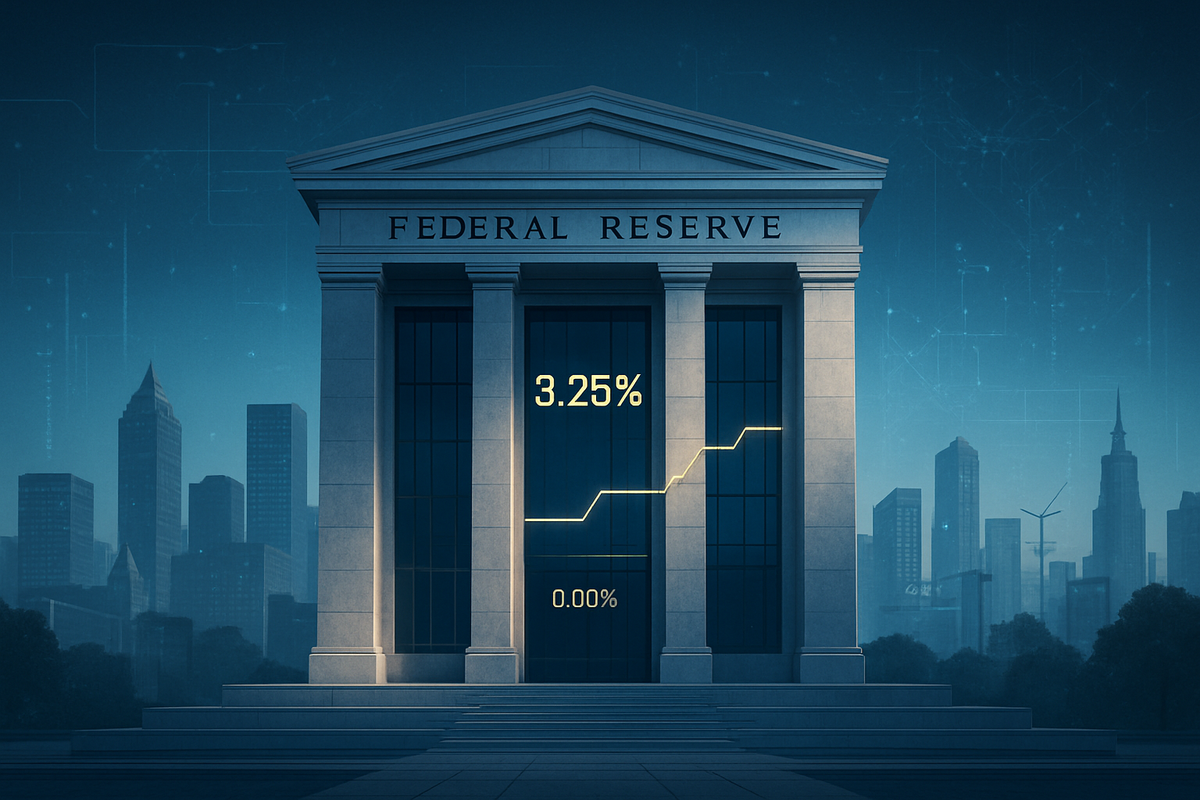
In a definitive shift that has sent ripples through global financial markets, a prominent Federal Reserve Governor signaled on Wednesday, April 8, 2026, that the elusive "neutral rate" of interest—the level that neither stimulates nor restricts economic growth—has likely settled at a floor of 3.25%. This commentary marks the official conclusion of the "higher for longer" era that characterized the mid-2020s, yet it carries a sobering message for those hoping for a return to the rock-bottom rates of the previous decade. By establishing 3.25% as the new baseline, the central bank has effectively declared that the era of zero-bound interest rates is over, ushering in a "New Normal" for the cost of capital.
The immediate market implications were swift. Treasury yields adjusted upward as investors recalibrated their long-term expectations, acknowledging that the Federal Reserve (Fed) is unlikely to cut rates below this 3.25% threshold in the foreseeable future. This "higher floor" reflects a fundamental reassessment of the U.S. economy’s structural resilience, driven by massive productivity gains from artificial intelligence, substantial public debt loads, and a transformative energy transition. For the market, the message is clear: the safety net of near-zero rates has been permanently removed, replaced by a 3.25% anchor that demands more rigorous fundamental analysis and disciplined capital allocation.
A Structural Shift: The Path to 3.25%
The commentary, largely attributed to key FOMC voices such as Dallas Fed President Lorie Logan and Governor Christopher Waller, follows a multi-year journey of economic recalibration. After the aggressive hiking cycle of 2022–2023, which saw rates peak at 5.50%, the Fed spent much of 2024 and 2025 orchestrating a "soft landing." As inflation finally stabilized at the 2% target by mid-2025, the central bank began a series of methodical cuts. However, as the federal funds rate approached the 3.50% mark earlier this year, policymakers observed that the economy remained remarkably robust, with unemployment hovering near 4.1% and GDP growth tracking at a steady 2.0%.
This resilience led to the landmark "Neutral Rate Re-assessment" during the most recent FOMC cycle. In speeches leading up to today’s announcement, Governor Waller noted that if the economy does not cool despite significantly higher rates, the logical conclusion is that the neutral rate (r-star) has moved higher. The formalization of 3.25% as the "longer-run" dot in the Summary of Economic Projections (SEP) represents the first time in over a decade that the Fed has structurally raised its baseline estimate by such a significant margin.
Market reaction has been characterized by a "bear steepening" of the yield curve. With the Fed signaling a 3.25% floor, the 10-year Treasury yield has stabilized in the 4.25% to 4.75% range, as investors demand higher premiums for long-term debt in a world where the Fed is no longer a buyer of last resort at low yields. The transition marks the end of the "Zero Lower Bound" trauma that defined the post-2008 period, replacing it with a policy framework focused on maintaining stability at a more traditional, historically grounded rate.
Winners and Losers: The New Interest Rate Hierarchy
The shift to a 3.25% neutral floor creates a distinct class of winners and losers across the corporate landscape. Large-cap "money center" banks like JPMorgan Chase & Co. (NYSE: JPM) and Bank of America Corp. (NYSE: BAC) stand as the primary beneficiaries. In the zero-interest-rate environment of the 2010s, these institutions suffered from chronic margin compression. With a 3.25% floor, they can now maintain much wider Net Interest Margins (NIM). Even as they eventually raise deposit rates for consumers, the spread between those costs and the rates they charge for commercial loans and mortgages—now likely to stay above 6%—provides a massive, sustainable profit engine that was absent for most of the last 15 years.
Insurance giants, including MetLife, Inc. (NYSE: MET) and Prudential Financial, Inc. (NYSE: PRU), are also poised for a long-term renaissance. These companies rely on "float"—the premiums they collect and invest before claims are paid. For years, these firms struggled to find safe, high-yielding fixed-income assets to cover their long-term liabilities. A 3.25% Fed floor allows them to reinvest their maturing portfolios into corporate and government debt yielding 5% or more, significantly strengthening their balance sheets and making their annuity products more competitive and profitable.
Conversely, capital-intensive sectors that thrived on cheap leverage are facing a permanent headwind. Utilities like NextEra Energy, Inc. (NYSE: NEE) and massive Real Estate Investment Trusts (REITs) such as Prologis, Inc. (NYSE: PLD) and Realty Income Corp. (NYSE: O) now face higher permanent debt-servicing costs. These stocks, once treated as "bond proxies" by yield-hungry investors, have lost their luster as risk-free Treasuries now offer competing yields without the operational risk. For these companies, the 3.25% floor necessitates a strategic pivot away from debt-fueled expansion toward more organic, high-efficiency growth models.
Even tech titans like Apple Inc. (NASDAQ: AAPL) and NVIDIA Corp. (NASDAQ: NVDA) face a mixed outlook. While both companies possess massive cash reserves that will now earn billions in interest income, their high valuations are mathematically pressured by the 3.25% floor. In a Discounted Cash Flow (DCF) model, a higher neutral rate serves as a higher discount rate, reducing the present value of future earnings. Investors are no longer willing to pay "growth at any price" when the cost of time has risen from 0% to 3.25%.
Historical Context and Wider Significance
To understand the weight of this 3.25% figure, one must look back at the late 1990s and the pre-2008 era. In the 1990s, the neutral rate was even higher, often exceeding 4.5% during the dot-com productivity boom. The Fed’s move today suggests a return to a "Goldilocks" environment similar to that era—one where productivity (this time driven by AI) is high enough to sustain moderate interest rates without choking off growth. It is a stark departure from the "secular stagnation" of the 2010s, where low growth and low inflation forced the Fed to keep rates near zero.
The structural drivers behind this shift are threefold:
- AI Productivity: The integration of generative AI across the economy is beginning to show up in productivity data, allowing the economy to grow faster without fueling inflation.
- Public Debt and Fiscal Expansion: With U.S. federal debt continuing to climb, the sheer volume of Treasury issuance requires higher rates to attract global buyers, naturally pushing up the neutral rate.
- The Energy Transition: The massive capital expenditure required to transition the global energy grid is inherently inflationary and demand-heavy, creating a structural tailwind for interest rates.
This move also signals a significant policy shift regarding the "Fed Put." For decades, investors expected the Fed to slash rates to zero at the first sign of a market correction. By cementing a 3.25% neutral rate, the Fed is signaling that it intends to keep its "dry powder" and will only return to the zero-bound in the event of a catastrophic economic collapse, rather than a standard market pullback.
What Comes Next: Navigating the 3.25% Floor
Looking ahead to the remainder of 2026 and into 2027, the primary challenge for the market will be the "repricing of risk." In the short term, we may see continued volatility in small-cap stocks and highly leveraged sectors as they adjust their balance sheets to the reality of 3.25% capital. Strategic pivots are already underway; many REITs and mid-market companies are slowing acquisition plans to focus on debt reduction and operational efficiency.
The most likely scenario is a period of "higher-base stability." If the Fed successfully holds the 3.25% floor while maintaining 2% inflation, it will have achieved a historic feat in central banking. However, the risk remains that the higher floor could eventually trigger a "slow-burn" recession if consumer spending, particularly in the housing market where 6.5% mortgage rates are the new norm, begins to buckle. Investors should watch the labor market closely; as long as unemployment remains near 4%, the Fed has no reason to deviate from its 3.25% anchor.
Closing Thoughts: A New Anchor for Investors
The formalization of a 3.25% neutral rate is perhaps the most significant policy evolution since the end of the Great Inflation. It marks a total rejection of the "low for long" philosophy that dominated the early 21st century and confirms that the structural dynamics of the global economy have shifted toward a more active, capital-intensive model.
For investors, the key takeaways are fundamental: quality matters more than ever. The companies that will thrive in this environment are those with strong "sticky" cash flows, minimal debt-refinancing needs, and the ability to pass on costs to consumers. As the market moves forward, the focus will shift from "when will the Fed cut?" to "how well can this company perform at 3.25%?" The coming months will be a period of discovery as the market finds its footing on this new, higher ground.
This content is intended for informational purposes only and is not financial advice.