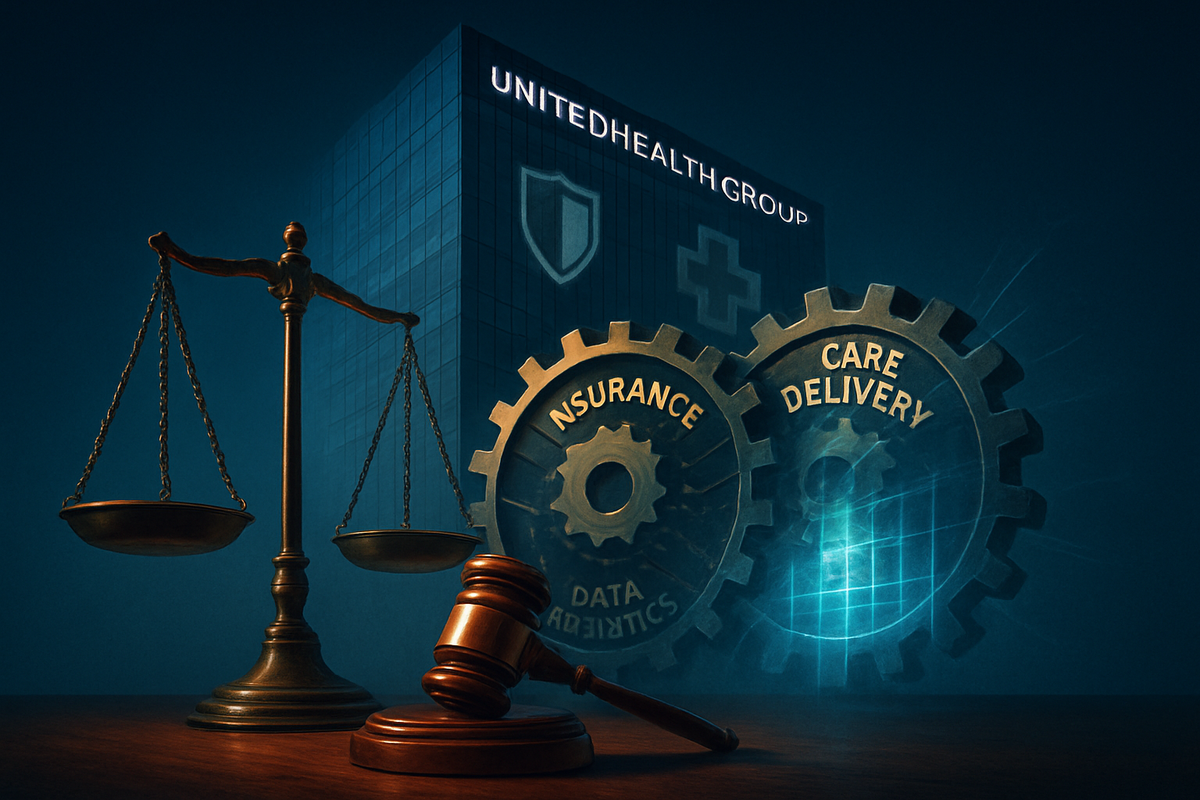
The Department of Justice’s long-standing pursuit of UnitedHealth Group (NYSE: UNH) has reached a fever pitch. As of April 8, 2026, the nation’s largest healthcare conglomerate finds itself entrenched in a high-stakes legal battle that could dismantle the "flywheel" model—the strategic integration of its insurance arm, UnitedHealthcare, and its massive health services division, Optum. This multi-year regulatory offensive, which shifted from investigation to active litigation in late 2025, represents a fundamental challenge to the vertical integration strategy that has defined the healthcare industry for over a decade.
The immediate implications are stark: UnitedHealth’s breakneck pace of domestic acquisitions has ground to a halt, and its valuation faces a persistent "regulatory discount." With the DOJ now seeking structural remedies—including the potential divestiture of primary care practices and data assets—the case threatens to decouple the synergy between the "payer" and "provider" that has long served as UnitedHealth’s primary engine for growth.
A Timeline of Confrontation
The path to this moment began in early 2024 when the DOJ’s Antitrust Division, led by Jonathan Kanter, launched a non-public probe into the internal mechanics of UnitedHealth’s ecosystem. The initial market shock occurred in February 2024, when news of the investigation sent UNH shares tumbling. Federal investigators were primarily concerned with "patient steering"—the practice of UnitedHealthcare funneling its insurance members toward Optum-owned clinics and surgical centers, regardless of cost or patient preference.
By October 2025, the DOJ moved from observation to action, filing an omnibus antitrust lawsuit targeting the core of the company’s vertical structure. This followed a mid-2025 settlement regarding the acquisition of home health provider Amedisys, where the DOJ forced UnitedHealth to divest over 100 locations to VitalCaring Group before allowing the $3.3 billion deal to close. Most recently, in February 2026, a supplemental filing targeted Optum Insight, the company’s data and analytics arm, alleging that UnitedHealth maintains an "informational monopoly" by using claims data from rival insurers to give its own providers an unfair competitive edge.
Measuring the Market Impact: Winners and Losers
The ongoing probe has created a clear divide across the healthcare landscape. UnitedHealth Group (NYSE: UNH) is the primary casualty of this shift, as the company has been forced to implement strict "Chinese Walls" between its data services and insurance underwriting, eroding the very synergies that once attracted investors. Furthermore, the mandatory divestitures in the home health and primary care sectors have signaled to the market that the era of the "unlimited roll-up" is over.
Conversely, Humana Inc. (NYSE: HUM) has emerged as a relative winner. As a more "pure-play" Medicare Advantage provider, Humana has benefited from the DOJ’s focus on leveling the playing field. With UnitedHealth restricted from using its data flywheel to optimize its Medicare bids, Humana’s specialized focus has allowed it to recapture market share in key geographic regions. Independent physician groups have also seen a resurgence; new "anti-steering" regulations sparked by the probe have forced insurers to offer more transparent reimbursement rates, protecting independent practices from being squeezed out by Optum-affiliated competitors.
For peers like CVS Health Corp (NYSE: CVS) and The Cigna Group (NYSE: CI), the outcome is more nuanced. While both are vertically integrated, they are smaller in scale than the UNH-Optum behemoth. They currently operate under a "regulatory shield," as the DOJ’s primary focus remains on the market leader. However, both companies have been forced to preemptively shift their Pharmacy Benefit Manager (PBM) models toward "pass-through" pricing to avoid falling under the same level of federal scrutiny.
The Broader Significance: The Death of the "Black Box"
The DOJ's offensive against UnitedHealth is not an isolated event; it is the centerpiece of a broader movement to eliminate the "black box" of healthcare pricing. This trend was codified by the PBM Transparency Act, which gained momentum in 2024 and 2025, eventually banning "spread pricing" in Medicaid managed care. The federal government’s use of the "foreclosure theory"—previously seen in tech cases like the challenge to the Microsoft-Activision merger—is now being applied to healthcare. The theory posits that when one company controls a critical "bottleneck" service (like Optum Insight’s data), it can effectively foreclose competition by withholding that service or charging exorbitant rates to rivals.
This legal shift marks the end of the "vertical integration honeymoon" that began with the CVS Health Corp (NYSE: CVS) acquisition of Aetna in 2018. Regulators are no longer accepting the promise of "synergies" as a justification for consolidation; instead, they are looking at the actual conduct of these integrated firms and the resulting impact on consumer costs and provider choice.
The Road Ahead: Divestiture or Defensive Pivot?
As the omnibus lawsuit enters the discovery phase in mid-2026, several scenarios are on the table. The most extreme outcome—a total court-ordered breakup of UnitedHealth—remains a low-probability event. More likely is a settlement that mandates the permanent divestiture of Optum Insight or a large-scale carve-out of its primary care business in markets where UnitedHealth’s dominance exceeds 50%.
In response, investors should expect a strategic pivot from UnitedHealth. The company is already shifting its focus away from domestic provider acquisitions and toward international markets and health-tech innovations that do not rely on insurance data synergies. This adaptation will be necessary to maintain growth in an era where the "flywheel" is under constant regulatory surveillance.
Conclusion and Investor Outlook
The DOJ's crusade against UnitedHealth Group represents a watershed moment for the financial markets. The investigation has successfully challenged the notion that "bigger is always better" in healthcare delivery. For investors, the takeaway is clear: the era of high-margin, opaque vertical integration is being replaced by an era of mandated transparency and competitive parity.
Moving forward, the market will be watching the quarterly margins of Optum Health and OptumRx with increased scrutiny. Any significant compression in these margins will be a signal that the DOJ’s "Chinese Walls" are working. In the coming months, the progress of the October 2025 lawsuit and any supplemental filings regarding PBM practices will be the primary drivers of volatility for the managed care sector. The "United model" isn't dead yet, but it is being forced to evolve into a more fragmented, more regulated version of its former self.
This content is intended for informational purposes only and is not financial advice.