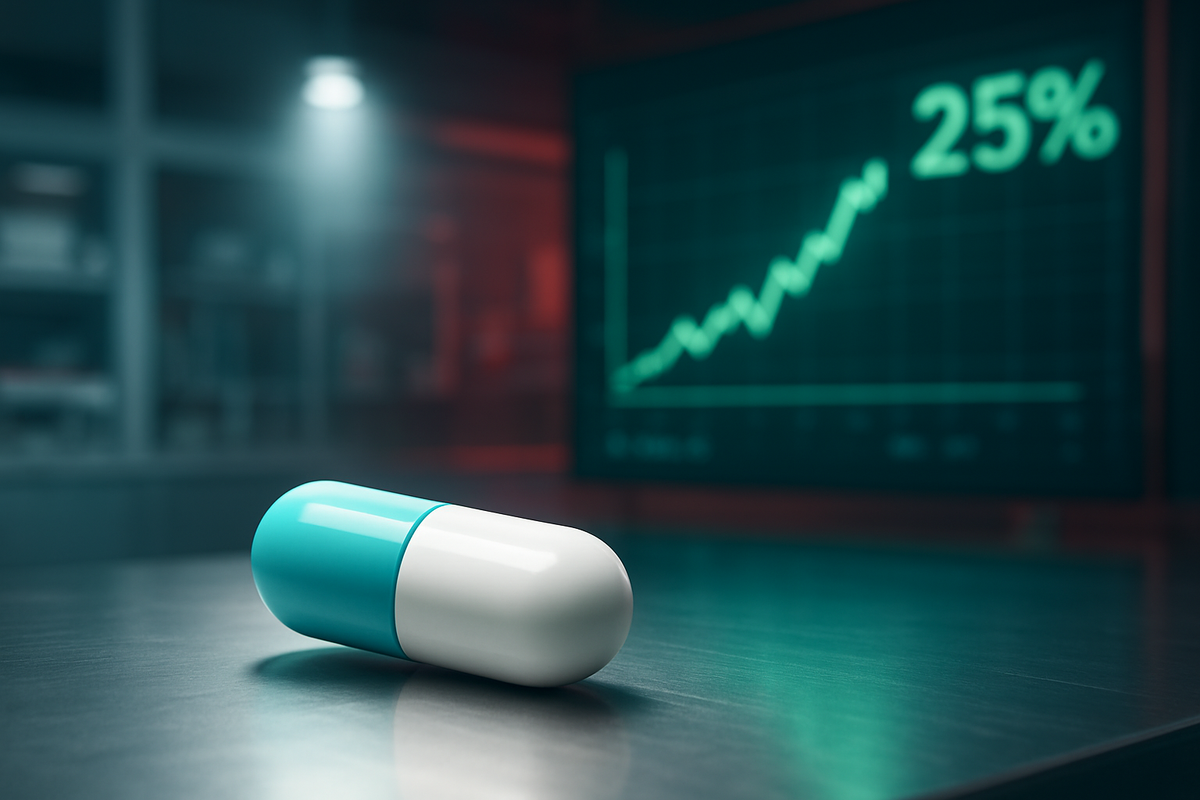
In a watershed moment for the pharmaceutical industry, Eli Lilly and Company (NYSE: LLY) has officially crossed the threshold into a new era of metabolic medicine. Freshly released data from the company’s Phase 3 ATTAIN clinical trial program has revealed that its experimental oral medication, Orforglipron, achieved a staggering 25.2% mean weight loss over 72 weeks. The news has sent shockwaves through the healthcare sector, propelling Lilly’s stock to historic highs and effectively distancing the firm from its Big Pharma peers in the high-stakes race to dominate the obesity market.
As of early April 2026, the implications of this breakthrough are immediate and profound. For years, the gold standard for significant weight loss was restricted to injectable GLP-1 agonists, which often faced hurdles related to "needle phobia" and complex cold-chain logistics. By delivering "injection-grade" results in a simple, once-daily pill that does not require the strict fasting protocols of previous oral treatments, Eli Lilly has not only expanded the potential patient base by millions but has also solved a massive manufacturing bottleneck that has long plagued the industry.
The ATTAIN Results: A New Benchmark in Efficacy
The breakthrough centers on the ATTAIN-1 trial, a global Phase 3 study involving over 3,000 participants with obesity or overweight. The headline figure—25.2% weight loss at the 72-week mark—represents the highest efficacy ever recorded for a non-injectable weight-loss drug. This follows a rigorous timeline that began with promising Phase 2 data in mid-2023, where Orforglipron first signaled its potential by achieving nearly 15% weight loss in just 36 weeks. Since then, under the leadership of CEO David Ricks, Lilly has fast-tracked the ATTAIN program to meet the surging global demand for metabolic therapies.
Key to this success is Orforglipron’s status as a "small molecule" agonist. Unlike its predecessor Tirzepatide (Zepbound) or Novo Nordisk’s (NYSE: NVO) Semaglutide, which are peptides requiring biological fermentation, Orforglipron is synthesized chemically. This allows for a more streamlined manufacturing process and a more stable pill form. Market reaction was instantaneous; upon the data release, LLY shares surged over 8%, crossing the psychological $1,000 per share barrier and pushing the company’s market capitalization toward the elusive $1 trillion mark.
Industry Winners and Losers: The Widening Gap
Eli Lilly (NYSE: LLY) stands as the undisputed victor in this latest clinical skirmish. By proving that a pill can match the potency of a needle, Lilly has secured a "first-mover" advantage in the high-efficacy oral segment. Analysts suggest that Orforglipron could become the highest-grossing pharmaceutical product in history, with some estimates projecting annual peak sales exceeding $30 billion by the end of the decade. The ease of production for small molecules means Lilly can likely scale to meet demand much faster than competitors reliant on complex "bio-factories."
On the other side of the ledger, Novo Nordisk (NYSE: NVO) faces a challenging pivot. While Novo’s oral Amyretin showed impressive results in early 2026 Phase 2 trials, it remains years behind in the regulatory pipeline compared to Orforglipron. Furthermore, Novo’s existing oral offering, Rybelsus, has struggled with efficacy levels (averaging 15–17% weight loss) and burdensome administration requirements. Meanwhile, secondary players like Pfizer (NYSE: PFE) and Amgen (NASDAQ: AMGN) find themselves in a precarious position; as the bar for "standard of care" moves toward 25% weight loss, their earlier-stage oral candidates risk being viewed as obsolete before they even reach the market.
The Global Shift: Beyond the Needle
The wider significance of the ATTAIN results lies in the democratization of obesity treatment. Historically, GLP-1 therapies were constrained by "cold chain" requirements—meaning they had to be refrigerated from the factory to the pharmacy. Orforglipron’s small-molecule stability eliminates this need, opening the door for massive distribution in emerging markets and rural areas where refrigeration is inconsistent. This fits into a broader industry trend of "de-medicalizing" chronic weight management, moving it from specialized clinics into the realm of routine primary care.
Regulatory and policy implications are also shifting. With the proven efficacy of oral pills, insurance payers and national health systems, such as the NHS in the UK or Medicare in the US, may find it more cost-effective to cover a pill than a high-cost injectable. The lower cost of chemical synthesis suggests that Eli Lilly could potentially offer Orforglipron at a price point that undercuts current injectables while maintaining healthy margins, a move that would exert immense pressure on the entire pharmaceutical pricing ecosystem.
The Road Ahead: Scaling to $1 Trillion
The immediate next steps for Eli Lilly include a formal New Drug Application (NDA) submission to the FDA, which many expect will receive a Priority Review designation. In the short term, the company is also looking toward the results of ATTAIN-J and ATTAIN-CN, which are testing the drug’s efficacy in Japanese and Chinese populations, respectively. If these trials mirror the ATTAIN-1 results, Lilly will have a truly global blockbuster on its hands by 2027.
Strategically, the challenge for Lilly will be managing its own success. The company must now navigate the transition of its patient base from the injectable Zepbound to the oral Orforglipron without "cannibalizing" its own profits too aggressively. However, most market observers believe the total addressable market is large enough to support both. The real opportunity lies in the "oral-first" patients—those who have avoided treatment due to a fear of needles or the inconvenience of weekly injections—who are now expected to enter the market in droves.
Conclusion: A New Era for Metabolic Health
The 25% weight-loss milestone achieved by Orforglipron is more than just a clinical win; it is a fundamental shift in how the market views chronic disease management. Eli Lilly has successfully bridged the gap between convenience and potency, setting a new gold standard that competitors will be chasing for years. For investors, the move past $1,000 per share signals a belief that Lilly is no longer just a "Big Pharma" company, but a high-growth "Tech-Bio" powerhouse.
Moving forward, the market will be watching for the FDA’s approval timeline and Lilly’s initial guidance on Orforglipron’s pricing. The "Weight-Loss Wars" have entered a decisive new phase where the needle is being replaced by the pill, and as of April 2026, Eli Lilly is the one holding the most powerful prescription.
This content is intended for informational purposes only and is not financial advice