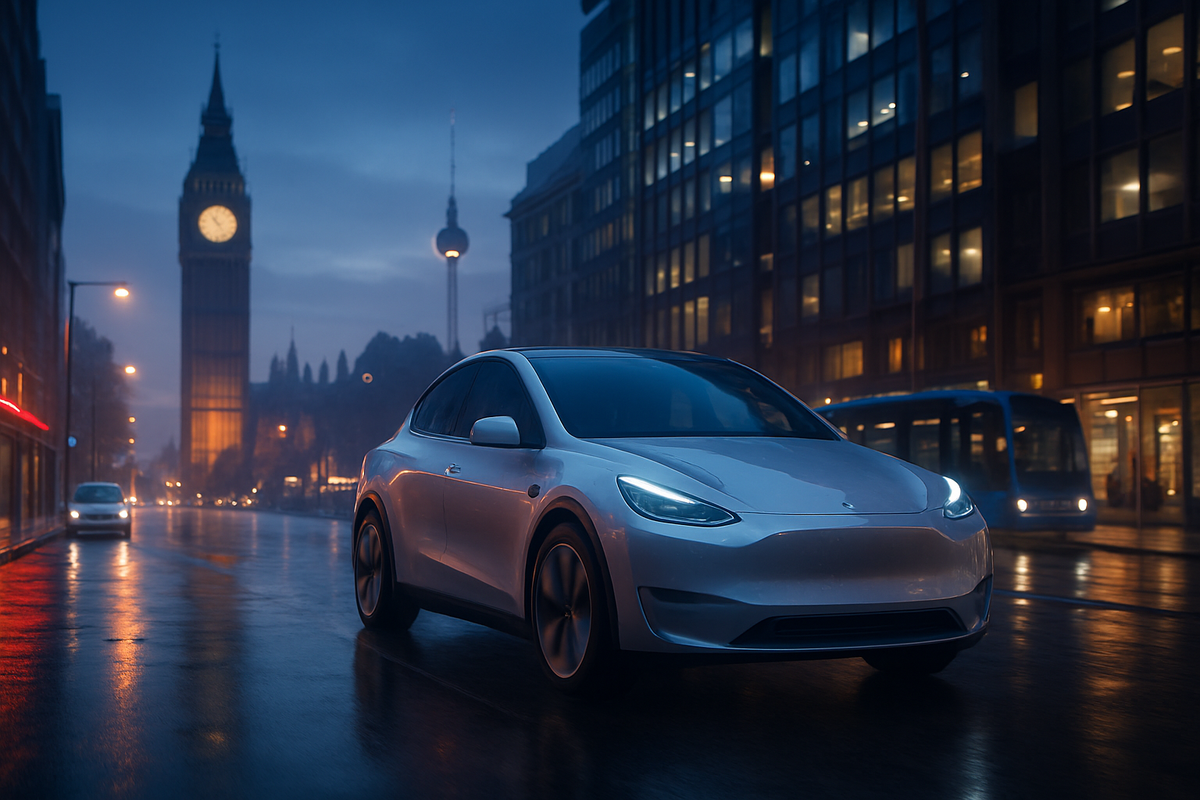
In a landmark shift for the global automotive industry, Tesla (NASDAQ: TSLA) has officially received regulatory approval to launch "Unsupervised" Full Self-Driving (FSD) pilot programs in London and Berlin. This move, announced earlier this month, marks the first time the company's end-to-end neural network-based driving system has been permitted to operate without a safety driver behind the wheel on European soil. As of today, April 8, 2026, a specialized fleet of "Cybercabs" and modified Model 3 and Model Y vehicles has begun traversing the historic streets of Westminster and the complex intersections of Mitte, signaling a new era for urban mobility.
The immediate implications are profound: Tesla is no longer just a manufacturer of electric vehicles but is operating as a full-scale robotics and AI firm in the heart of Europe’s strictest regulatory environments. This expansion into "Unsupervised" pilots suggests that the v14 software architecture has successfully navigated the high-density pedestrian traffic and idiosyncratic road layouts of major European capitals—milestones that many analysts thought were years away.
The Road to Autonomy: Regulatory Green Lights and Technical Triumphs
The path to the April 2026 rollout was paved by a series of legislative breakthroughs. In the United Kingdom, the expansion was enabled by the Automated Vehicles (AV) Act 2024, which established a "safety-first" framework and clarified that the "Authorized Self-Driving Entity"—in this case, Tesla—is legally liable for the vehicle’s actions during autonomous operation. Tesla’s engineering team worked closely with the Centre for Connected and Autonomous Vehicles (CCAV) and Transport for London (TfL) to integrate real-time traffic signal data and satisfy the rigorous "Statement of Safety Intent."
In Berlin, Tesla leveraged Germany’s AFGBV (Autonomous Driving Directive), which was expanded in late 2025 to allow for Level 4 operations in specified "operating areas." The Federal Motor Transport Authority (KBA) granted Tesla "type approval" after months of shadow-mode testing, during which Tesla vehicles recorded millions of miles across the Autobahn and Berlin’s urban centers. Key players in this negotiation included Tesla’s AI lead and German transport regulators, who balanced the nation's traditional automotive interests with the need for digital innovation. The market's initial reaction has been electric, with Tesla shares surging as investors price in the high-margin potential of a localized "Tesla Network" robotaxi service.
The Competitive Landscape: Disruption in the Fast Lane
The arrival of Unsupervised FSD v14 creates a clear divide between the "winners" of the AI race and those struggling to pivot. Tesla (NASDAQ: TSLA) stands as the primary beneficiary, utilizing its massive data advantage and "vision-only" approach to scale rapidly without the need for expensive high-definition (HD) maps. By flipping the switch in London and Berlin, Tesla has effectively leapfrogged traditional competitors who are still testing localized, sensor-heavy solutions.
Alphabet Inc.’s Waymo (NASDAQ: GOOGL) remains a formidable peer, though its strategy differs. Waymo has maintained a lead in "pure technical safety" and has successfully launched its own luxury Robotaxi service in London through a partnership with Uber (NYSE: UBER). However, Waymo’s reliance on lidar and HD maps makes its expansion more capital-intensive than Tesla’s software-led rollout. Meanwhile, Mobileye (NASDAQ: MBLY) continues to find success as a Tier 1 supplier, providing its "SuperVision" and "Chauffeur" platforms to European giants like Porsche and Volkswagen (OTC: VWAGY), positioning itself as the "safe" alternative for legacy OEMs.
Conversely, the "losers" in this new paradigm appear to be the traditional European manufacturers who have struggled with software sovereignty. Mercedes-Benz (OTC: MBGYY), despite being the first to offer Level 3 autonomy on motorways, now finds its "Drive Pilot" system looking dated compared to Tesla's "anywhere-to-anywhere" urban capabilities. Similarly, Volkswagen’s internal software unit, Cariad, has faced repeated delays, forcing the group to rely more heavily on external partners and potentially ceding the high-margin "software-as-a-service" revenue to Silicon Valley.
A Global Shift in Transport Policy and Technology
This event is more than a corporate milestone; it represents a broader industry trend toward "end-to-end" AI. Unlike previous iterations of autonomous software that relied on hand-coded rules (e.g., "if red light, then stop"), Tesla’s FSD v14 is trained on video data from millions of vehicles, allowing it to "learn" nuanced behaviors like navigating London’s narrow "mews" or Berlin’s tram-integrated streets. This shift has forced regulators worldwide to reconsider how they certify AI, moving away from static checklists toward dynamic, performance-based safety assessments.
The ripple effects are already being felt in the ride-hailing and insurance sectors. If Tesla’s pilots prove that robotaxis can operate at a 30-50% lower cost per mile than human-driven vehicles, the business models of local taxi firms and private hire drivers will face existential pressure. Furthermore, the precedent set by the UK’s AV Act 2024 is now being mirrored in discussions across the European Union, as nations like France and Italy look to harmonize their laws with the UNECE’s "Phase 2" DCAS regulations to avoid being left behind in the autonomous revolution.
The Next Horizon: From Pilots to the "Tesla Network"
Looking ahead, the short-term focus for Tesla will be the transition from these controlled pilots to a full commercial launch of the "Tesla Network" by 2027. This will require the company to manage a dual challenge: maintaining a flawless safety record under intense public scrutiny while scaling its server infrastructure to handle the massive data processing required for European-wide operations. Strategic pivots may include specialized vehicle designs—like the purpose-built Cybercab—which lack traditional controls entirely.
However, challenges remain. Consumer rights groups in the EU are already lobbying for "Black Box" data-sharing requirements, which would force Tesla to reveal its proprietary neural network logs in the event of an accident. How Tesla navigates these privacy and intellectual property hurdles will determine how quickly it can expand into more conservative markets like Paris or Madrid. The ultimate prize is a dominant share of the multi-trillion-dollar global transportation-as-a-service (TaaS) market.
Final Assessment: The Dawn of the AI Transport Era
The authorization of Unsupervised FSD in London and Berlin is a definitive "I told you so" moment for Tesla and its supporters. It validates the company's long-term bet on vision-based AI and sets a high bar for the rest of the automotive world. For investors, the takeaway is clear: Tesla is successfully transitioning its revenue mix from hardware sales to high-margin AI software and services.
Moving forward, the market will be watching two key metrics: the "take-rate" of FSD subscriptions in Europe and the frequency of disengagements or incidents within the pilot zones. While the technical hurdles are being cleared, the social and political hurdles of total autonomy are just beginning. As of April 2026, the race isn't just about who can build the best car, but who can build the most competent "digital driver."
This content is intended for informational purposes only and is not financial advice.