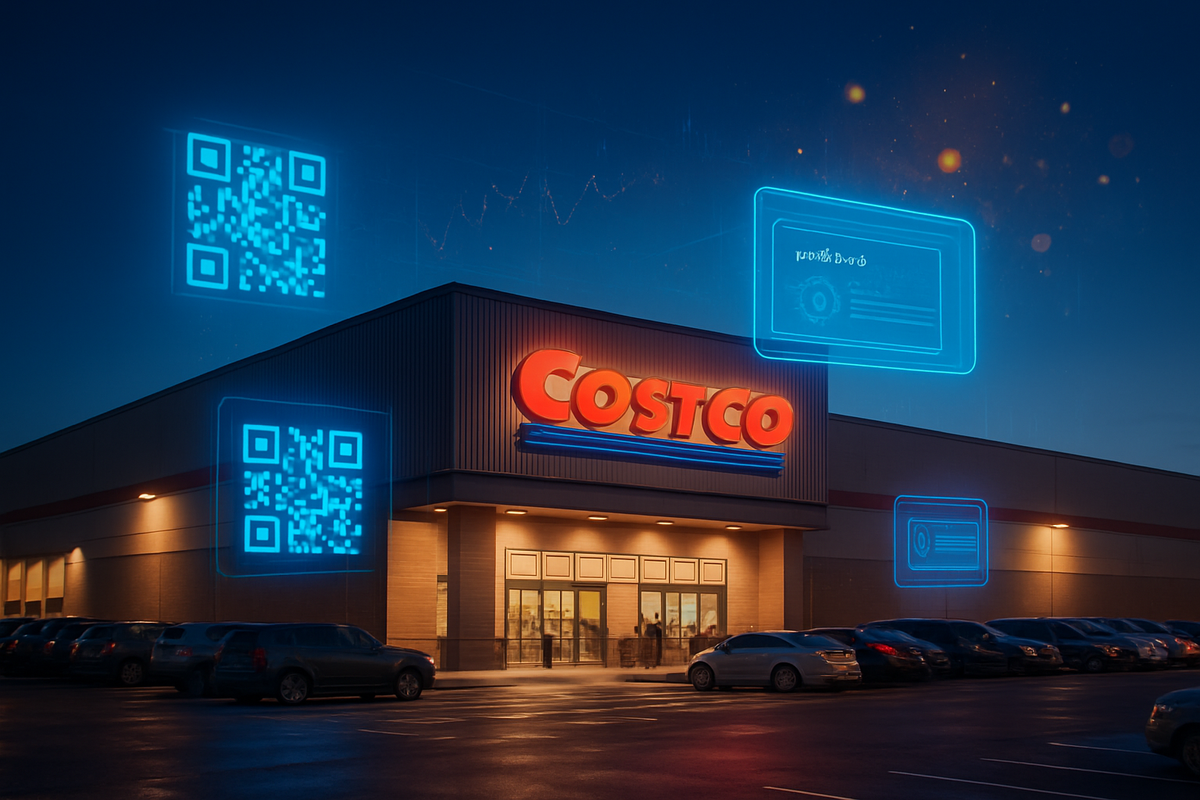
The road to the $12 special dividend began in late 2024 and 2025, when Costco initiated what analysts are calling the "Netflix-style crackdown" of the retail world. For decades, Costco’s manual card-checking at the entrance was porous, allowing non-members to often slide through using borrowed cards. Starting in early 2024, the company began a global rollout of digital membership scanners at warehouse entrances. By early 2026, these scanners became mandatory across nearly all 870+ locations.
This technological shift required every shopper to scan a physical or digital QR code linked to a verified account before setting foot on the warehouse floor. The result was an unprecedented surge in new membership sign-ups, as "shared" users were forced to purchase their own accounts to maintain access to the "treasure hunt" shopping experience. Furthermore, the adoption of the Costco App skyrocketed, with over 70% of active members now utilizing the Digital Membership Card. This shift allowed Costco to more effectively track shopping behaviors and target high-margin Executive Membership upgrades through the app’s real-time "Reward Tracker" feature.
The timing of the dividend was precise. Costco officially announced the $12.00 payout on December 17, 2025, during its Q1 FY2026 earnings cycle. The record date followed on December 31, 2025, with checks hitting accounts on January 16, 2026. This move followed the successful cycling of the September 2024 fee increase—which raised Gold Star memberships to $65 and Executive memberships to $130—providing a massive infusion of high-margin recurring revenue that bolstered the company’s cash reserves to over $14.5 billion prior to the payout.
Strategic Divergence: Winners, Losers, and the Friction War
While Costco shareholders and the corporate treasury are the clear winners of this event, the competitive landscape has been forced to react to Costco’s "exclusivity-first" strategy. Walmart Inc. (NYSE: WMT) has taken a different path with its Sam's Club division. Rather than tightening the entrance, Sam’s Club has focused on "frictionless exits," utilizing AI-powered computer vision technology to eliminate receipt checks entirely. By early 2026, Sam’s Club has positioned itself as the "speed" alternative to Costco’s "security" model, appealing to time-strapped shoppers while using biometric data in its Scan & Go app to quietly curb card sharing.
BJ’s Wholesale Club Holdings, Inc. (NYSE: BJ) has attempted to capitalize on the fallout from Costco’s entrance scanners. In early 2026, BJ’s launched a "Membership Match" program, specifically targeting former Costco card-sharers who were displaced by the new scanners. While BJ's has seen a bump in membership growth, it continues to trade at a significant valuation discount compared to Costco, as investors favor Costco's higher membership renewal rates and superior capital return history.
The "membership economy" at large is also feeling the ripple effects. Amazon.com, Inc. (NasdaqGS: AMZN) responded to the warehouse club resurgence by introducing "Prime Premier," a tiered membership level that integrates deeper local grocery savings, directly competing with the bulk-buy value proposition. Meanwhile, delivery-adjacent firms like Uber Technologies, Inc. (NYSE: UBER) and Instacart (NasdaqGS: CART) have deepened their integration with Costco’s digital ecosystem, as the warehouse giant now routes "last-hour" grocery orders directly through its proprietary app, retaining more of the customer data and transaction fee revenue.
The "Netflix Effect" in Retail: A Shift in Industry Standards
Costco’s $12 dividend is more than just a cash return; it is a validation of a broader shift toward "membership integrity." Much like the streaming industry’s move to end password sharing, Costco has proven that a high-value brand can afford to introduce minor friction—such as mandatory entrance scans—if the underlying value proposition is strong enough. This event marks the end of the "growth-at-all-costs" era of memberships and the beginning of a focus on account monetization and exclusivity.
Historically, Costco has issued special dividends roughly every two to three years (notably $7 in 2012, $5 in 2015, $7 in 2017, $10 in 2020, and $15 in 2023). However, the 2026 payout is distinct because it was funded not just by generic growth, but by a specific technological transition. This sets a precedent for other subscription-based retailers to leverage hardware and digital verification to protect their moats. Regulatory bodies have watched this transition closely, but since the "crackdown" involves enforcing existing contractual terms of membership, there has been little policy pushback, effectively green-lighting this model for other retailers.
The Road Ahead: 2026 and Beyond
Looking forward to the remainder of 2026, Costco shows no signs of slowing down its capital expenditure despite the $5.3 billion payout. The company has earmarked nearly $5 billion for the 2026 fiscal year to fund the opening of 30+ new warehouses globally, with a heavy focus on the Asia-Pacific region, specifically Tier 1.5 cities in China like Chengdu and Chongqing.
Technologically, the focus is shifting toward "The Costco Logistics Advantage." By mid-2026, Costco aims to handle 90% of its "big and bulky" deliveries—appliances and furniture—through its in-house logistics arm, reducing reliance on third-party carriers. Investors should also watch for the full deployment of the "Real-Time Inventory Project," a new app feature that will finally allow members to see exact warehouse stock levels at their local building, a long-requested feature that was technically impossible before the recent digital infrastructure upgrades.
Market Wrap-Up and Investor Outlook
The $12 special dividend of 2026 will likely be remembered as the moment Costco successfully bridged the gap between a traditional brick-and-mortar warehouse and a modern digital powerhouse. By leveraging technology to secure its membership moat and capitalizing on the resulting surge in verified users, Costco has demonstrated a rare ability to return massive amounts of capital to shareholders while simultaneously funding an aggressive global expansion.
For investors, the key metrics to watch in the coming months will be the membership renewal rate—which historically hovers around 90%—and the growth of the Executive Member tier. If Costco can maintain these levels while continuing to integrate its in-house logistics and real-time inventory tech, the "Costco Premium" on its stock price is likely to persist. While the special dividend provided a significant one-time yield, the true value lies in the company’s proven ability to turn operational discipline into shareholder wealth.
This content is intended for informational purposes only and is not financial advice.