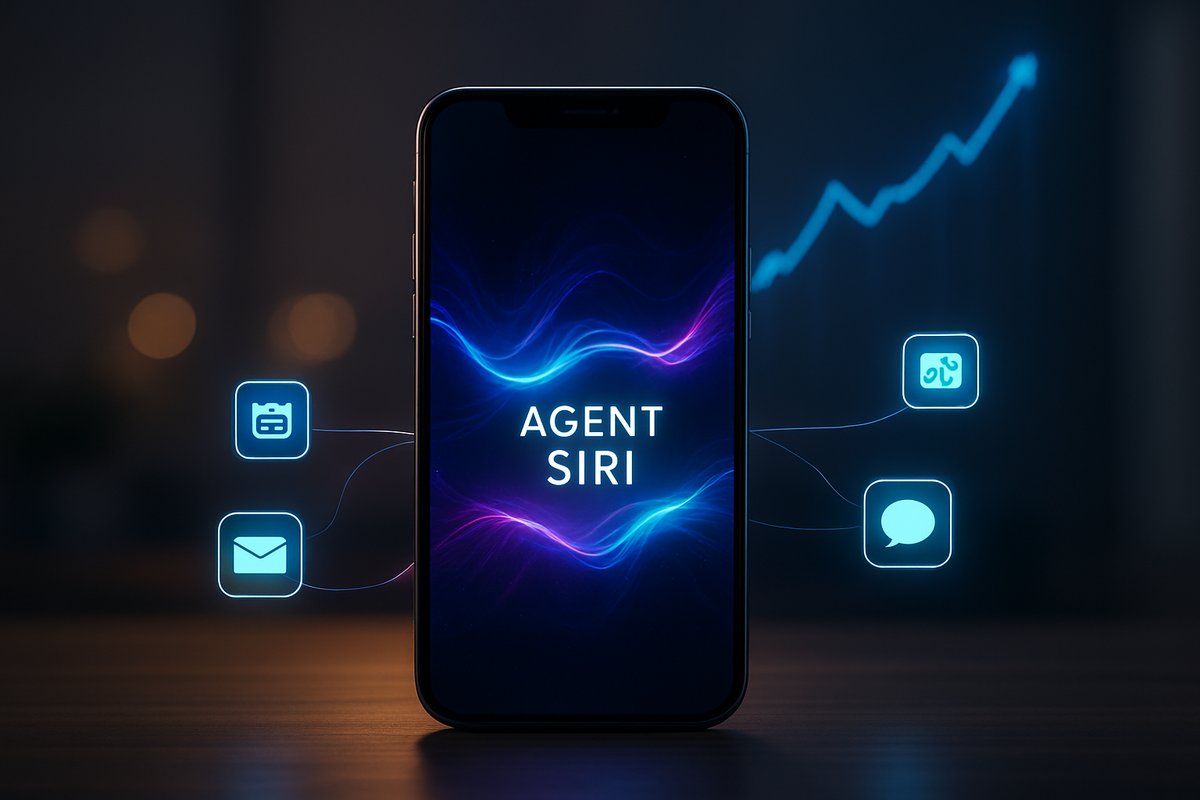
The intersection of generative artificial intelligence and mobile operating systems has reached a fever pitch, with Apple Inc. (NASDAQ: AAPL) shares hitting an all-time high of $245.00 this week. The catalyst for this rally is a flurry of reports surrounding "iOS 20," the upcoming software update rumored to introduce "Agent Siri"—a revolutionary iteration of Apple’s virtual assistant powered by a proprietary Large Action Model (LAM). Unlike previous versions that focused on information retrieval, Agent Siri is expected to possess full cross-app task completion capabilities, effectively turning the iPhone into an autonomous personal agent.
The market’s enthusiastic response reflects a growing consensus among institutional investors that Apple has successfully navigated the "AI transition" that began in 2024. By moving beyond simple text-based responses to a "reasoning and planning" engine, Apple is positioning itself to capture a significant share of the burgeoning AI services market. Analysts suggest that the requirement for high-end silicon to run these agentic features will spark a massive hardware upgrade cycle, as users with older devices seek to unlock the next generation of on-device intelligence.
The Dawn of the Large Action Model: What to Expect from iOS 20
The rumors surrounding iOS 20 suggest a fundamental architectural shift in how Siri interacts with the iPhone's ecosystem. While the initial launch of Apple Intelligence focused on summarization and image generation, Agent Siri is designed for "agency"—the ability to execute complex, multi-step workflows across diverse applications. According to industry insiders, the new system utilizes a Large Action Model that can navigate app interfaces as a human would, but with the speed and precision of a machine. This development marks the culmination of a multi-year strategy that began with the introduction of "App Intents" in earlier versions of iOS, now upgraded to version 3.0 to allow deeper, more secure integration.
A typical use case for Agent Siri might involve a single prompt such as, "Siri, plan a dinner for four tonight based on the invite I got in Slack, book a table, and notify everyone." In this scenario, the agent would autonomously parse the Slack message for context, check the user's calendar for availability, search for a restaurant via a third-party app like OpenTable, confirm the booking, and send a group text or calendar invite to the participants. This "autonomous chaining" capability is expected to be the centerpiece of Apple’s WWDC 2026 presentation, moving the smartphone from a tool that runs apps to an assistant that uses them on the user's behalf.
The timeline leading to this milestone has been deliberate. Following the 2024 release of Apple Intelligence, the company spent 2025 refining its Private Cloud Compute infrastructure to ensure that complex AI tasks could be handled with the same privacy standards as on-device processing. Key figures such as Craig Federighi, Senior VP of Software Engineering, have reportedly been obsessed with ensuring that "Agent Siri" does not compromise user data—a point that has become a major selling point in an era of increasing AI skepticism. The market reaction has been swift, with Apple’s market capitalization swelling as investors price in both hardware sales and a rumored "Apple Intelligence+" subscription tier.
Winners and Losers in the Agentic Economy
As Apple sets a new benchmark for mobile AI, the ripple effects are being felt across the semiconductor and software industries. The most immediate winner, aside from Apple itself, is Taiwan Semiconductor Manufacturing Co. (NYSE: TSM), the sole manufacturer of the A19 Pro and M5 chips required for Agent Siri’s local execution. The shift toward 2nm process technology is critical for maintaining battery life while running high-parameter models on-device, making TSMC an indispensable partner. Similarly, Arm Holdings (NASDAQ: ARM) stands to benefit as its v9 architecture provides the instruction set for these high-performance AI cores, ensuring a steady stream of royalty revenue regardless of which consumer device dominates the market.
Conversely, the rise of "Agent Siri" poses a significant threat to mid-tier Android manufacturers and standalone AI hardware startups. Companies that lack the vertical integration of Apple or Alphabet Inc. (NASDAQ: GOOGL) may find it difficult to compete with a system that has deep-level access to the operating system. Startups like Humane and Rabbit, which attempted to launch standalone AI pins and handhelds, have seen their value propositions challenged as the smartphone absorbs their core features. Furthermore, Intel Corporation (NASDAQ: INTC) continues to face headwinds as it struggles to displace ARM-based architectures in the mobile and low-power AI chip segments.
Google remains a complex player in this landscape. While Apple is encroaching on the "intent" data that traditionally powered Google Search, Alphabet is countered by integrating Gemini Nano directly into the Android kernel. The competition is no longer about who has the best search engine, but who has the most capable OS-level agent. For app developers, the "Agent Siri" era is a double-edged sword: those who integrate early with App Intents 3.0 may see increased usage, while those who rely on "walled garden" strategies may find themselves "Sherlocked" or bypassed by the agent's autonomous capabilities.
A Paradigm Shift: Privacy, Regulation, and the End of App Silos
The transition to agentic AI represents a shift in the broader industry trend from "software as a service" to "intelligence as a service." Historically, the mobile experience was defined by app silos—isolated environments where data lived independently. Agent Siri effectively breaks these silos, using the operating system as the connective tissue. This shift mirrors the evolution of the web from static pages to interactive platforms, but with a focus on local execution and privacy. Apple’s "Privacy-First" moat is particularly significant here, as it allows the agent to access sensitive data (like emails and messages) that users might be hesitant to share with a cloud-only AI.
However, this new era is not without its regulatory challenges. In the European Union, the Digital Markets Act (DMA) is already looming over Apple’s AI ambitions. Regulators are likely to scrutinize whether Apple is giving Siri "unfair" system-level access that it denies to third-party agents like OpenAI’s ChatGPT or Microsoft (NASDAQ: MSFT) Copilot. There is a real risk of "regulatory balkanization," where AI features are delayed or disabled in certain regions to comply with local antitrust laws. In the United States, the Federal Trade Commission (FTC) has expressed interest in the "bundling" of AI agents with dominant operating systems, questioning if it stifles competition from independent AI developers.
Historically, Apple has used these moments of technological transition to consolidate its ecosystem lock-in. Much like the transition from the iPod to the iPhone, the move from a "touch-first" interface to an "agent-first" interface is designed to make the hardware indispensable. By making Siri the primary interface for all digital tasks, Apple is betting that users will prioritize the convenience of a unified agent over the diversity of individual apps.
The Road Ahead: Hardware Cycles and AI Monetization
In the short term, the primary driver for Apple will be the hardware "super-cycle." The advanced reasoning capabilities of Agent Siri will almost certainly be restricted to the latest Pro-model iPhones and M-series Macs, creating a compelling reason for the hundreds of millions of users on 2- or 3-year-old devices to upgrade. This hardware-led growth is a familiar play for Apple, but the stakes are higher as the market seeks proof that AI can drive sustainable revenue beyond the initial hype cycle.
Long-term, the focus will shift to monetization through services. The rumored "Apple Intelligence+" tier suggests that while basic agentic features may be free, "high-order reasoning" or unlimited cross-app tasks could be locked behind a subscription. This would create a high-margin recurring revenue stream that could eventually rival the App Store's commission model. Investors should also watch for strategic pivots in the advertising space; if Siri becomes the primary way users find products and services, Apple may finally launch its own "Privacy-Safe" intent-based advertising network to challenge Google’s dominance.
The biggest challenge facing Apple in the coming months will be the "execution gap." Delivering a truly autonomous agent that doesn't make mistakes in critical tasks—like booking a non-refundable flight or deleting an important email—is a monumental technical hurdle. Any high-profile "AI hallucinations" or failures in task execution could quickly dampen the current market euphoria and lead to a correction in the stock price.
Conclusion: A Milestone in the AI Revolution
Apple’s climb to a $245 share price is more than just a financial milestone; it is a vote of confidence in the company's vision for the future of personal computing. By transforming Siri from a voice-activated assistant into a proactive agent, Apple is attempting to redefine the relationship between humans and their devices. The potential for iOS 20 to break down app silos and automate daily workflows represents the most significant change to the mobile experience since the introduction of the App Store in 2008.
Moving forward, investors should keep a close eye on the official iOS 20 reveal at WWDC and the subsequent developer feedback regarding the App Intent framework. The ability of developers to easily integrate their apps into "Agent Siri" will determine the ultimate utility of the system. Furthermore, watch for regulatory developments in the EU and US, as these will dictate how "open" or "closed" this new agentic ecosystem will be.
While the "Agent Siri" era promises unprecedented convenience, it also brings new questions about digital autonomy and the power of platform gatekeepers. For now, however, Apple sits at the pinnacle of the market, fueled by the promise of an AI that doesn't just talk, but acts.
This content is intended for informational purposes only and is not financial advice.