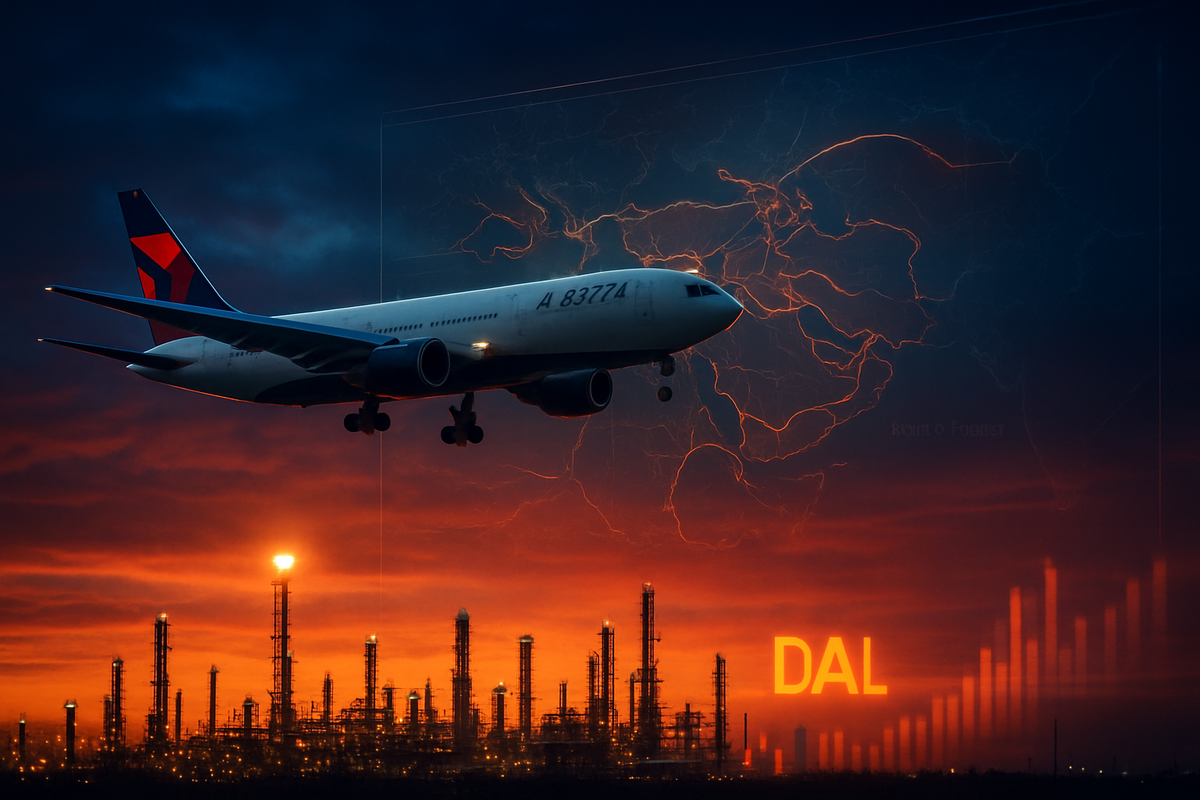
As the global aviation industry grapples with the most severe energy shock in nearly two decades, Delta Air Lines (NYSE: DAL) is emerging as a critical bellwether for how legacy carriers must adapt to survive. With the "Iran War" entering a fragile ceasefire as of April 10, 2026, the Atlanta-based carrier has signaled a definitive pivot from aggressive expansion toward a strategy of "tactical rationalization." Despite the volatility, Delta’s ability to maintain pricing power through record-high travel demand suggests that the premium travel market remains resilient, even as the cost of jet fuel threatens to ground the industry’s recovery.
The immediate implications are clear: the era of post-pandemic growth has hit a geopolitical wall. On April 8, 2026, Delta reported a first-quarter net loss of $289 million, largely due to external investment volatility. However, its adjusted earnings of $0.64 per share exceeded market expectations, proving that its core operations can withstand significant pressure. The airline is now leading the charge in industry-wide capacity cuts, aiming to protect margins against a projected doubling of fuel costs in the coming quarter.
The Strait of Hormuz Crisis and the Fuel Surge
The current crisis traces its roots back to late February 2026, when escalating military strikes between U.S.-Israeli forces and Iranian military targets led to an effective blockade of the Strait of Hormuz. By mid-March, nearly 20% of the world’s oil supply was effectively trapped, causing jet fuel prices to skyrocket. Prices peaked at an eye-watering $209 per barrel, forcing airlines to navigate a market where fuel availability became as significant a concern as fuel cost.
The operational impact has been staggering. Major international routes have been forced into the "Caucasus Corridor," with flights between Europe and Asia adding four to six hours of airtime to avoid closed airspace over Iran and Iraq. This detour has not only increased fuel burn but has also strained crew schedules and aircraft maintenance cycles. For Delta, the timing was particularly challenging, occurring just as the carrier was preparing for its most ambitious summer schedule in company history.
In response, CEO Ed Bastian announced that Delta would "meaningfully" pull back its capacity growth by 3.5% for the second quarter. This move reflects a broader industry realization that the costs of operating at full scale are becoming prohibitive. The market’s reaction was initially one of caution, but a 13% pre-market rally on April 8—following news of a two-week ceasefire—indicates that investors are rewarding Delta’s disciplined approach to the crisis.
Winners, Losers, and the Refinery Hedge
While the entire sector is under pressure, the impact is far from uniform. Delta Air Lines (NYSE: DAL) stands in a unique position due to its ownership of the Trainer refinery in Pennsylvania. In an environment where "crack spreads"—the profit margin on refining crude into jet fuel—have tripled, this internal asset has become a financial fortress. Analysts estimate the refinery will provide a $300 million benefit to Delta in Q2 alone, effectively subsidizing its own fuel costs while competitors must pay full market rates.
In contrast, United Airlines (NASDAQ: UAL) and American Airlines (NASDAQ: AAL) are facing steeper uphill battles. United has already cut 5% of its planned flying, suspending high-exposure routes to Tel Aviv and Dubai. American Airlines has leaned heavily on pricing surcharges and bag fee increases to stay afloat, raising the cost of a first checked bag to $50. Meanwhile, low-cost carriers like Spirit Airlines (NYSE: SAVE) and JetBlue Airways (NASDAQ: JBLU) are facing "existential pressure." With narrower margins and a customer base more sensitive to price hikes, these budget airlines have little room to pass on the surging costs of fuel, leading to significant route cancellations and a potential consolidation wave.
The energy sector, conversely, has seen a windfall. Companies like ExxonMobil (NYSE: XOM) and Chevron (NYSE: CVX) are benefiting from the supply crunch, though the geopolitical instability makes long-term planning difficult even for them. The clear winners in this scenario are the carriers with "premium-first" models and diversified revenue streams, such as Delta’s robust partnership with American Express (NYSE: AXP).
A New Era of Capacity Discipline
This event marks a significant turning point in the post-COVID airline industry. The transition from growth-at-all-costs to a "downward bias" in capacity is reminiscent of the disciplined period following the 2008 financial crisis. By restricting the number of seats available, airlines are successfully maintaining pricing power. Delta’s premium cabin revenue rose 13% in Q1 2026, suggesting that high-net-worth travelers are willing to absorb the higher costs associated with geopolitical risk.
The crisis is also accelerating a shift in global flight patterns. The reliance on the "Caucasus corridor" and the avoidance of Middle Eastern hubs like Dubai for transit are reshaping how global alliances operate. We are seeing a "re-hubbing" of international travel, with secondary European and Central Asian airports gaining prominence. This shift has long-term implications for aircraft manufacturers like Boeing (NYSE: BA) and Airbus (OTC: EADSY), as airlines prioritize ultra-long-range, fuel-efficient twin-engine jets over older, thirstier widebodies.
Regulatory bodies are also watching closely. The U.S. Department of Transportation has signaled it will monitor the recent spike in ancillary fees—such as Delta’s $10 increase in bag fees—to ensure that airlines are not using the Iran conflict as a pretext for price gouging. However, the industry’s argument that these fees are necessary to offset a $2 billion fuel headwind appears to be holding weight for now.
The Road to Islamabad: What Comes Next
The future of the U.S. airline sector currently hinges on diplomatic efforts in Pakistan. As of today, April 10, 2026, high-stakes negotiations are underway in Islamabad between U.S. and Iranian officials. If the two-week ceasefire can be converted into a permanent reopening of the Strait of Hormuz, fuel prices could stabilize rapidly, allowing Delta and its peers to reinstate some of their shelved growth plans by the third quarter.
In the short term, investors should prepare for a "choppy" Q2. Even if a peace deal is reached today, it will take three to six months to replenish global jet fuel inventories and normalize shipping lanes. Delta’s management has already warned that Q2 fuel costs could reach $4.30 per gallon, nearly double the price from a year ago. Strategic pivots will continue, with a focus on "high-yield" routes and a continued pull-back from underperforming regional markets.
The long-term outlook remains tied to the resilience of the consumer. If the U.S. economy remains strong and travel demand holds steady despite the "conflict surcharges," Delta is well-positioned to emerge from this crisis with a larger market share in the premium segment. However, any sign of a consumer slowdown combined with sustained high energy costs would be a "black swan" scenario for the industry.
Summary: Key Takeaways for the Market
The current situation highlights Delta Air Lines' (NYSE: DAL) status as the financial gold standard of the industry. By leveraging its refinery hedge and focusing on premium loyalty revenue, the company is navigating a geopolitical minefield that would have crippled it a decade ago. The key takeaway for the market is the return of extreme capacity discipline; by flying less, airlines are making more per seat, effectively "taxing" the traveler to pay for the Iran conflict.
Moving forward, the airline sector is in a state of "forced evolution." Investors should watch for the outcome of the Islamabad peace talks and the subsequent movement in jet fuel crack spreads. A failure in diplomacy would likely lead to further capacity cuts and could trigger a localized recession within the travel and tourism sectors.
For the coming months, the critical metrics to monitor will be fuel price per gallon (PPG) and passenger yield. As Delta leads the industry through this volatile Q2, its ability to keep planes full at record-high prices will determine if the airline can turn a geopolitical crisis into a story of operational resilience.
This content is intended for informational purposes only and is not financial advice