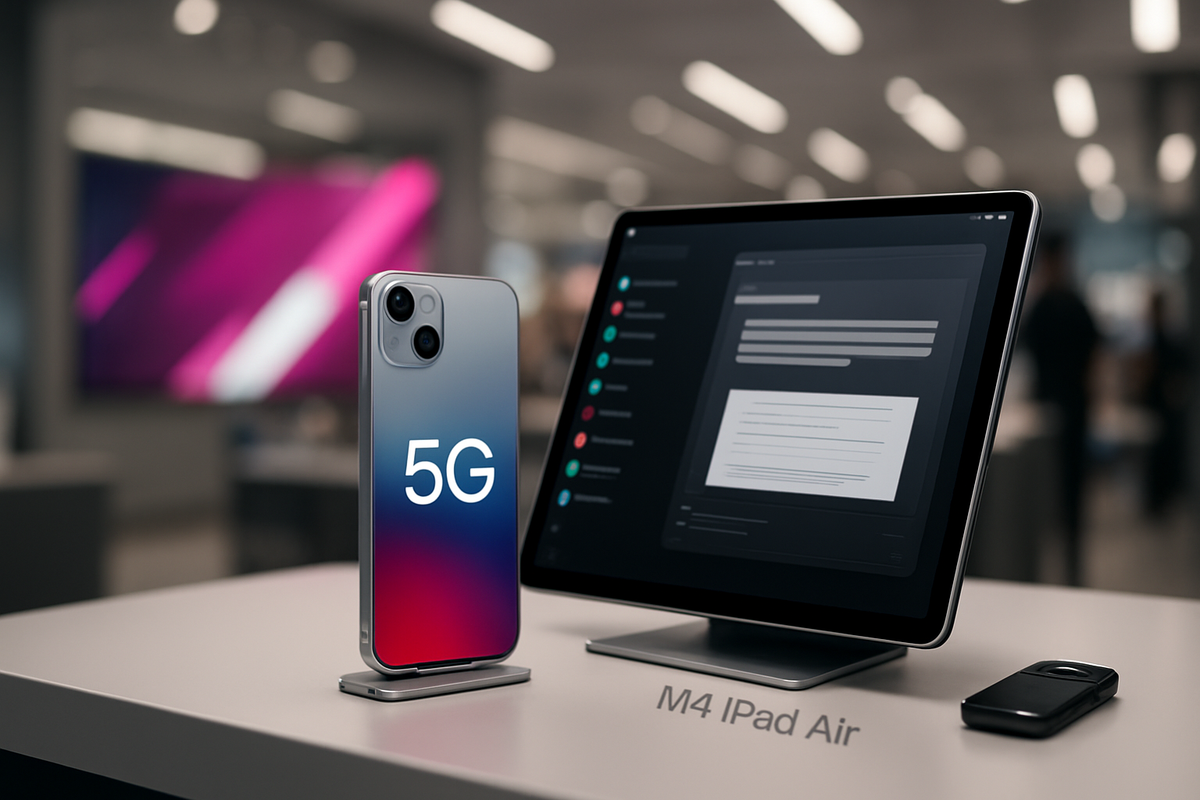
BELLEVUE, WA — In a strategic move to capitalize on Apple Inc.’s (NASDAQ: AAPL) mid-cycle hardware refresh, T-Mobile US, Inc. (NASDAQ: TMUS) has announced a sweeping set of promotional offers for the newly released iPhone 17e and M4 iPad Air. The "Spring Surge" campaign, launched today, March 6, 2026, marks a pivotal moment for the "Un-carrier" as it leans heavily into its new "Experience Beyond" premium tier to drive revenue growth. By bundling the budget-friendly yet powerful iPhone 17e with discounted tablet lines, T-Mobile is signaling a shift in its growth strategy: focusing less on raw subscriber counts and more on deepening "device-attach" rates and Average Revenue Per User (ARPU).
The immediate implications for the market are clear: T-Mobile is aggressively defending its lead in the 5G era by making the barrier to entry for the Apple ecosystem lower than ever, provided customers opt for its most expensive service plans. With the iPhone 17e positioned as a premium "budget" alternative to the flagship iPhone 17 series, the carrier is targeting value-conscious consumers who still demand high performance. Early market reactions suggest that while the hardware is the hook, the real story lies in T-Mobile's ability to transition its massive user base to higher-margin service tiers that, for the first time in years, no longer include taxes and fees in the base price.
The "Experience" Era: T-Mobile’s New Playbook
The centerpiece of the March 2026 promotion is the iPhone 17e, a device Apple released just weeks ago to bridge the gap between its entry-level SE and the standard iPhone 17. Featuring a slightly downclocked A19 chip and a doubled base storage of 256GB, the 17e is designed for longevity. T-Mobile is offering the device "on us"—up to an $830 credit—but with a significant catch: customers must be on the "Experience Beyond" plan. This tier, which succeeded the Go5G Next plan late last year, is now the primary vehicle for T-Mobile's best hardware subsidies.
Parallel to the phone offers, T-Mobile is pushing the M4 iPad Air with an unprecedented ecosystem incentive. Customers on the "Experience Beyond" plan can now add a high-speed tablet or watch line for a mere $5 per month—a 50% discount from previous years. This aggressive pricing on data lines is a deliberate attempt to boost "device-attach" rates, or the number of non-phone devices connected to a single account. Industry insiders note that this timeline follows a series of network upgrades in late 2025 that increased T-Mobile’s capacity, allowing it to support millions of new tablet connections without degrading the experience for mobile users.
The reaction from the industry has been one of cautious observation. While T-Mobile’s share price has remained stable, analysts are closely watching the impact of its new pricing structure. The "Experience" plans represent a quiet departure from the decade-long "Un-carrier" promise of "Taxes and Fees Included." By removing this benefit from its flagship tiers while simultaneously offering heavy hardware subsidies, T-Mobile is effectively raising its ARPU under the guise of lower advertised base prices.
Winners and Losers in the 5G Advanced Landscape
T-Mobile US, Inc. (NASDAQ: TMUS) appears to be the primary beneficiary of this strategy in the short term. By locking customers into 24-month bill credit cycles on premium plans, the company is insulating itself against churn in an increasingly saturated market. Analysts expect T-Mobile’s Postpaid Average Revenue Per Account (ARPA) to grow by as much as 3% in 2026, a significant figure given the carrier's already massive scale. Apple Inc. (NASDAQ: AAPL) also stands to win, as these promotions effectively subsidize the adoption of its latest hardware, ensuring that its services ecosystem—from iCloud to Apple TV+—remains deeply embedded in the consumer's daily life.
On the other side of the ledger, Verizon Communications Inc. (NYSE: VZ) and AT&T Inc. (NYSE: T) find themselves in a reactive position. Verizon has responded with its own "no trade-in" simplicity deals for the iPhone 17e on its Unlimited Ultimate tiers, but it lacks the same aggressive $5 tablet add-on that T-Mobile is using to drive ecosystem depth. AT&T continues to rely on its "Best Deals for Everyone" strategy, offering the 17e at a subsidized $5.99/mo rate for both new and existing customers, but its requirement for 36-month commitments is becoming a tougher sell compared to T-Mobile’s 24-month cycles.
The potential "loser" in this new paradigm may be the budget-conscious consumer who has grown accustomed to the all-in pricing of the early 2020s. As carriers move away from "taxes-included" models and push users toward $90+ per month plans to get "free" phones, the total cost of ownership for mobile service is creeping upward. While the hardware is subsidized, the monthly service obligation is becoming a more substantial portion of the average household's fixed expenses.
The ARPU Pivot: A Broader Industry Trend
T-Mobile's "Spring Surge" is a microcosm of a broader shift across the telecommunications industry. With 5G coverage now nearly universal in the United States, carriers can no longer rely on network expansion as their primary differentiator. Instead, the focus has shifted to "monetizing the connection." This means moving beyond the smartphone and capturing revenue from tablets, smartwatches, and even connected cars. T-Mobile's $5 tablet line is a masterclass in this strategy; the marginal cost of adding a tablet to an existing high-tier account is negligible for the carrier, but the data harvested and the increased "stickiness" of the customer are invaluable.
This event also highlights the evolution of the "mid-cycle refresh." Traditionally, Apple’s spring releases were minor updates or color changes. The iPhone 17e represents a more substantial hardware play, designed to keep sales momentum high between flagship launches. By aligning its most aggressive promotions with this "value" device, T-Mobile is effectively creating a new "buying season" in the spring, reducing its reliance on the high-pressure Q4 holiday window.
Historically, this mirrors the transition from 3G to 4G, where carriers initially competed on speed before shifting to "shared data plans" to increase revenue per household. However, in 2026, the complexity of the "Experience" plans—with their tiered benefits like streaming service bundles and international roaming—makes it harder for consumers to do a direct "apples-to-apples" comparison between T-Mobile, Verizon, and AT&T, a trend that typically benefits the incumbent leader.
Looking Ahead: The Road to 2027
In the short term, investors should watch T-Mobile’s Q1 and Q2 2026 earnings reports for signs of a "tablet spike." If the $5 add-on successfully drives device-attach rates, it could set a new industry standard that forces Verizon and AT&T to slash their own tablet data pricing. Long-term, the industry is already looking toward the 5G Advanced (often called 5.5G) and the eventual 6G roadmap. T-Mobile’s focus on high-tier plans ensures that its most profitable customers are also the ones on the newest hardware, ready to utilize the next generation of network speeds as they arrive.
The challenge for T-Mobile will be maintaining its "Un-carrier" brand identity while simultaneously behaving like a traditional, high-margin incumbent. The removal of "Taxes and Fees Included" from the newest plans is a test of brand loyalty. If consumers push back, T-Mobile may have to pivot its marketing strategy or offer more "value" perks to justify the rising costs. Conversely, if the strategy succeeds, it will likely be the final nail in the coffin for the "all-in" pricing era in the U.S. wireless market.
Final Assessment: A Calculated Risk for Long-Term Gain
T-Mobile’s strategy with the iPhone 17e and iPad Air is a calculated bet that consumers will trade transparency for high-end technology. By dangling the latest Apple hardware as the "carrot," the carrier is successfully herding its subscribers toward a more profitable, ecosystem-locked future. The shift toward higher device-attach rates is not just about the $5 line fee; it is about making the cost of leaving T-Mobile—and losing the subsidies on multiple devices—prohibitively high.
Moving forward, the market should be viewed through the lens of ARPU and account retention rather than just "net additions." T-Mobile has clearly stated its intent to dominate the "Experience" of mobile connectivity, and so far, the numbers suggest that consumers are willing to follow. Investors should keep a close eye on churn rates in the second half of 2026; if those rates remain low despite the plan price increases, T-Mobile’s pivot will be heralded as a definitive success in the post-growth 5G era.
This content is intended for informational purposes only and is not financial advice.