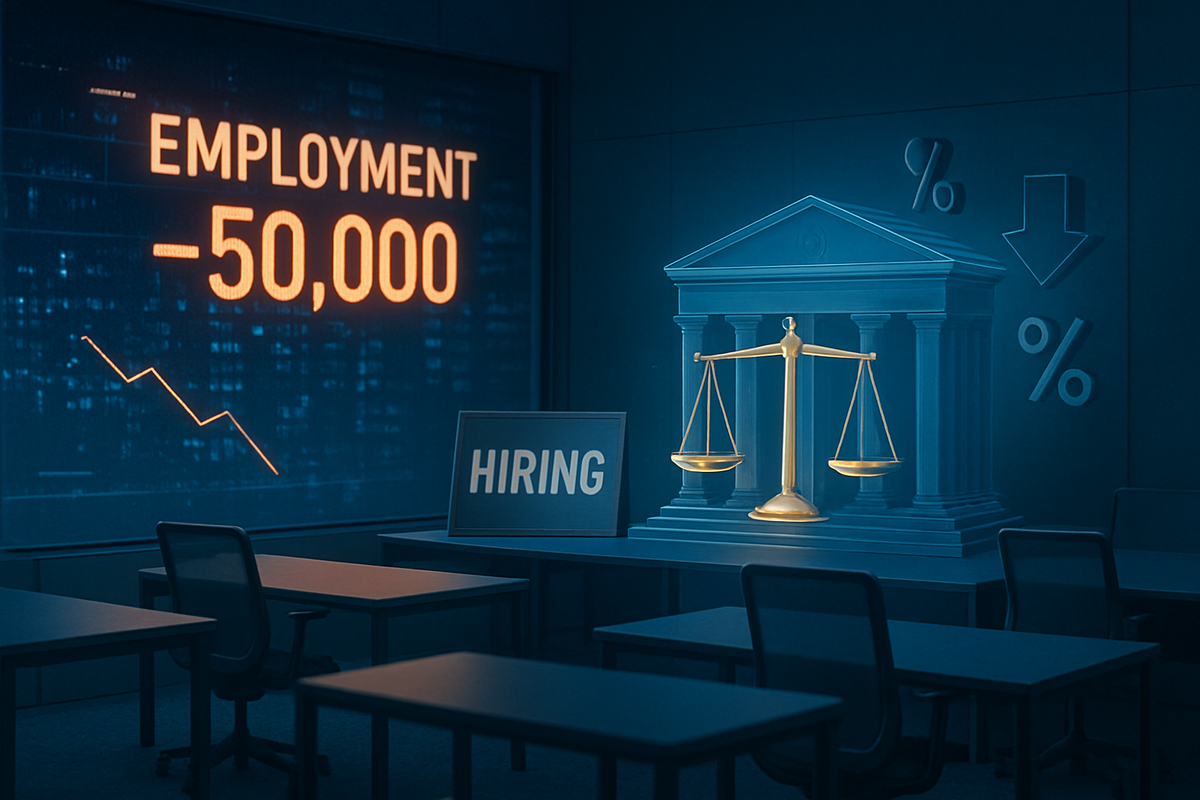
The U.S. labor market hit a significant stumbling block in February, as the Bureau of Labor Statistics reported a meager addition of just 50,000 nonfarm payroll jobs. This figure represents a sharp deceleration from the revised 130,000 jobs added in January and falls significantly short of the robust hiring patterns seen throughout much of 2025. The cooling data has immediately ignited a debate among economists and Wall Street analysts regarding the Federal Reserve’s next move, as the "higher for longer" interest rate mantra faces its most substantial challenge yet.
The implications of this slowdown are far-reaching, signaling that the aggressive monetary tightening of the past year may finally be catching up with the broader economy. With the unemployment rate ticking up to 4.4% and wage growth remaining stubbornly high at 3.8% year-over-year, the Federal Reserve is now caught in a "stagflationary" pincer. Investors are scurrying to price in a more dovish path for interest rates, even as persistent inflation in the service sector complicates the central bank's mandate to stabilize prices without triggering a deep recession.
The Numbers: A Sharp Cooling in Hiring
The February report, released on March 6, 2026, paints a picture of an economy in transition. While the addition of 50,000 jobs is technically positive, it is the lowest non-recessionary growth figure since the early 2000s. The manufacturing and healthcare sectors, previously the engines of growth, showed signs of exhaustion, while the information technology sector continued to shed roles. According to the report, the information sector lost approximately 11,000 jobs, continuing a trend of "right-sizing" that has plagued the industry for the past 18 months.
The rise in the unemployment rate to 4.4%—up from 4.3% in January—marks a level not seen consistently since the post-pandemic recovery stabilized in late 2021. Labor force participation also saw a slight retreat to 62.0%, suggesting that some discouraged workers may be stepping to the sidelines. Despite the hiring freeze, average hourly earnings rose by 0.4% in February to $37.32. This "wage-push" dynamic is a critical concern for policymakers, as it suggests that while fewer people are being hired, the cost of labor remains high enough to keep upward pressure on consumer prices.
Market reactions were swift and volatile. In the hours following the release, the S&P 500 initially dipped 0.8% as fears of an economic slowdown took hold, before recovering some ground as traders bet on a Fed pivot. Surprisingly, the 10-year Treasury yield rose to 4.15%, as inflation concerns—exacerbated by rising energy prices in the Middle East—outweighed the cooling effect of the weak jobs data. This "bad news is good news" dynamic for stocks appears to have finally broken, with investors now genuinely worried about the underlying health of the American consumer.
Market Impact: Banking Giants Retreat while Tech Braces
The financial sector bore the brunt of the negative sentiment following the payrolls release. JPMorgan Chase (NYSE: JPM) saw its shares slide nearly 2%, breaking below the critical $300 support level to close near $297. Analysts point to a double-whammy of concerns for the banking giant: the potential for a narrowing net interest margin if the Fed cuts rates, and the need to increase credit loss reserves as the labor market weakens. JPMorgan's recent $2.2 billion reserve build for its Apple Card portfolio has already made investors wary of credit quality in a slowing economy.
In the technology space, the reaction was more nuanced. Apple (NASDAQ: AAPL) shares fell 0.85% to $260.29, as the hardware giant faces a cooling consumer environment. While Apple’s services revenue remains a bright spot, the prospect of a 4.4% unemployment rate threatens the upgrade cycle for the iPhone and Mac lines. Conversely, Amazon (NASDAQ: AMZN) managed to find some footing, gaining 0.98% to end the day at $218.94. Investors appear to be viewing Amazon’s massive $200 billion capital expenditure on AI and its strategic tie-up with OpenAI as a defensive moat that could help the company navigate a period of slower broad-market growth.
For growth-oriented firms like Block (NYSE: SQ), the report validated recent austerity measures. Block has already slashed nearly 40% of its workforce in anticipation of this environment, and its stock remained flat as the market had already priced in the "techpocalypse" hiring freeze. However, for most cyclical companies, the February data is a stark reminder that the "soft landing" remains a precarious goal rather than a guaranteed outcome.
The Fed’s Dilemma: Stagflation vs. The Soft Landing
This slowdown does not exist in a vacuum; it follows a series of massive benchmark revisions in 2025 that wiped out nearly 900,000 previously reported jobs. Historical comparisons are now being drawn to the 2008 Financial Crisis and the 2000 Dot-com bust, with some analysts arguing that the U.S. is currently experiencing the weakest labor market expansion in over two decades. The key difference today is the presence of "sticky" inflation, which prevents the Fed from immediately slashing rates back to zero.
The broader industry trend is shifting from "growth at all costs" to "operational efficiency." Across the Fortune 500, companies are prioritizing automation and AI over human capital to preserve margins in a high-wage, low-growth environment. This shift has massive ripple effects on the recruitment and staffing industry, which has seen its worst performing quarter in five years. If the Fed continues to wait for inflation to hit its 2% target while jobs growth stalls at 50,000 per month, it risks a policy error that could turn a shallow slowdown into a protracted recession.
Furthermore, the geopolitical landscape is complicating matters. With oil prices hovering near $100 per barrel, the Fed is facing a classic stagflationary shock: slowing growth and rising input costs. This limits their ability to use the traditional "Fed Put" to bail out equity markets. Historically, when the unemployment rate rises by 0.5% from its cycle low (the "Sahm Rule"), a recession is almost always imminent. We are currently teetering on that very edge.
The Path to March 17: Will the Fed Finally Blink?
All eyes are now focused on the upcoming FOMC meeting on March 17-18, 2026. Prior to this report, the consensus was for the Fed to hold rates steady at 3.5%–3.75%. However, the CME FedWatch Tool now shows a 45% probability of a 25-basis point cut, a significant jump from just 10% a week ago. Fed Governor Christopher Waller’s previous warnings that 2025 data would be revised downward now seem prophetic, and the central bank may be forced to acknowledge that the labor market is cooler than they originally suspected.
In the short term, we may see a strategic pivot from the Fed, moving away from a hawkish stance to a "wait and see" neutrality. If the March data—scheduled for release in early April—shows another sub-100,000 gain, the pressure for a summer rate-cutting cycle will become unbearable. Companies will likely continue their defensive posturing, with more focus on share buybacks and dividend preservation to keep shareholders happy while organic growth slows.
The biggest challenge for the market moving forward will be the transition from an "inflation-focused" narrative to a "growth-focused" one. If earnings for the first quarter of 2026 show that the jobs slowdown is translating into lower consumer spending, the S&P 500 could face a 10% to 15% correction as valuations are reset to reflect a lower growth reality.
A Turning Point for the 2026 Economy
The February payrolls report is a watershed moment for the 2026 economic outlook. The addition of 50,000 jobs serves as a definitive signal that the post-pandemic hiring boom is over and that the economy has entered a phase of stagnation. While the Federal Reserve has successfully cooled the "overheated" labor market, the risk of over-tightening is now the primary concern for investors and policymakers alike.
Moving forward, the market will be hyper-sensitive to any signs of further labor market erosion. Investors should watch for the March 17 Fed statement and the subsequent retail sales data, which will indicate if the 50,000-job figure was a one-month anomaly or the start of a trend. The "soft landing" is still possible, but the margin for error has narrowed significantly.
As we move deeper into the first half of 2026, the resilience of the U.S. consumer will be the ultimate arbiter of the market's direction. For now, the "wait and see" approach of the Federal Reserve is being tested by the reality of a cooling economy, and the coming months will determine if the central bank can navigate this transition without a hard crash.
This content is intended for informational purposes only and is not financial advice.