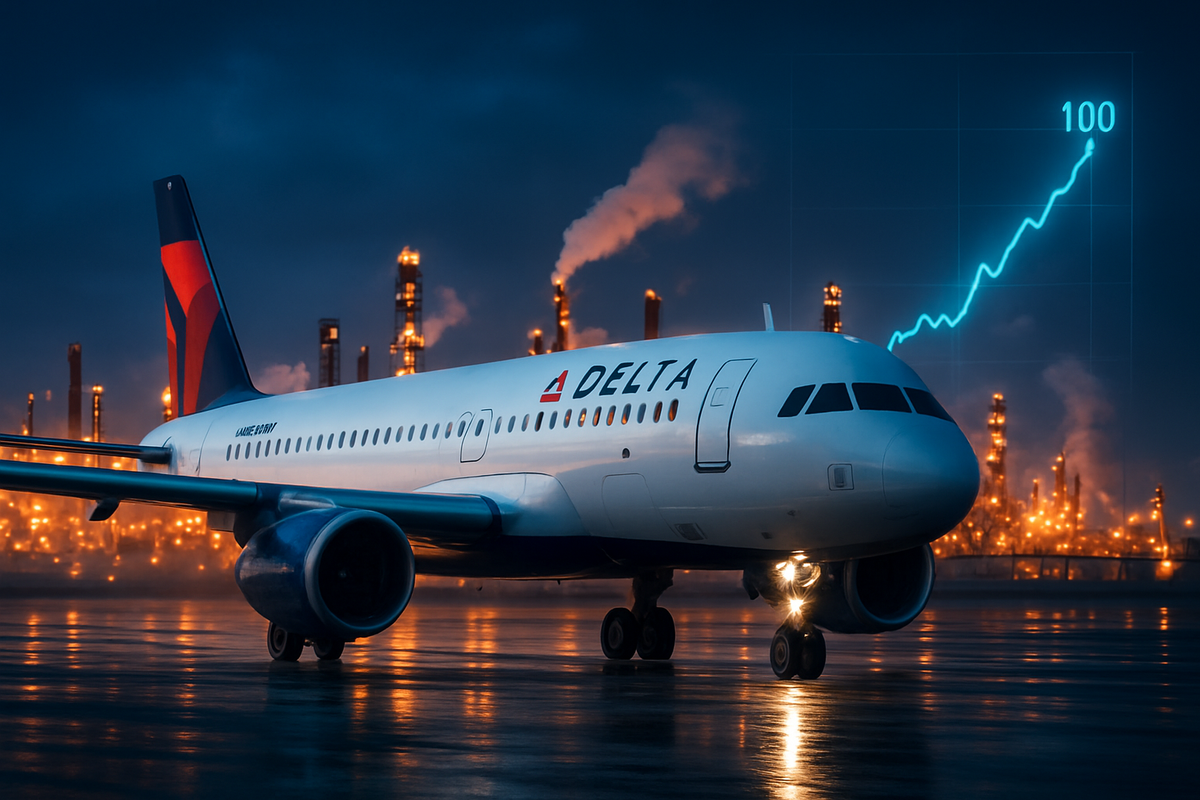
As the first quarter of 2026 draws to a close, the global aviation industry finds itself navigating a familiar yet formidable storm. Just months after analysts predicted a "punishing surplus" in the oil markets, a rapid escalation of geopolitical tensions in the Middle East has sent crude prices soaring past the psychological $100-per-barrel mark. For Delta Air Lines (NYSE: DAL) and its peers, the sudden shift from the $60 range in late 2025 to nearly $120 in March 2026 has turned a projected year of record profits into a high-altitude battle for margin preservation.
The immediate implications are stark: fuel expenses, which typically account for 20% to 30% of an airline’s operating costs, have ballooned by nearly 50% in less than eight weeks. While a post-pandemic travel boom continues to fill seats, the "fuel wedge" is widening the gap between industry leaders and struggling carriers. Investors are now laser-focused on how much of this cost can be passed on to passengers before the "travel revenge" phase finally meets its match in consumer price sensitivity.
A Geopolitical Shockwave Hits the Tarmac
The current crisis began in late February 2026, when the effective closure of the Strait of Hormuz triggered a global supply shock. Brent crude, which had averaged a comfortable $65 in late 2025, surged to a peak of $119.50 earlier this month. The timeline for the industry has been dizzying; in early January, airline executives were discussing expansion plans and dividend increases. By mid-March, those same executives were issuing warnings about hundred-million-dollar hits to their bottom lines.
Delta Air Lines has already confirmed a $400 million additional fuel expense for the month of March alone. However, the Atlanta-based carrier has managed to hold its earnings guidance steady at 50 to 90 cents per share for the quarter—a feat that has surprised Wall Street. This resilience is largely attributed to Delta’s unique position in the market; unlike many of its competitors, Delta owns the Monroe Energy refinery in Pennsylvania. This "operational hedge" allows the airline to capture refining margins (the "crack spread") which often widen during periods of crude oil volatility, providing a crucial buffer that pure financial hedging cannot match.
Winners and Losers in a Triple-Digit Oil Environment
The current energy environment is acting as a brutal Darwinian filter for the transportation sector. Delta and United Airlines Holdings (NASDAQ: UAL) appear to be the best-positioned "survivors." United CEO Scott Kirby recently noted that while $100 oil could represent an $11 billion annual headwind for the industry, United’s dominant position in international and premium travel allows it to adjust ticket prices with more agility. In fact, United and Delta have both seen their stock prices recover roughly 5% from their March lows, as they successfully pass through costs to a resilient upper-middle-class consumer base.
Conversely, the "losers" list is growing. American Airlines Group (NASDAQ: AAL), despite forecasting record revenue growth of 10%, is expected to see its Q1 earnings squeezed to the lowest end of previous guidance due to its lack of significant hedging and higher debt load. The most severe casualties, however, are in the low-cost carrier (LCC) segment. Spirit Airlines (NASDAQ: SAVE), which was already navigating the aftermath of a late-2025 bankruptcy filing, has been forced to cancel service to a dozen cities this month. For budget airlines, where the customer base is hyper-sensitive to price, the inability to raise fares to cover fuel spikes often leads to a "death spiral" of reduced capacity and dwindling cash reserves.
The Broader Impact on Global Trade and Policy
The significance of $100 oil extends far beyond the airport terminal. Historically, such spikes have served as a leading indicator for broader economic cooling. In the transportation sector, the JETS ETF has fallen 18% since the start of 2026, serving as a proxy for the heightened geopolitical risk now baked into the global economy. This event fits into a broader trend of "energy insecurity" that has plagued the mid-2020s, forcing companies to rethink just-in-time logistics and lean operating models.
From a regulatory standpoint, the fuel crisis is accelerating the push for Sustainable Aviation Fuel (SAF). As traditional Jet-A prices skyrocket, the price gap between conventional fuel and SAF narrows, making green alternatives more economically viable. Furthermore, the U.S. Department of Transportation is reportedly monitoring fare increases closely, though current policy remains hesitant to intervene in pricing during a genuine energy supply crisis. The historical precedent of the 2008 oil spike looms large, reminding investors that while airlines can survive $100 oil during a period of high demand, a simultaneous drop in consumer confidence could be catastrophic.
The Path Forward: Strategic Pivots and Scenarios
In the short term, the industry is expected to rely on "capacity discipline"—limiting the number of flights to ensure every plane is at maximum occupancy. We may also see a strategic pivot toward premium-heavy configurations. If fuel remains above $100, the "race to the bottom" on economy fares will likely end, as airlines can no longer afford to fly budget-conscious travelers at a loss. Delta and United are already accelerating the retirement of older, less fuel-efficient aircraft in favor of next-generation jets like the Airbus A321neo and Boeing 737 MAX 10, which offer 20% better fuel efficiency.
Looking ahead, two primary scenarios emerge. If diplomatic efforts reopen maritime routes and Brent falls back toward $80 by the third quarter of 2026, as the EIA predicts, the major carriers could see a massive "relief rally" in their stock prices. However, if oil sustains a level above $120, we may see a wave of consolidation in the industry, as smaller carriers are forced to merge with larger "fortress" balance sheets to survive the liquidity drain.
Conclusion: An Industry at a Crossroads
The events of March 2026 serve as a stark reminder that for all the technological advancement in aviation, the industry remains tethered to the price of a barrel of crude. Delta’s refinery strategy and the premium-travel boom have provided a temporary shield, but the pressure on the sector is undeniable. The primary takeaway for investors is the divergence in the market: quality and scale have become the ultimate defensive assets.
Moving forward, the market will be watching the second-quarter earnings calls with intense scrutiny. Investors should pay close attention to "load factors" and "yield growth"—metrics that will reveal exactly how much more the traveling public is willing to pay. While the skies remain crowded for now, the cost of staying airborne has never been higher.
This content is intended for informational purposes only and is not financial advice.