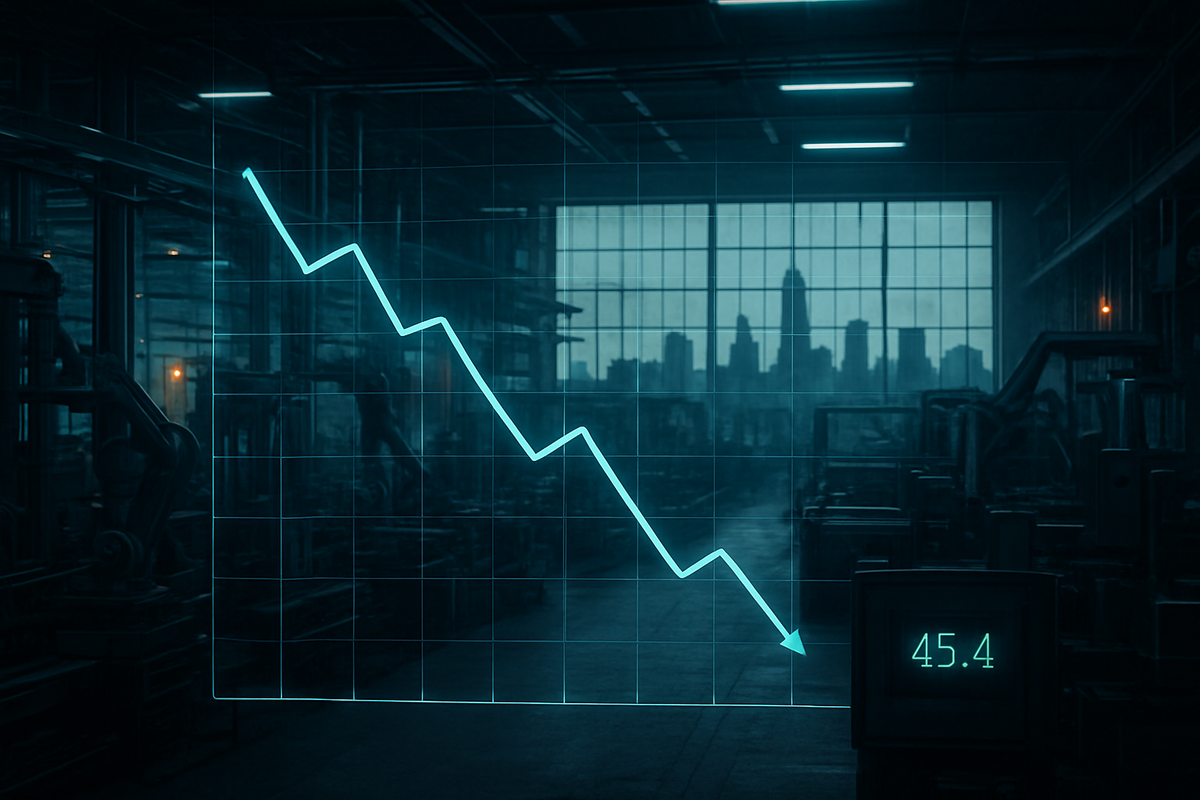
The Midwest manufacturing sector, long considered the industrial heartbeat of the United States, suffered a stunning reversal in March 2026. The Chicago Business Barometer, commonly known as the Chicago PMI, collapsed to a reading of 45.4 this month, down sharply from February’s multi-year high of 57.7. This reading—well below the neutral 50.0 threshold—signals a decisive return to contraction for regional factory activity and has sent shockwaves through a market that had begun to price in a sustained industrial recovery.
The 12.3-point drop represents one of the most volatile month-over-month shifts in the index’s history, effectively erasing the growth gains seen in the first two months of the year. Economists had largely expected a modest cooling to around 52.0, but the 45.4 figure suggests that the "restocking rally" of early 2026 has hit a brick wall. With new orders evaporating and employment levels dipping back into negative territory, the report raises urgent questions about the resilience of the broader U.S. economy as it enters the second quarter of 2026.
Sudden Reversal Erases Early-Year Optimism
The March reading of 45.4 is a stark departure from the narrative of "cautious expansion" that dominated the early weeks of 2026. Following a brutal 2025 characterized by 25 consecutive months of contraction, the Chicago PMI had finally broken into positive territory in January (54.0) and surged in February (57.7). However, the data released today by ISM-Chicago reveals that the momentum was short-lived. The primary culprits for the decline were a massive pullback in the New Orders component and a significant slowdown in Production, both of which fell into contractionary territory after briefly flirting with expansion.
The timeline of this downturn appears tied to the exhaustion of "pre-tariff buying." Throughout late 2025 and January 2026, Midwest manufacturers saw a spike in activity as firms rushed to build inventories ahead of the full implementation of the "One Big Beautiful Bill Act," which introduced complex new domestic-content requirements and finalized 25% tariffs on imported steel and aluminum. Market analysts now believe that February’s 57.7 peak was an artificial "sugar high" caused by this front-running of trade policy, leaving March to face the reality of depleted order books and high carrying costs.
Initial market reactions were swift. Industrial futures dipped immediately following the 9:45 AM ET release, as the reading suggests the Midwest is leading a potential national cooling. Stakeholders, including the Federal Open Market Committee (FOMC), which recently paused its rate-cutting cycle in January 2026 to keep the fed funds rate at 3.50% to 3.75%, now face a difficult dilemma. The manufacturing sector's sudden fragility may force a reassessment of the "higher for longer" stance that has been in place since the February inflation data came in higher than expected.
Industrial Titans Caught in the Crosscurrents
The sharp contraction in the Chicago PMI is expected to weigh heavily on the region’s heavyweights, most notably Caterpillar Inc. (NYSE: CAT) and Deere & Company (NYSE: DE). Caterpillar, which had recently seen its stock price bolstered by high-margin demand in the energy sector, may find its domestic construction and mining segments under pressure as the Midwest slows. While the company has diversified its operations into Texas and overseas, a 45.4 reading in its historic regional base often correlates with a slowdown in the heavy equipment replacement cycles that drive its top-line growth.
For Deere & Company, the news is particularly unwelcome. CEO John May had recently characterized early 2026 as the "bottom of the large ag cycle," but a contractionary PMI suggests that the recovery in agricultural and turf equipment may be deferred once again. With farmers facing high equipment financing costs and volatile commodity prices, the industrial weakness in the Midwest could lead to further inventory gluts for the Moline-based giant. Similarly, Illinois Tool Works Inc. (NYSE: ITW), a bellwether for diversified industrial demand, is likely to see its organic growth projections challenged if the regional "New Orders" index remains suppressed.
On the other hand, some companies may find defensive positioning or strategic advantages in this environment. Fastenal Company (NASDAQ: FAST), a major distributor of industrial and construction supplies, often serves as a "canary in the coal mine." While a slowing PMI usually hurts volume, Fastenal’s high-frequency data and automated supply-chain solutions allow it to pivot faster than manufacturers. Additionally, companies focused on domestic infrastructure—the primary beneficiaries of the late-2025 stimulus act—might remain insulated if federal funds continue to flow into regional projects despite the broader manufacturing malaise.
A Looming "Soft Patch" for the U.S. Industrial Sector
The March PMI reading fits into a broader, more concerning trend of "industrial divergence." While the service sector has remained relatively robust in 2026, the manufacturing core of the U.S. is struggling to find a stable equilibrium. Historically, a Chicago PMI reading of 45.4 serves as a leading indicator for the national ISM Manufacturing Index; a reading this low typically suggests the national index will soon dip into the 46.0–48.5 range. While the "42.3 rule" suggests that the overall U.S. GDP is still technically expanding, a 45.4 reading indicates that the manufacturing sector is essentially in its own private recession.
This event also draws comparisons to the "mid-cycle slowdowns" of the past, such as the 2015-2016 industrial slump. In both cases, a combination of high interest rates and trade uncertainty stifled capital expenditure. However, the 2026 scenario is complicated by the "Hybrid Renaissance" in the automotive sector. Major players like General Motors (NYSE: GM) and Ford Motor Company (NYSE: F) have been retooling Midwest plants to accommodate a surge in hybrid vehicle demand, moving away from pure EV strategies. The 45.4 PMI reading suggests that even this pivot hasn't been enough to offset the broader cooling in consumer demand for big-ticket industrial goods.
Furthermore, the regulatory landscape is shifting. The de-escalation of tensions in the Middle East in late March 2026 initially provided a boost to aerospace firms like The Boeing Company (NYSE: BA). However, if the Chicago PMI indicates a broader regional slowdown, the logistical and labor costs associated with Boeing’s push to reach a 737 MAX production rate of 53 per month may become harder to justify. If regional suppliers for Boeing’s vast Midwest network begin to struggle or consolidate due to the contraction, the aerospace giant could face renewed supply chain bottlenecks just as it was beginning to find its footing.
Navigating the Contraction: What Lies Ahead
In the short term, the primary concern for Midwest manufacturers will be inventory management. If the surge in January and February led to overproduction, many firms will likely spend the second quarter of 2026 aggressively cutting back on hours and delaying raw material purchases to avoid a glut. We may see a strategic pivot toward "leaner" operations, with a renewed focus on automation to maintain margins despite falling volumes. This could lead to a further divergence between "Production" and "Employment" components in the PMI, as companies attempt to do more with fewer workers.
Long-term, the focus will shift to the Federal Reserve. The 45.4 reading provides significant ammunition for those calling for an immediate interest rate cut in June. If the industrial sector continues to contract, the Fed may be forced to prioritize growth over its lingering concerns about wholesale inflation. A "pivot" to a 3.25% terminal rate by year-end would be a major tailwind for heavy machinery and automotive sales, potentially setting the stage for a more "organic" recovery in late 2026 that isn't dependent on pre-tariff buying frenzies.
Market participants should also watch for potential consolidation. Smaller, tier-two and tier-three suppliers in the Illinois-Indiana-Michigan corridor may not have the balance sheets to survive a prolonged return to contraction. This could lead to a wave of M&A activity as larger players like Caterpillar or Illinois Tool Works move to secure their supply chains. The emergence of a "two-speed" economy—where large, diversified industrials survive while regional specialists struggle—appears to be the most likely scenario for the remainder of the year.
The Bottom Line for Investors
The March 2026 Chicago PMI reading of 45.4 is a sobering reminder that the road to industrial recovery is rarely a straight line. The data suggests that the optimism of early 2026 was largely built on the shifting sands of trade policy and temporary restocking, rather than a fundamental rebound in global demand. For investors, the takeaway is clear: the "manufacturing renaissance" is currently on hold, and the Midwest industrial sector is entering a period of renewed volatility.
Moving forward, the market will be hyper-focused on the national ISM Manufacturing report and the April employment data to see if the Chicago contraction is an isolated regional "glitch" or the start of a broader national trend. For now, the "wait-and-see" approach that defined late 2025 has returned. Investors should closely monitor the order backlogs and "Prices Paid" components of upcoming reports; if prices remain high while demand falls, the dreaded specter of "stagflation" in the industrial sector could become the dominant narrative of 2026.
This content is intended for informational purposes only and is not financial advice.