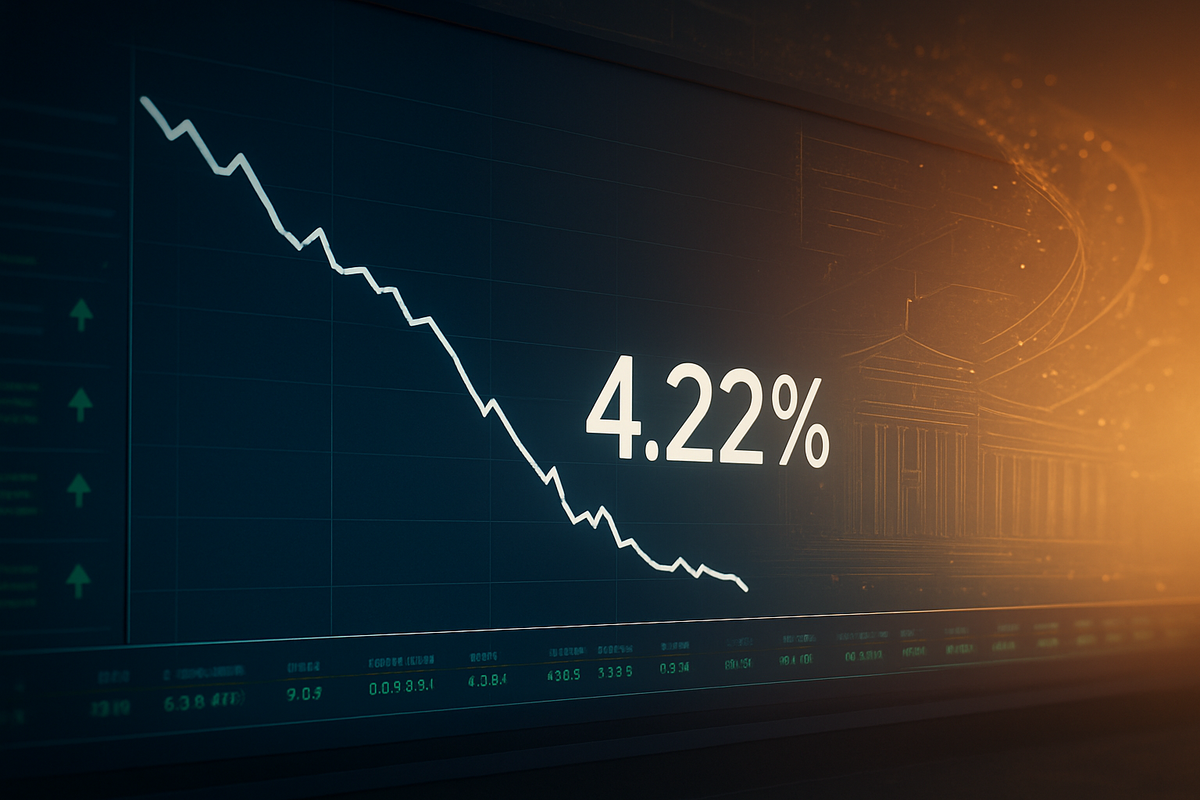
The fixed income market experienced a decisive shift on March 31, 2026, as Treasury yields tumbled across the curve. The benchmark 10-year Treasury note, a critical barometer for global borrowing costs, fell to 4.22% from a morning high of 4.31%. This move reflects a complex realignment of investor expectations, balancing a sudden de-escalation in Middle Eastern geopolitical tensions with a growing conviction that the Federal Reserve is prepared to initiate a series of rate cuts before the summer.
The immediate implications of this yield drop are far-reaching, signaling a potential easing of the "higher-for-longer" regime that has dominated financial discourse for the past two years. As the 10-year yield retreats, mortgage rates and corporate lending costs are expected to follow, providing a much-needed tailwind for a domestic economy currently navigating the implementation of the "One Big Beautiful Bill Act" (OBBBA) and the early stages of a productivity boom fueled by advancements in artificial intelligence.
Rate Cut Fever Grips Wall Street as Geopolitical Risk Subsides
The trading day began with a flurry of activity following reports of a multilateral peace proposal aimed at stabilizing the Strait of Hormuz. For much of early 2026, a "flight to safety" had kept Treasury yields relatively suppressed compared to inflation expectations; however, as that safety trade began to unwind today, many analysts expected yields to rise as investors moved back into equities. Instead, the opposite occurred. The "unwinding" of geopolitical fear was immediately overshadowed by a wave of buying in the long end of the curve, driven by new economic data suggesting that core PCE inflation has stabilized at 2.7%, well below the 3.0% threshold many feared.
This shift in sentiment was further amplified by mounting speculation surrounding the Federal Reserve's leadership transition. With Chair Jerome Powell’s term set to expire in May 2026, the potential nomination of Kevin Warsh has the market pricing in a "regime change." While Warsh is traditionally viewed as an inflation hawk, recent commentary from his inner circle suggests a focus on AI-driven productivity gains as a justification for lower nominal rates. By mid-afternoon, the CME FedWatch tool indicated that the probability of a 25-basis-point cut in June had surged from 42% to 68%, effectively forcing a repricing of the entire Treasury curve.
The timeline leading to this moment has been characterized by extreme volatility. Throughout February and early March, the "flight to safety" was the dominant narrative, keeping the 10-year yield anchored near 4.30% despite sticky inflation data. Today's "unwinding" of that trade—shifting capital from defensive cash positions into duration—marks a pivot point. Stakeholders, from institutional asset managers like BlackRock, Inc. (NYSE: BLK) to sovereign wealth funds, have spent the day rebalancing portfolios to account for a flatter yield curve, anticipating that the short end will soon move lower in tandem with Fed policy.
Winners and Losers in a Falling Yield Environment
The primary beneficiaries of today’s yield retreat are the major financial institutions and interest-rate-sensitive sectors. JPMorgan Chase & Co. (NYSE: JPM) and Bank of America Corp. (NYSE: BAC) saw immediate impacts on their forward-looking net interest margin (NIM) projections. While falling yields can sometimes squeeze margins, the rally in the long end of the curve—if sustained—allows these banks to lower their own funding costs while maintaining a healthy spread on existing long-term loan portfolios. Furthermore, the drop in yields sparked a rally in the mortgage-backed securities (MBS) market, potentially reviving a stagnant housing sector.
In the real estate sector, the Vanguard Real Estate ETF (NYSEARCA: VNQ) surged by 1.8% on the news. Lower yields reduce the discount rate applied to future cash flows for REITs, making their dividend yields more attractive relative to risk-free Treasuries. Similarly, growth-oriented technology firms, led by NVIDIA Corporation (NASDAQ: NVDA), saw their valuations climb as the present value of future earnings increased. These "long-duration" equities are the natural winners when the market moves away from a "higher-for-longer" mindset.
On the losing side of this shift are cash-heavy savers and conservative insurance companies like MetLife (NYSE: MET). These entities have thrived in the 4.5% to 5.0% yield environment of 2025, but a move toward 4.0% threatens their reinvestment rates. As the "flight to safety" premium evaporates, those who remained parked in short-term money market funds are now facing "reinvestment risk," as the yields on 2-year and 5-year notes also trended lower today, closing at 3.92% and 4.05%, respectively.
AI Productivity and the New Disinflationary Paradigm
Today’s market move fits into a broader industry trend where "AI 2.0"—the phase where artificial intelligence moves from infrastructure build-out to measurable corporate efficiency—is beginning to act as a disinflationary force. This productivity surge is allowing the economy to grow at a projected 2.3% for 2026 without triggering the wage-price spirals seen in previous years. This "Goldilocks" scenario is what allowed yields to drop even as the geopolitical "fear premium" was removed; the market is betting that the Fed can now afford to be proactive rather than reactive.
The ripple effects of this event will likely be felt in the corporate credit markets. Goldman Sachs Group, Inc. (NYSE: GS) noted in a flash report that the narrowing of spreads between Treasuries and high-yield corporate bonds suggests a "soft landing" is now the consensus view for the second half of 2026. This is a significant departure from the recessionary fears that gripped the market in late 2025. Historically, such "yield curve normalizations" have preceded periods of sustained equity growth, provided the Fed does not over-tighten during the transition of leadership.
The policy implications are equally significant. The Treasury Department, led by the current administration, is closely watching these yields as it prepares to auction more debt to fund the OBBBA stimulus. A drop to 4.22% significantly lowers the government’s debt-servicing costs, potentially creating fiscal space for further initiatives. This synergy between falling yields and fiscal expansion is reminiscent of the mid-1990s "productivity miracle," a comparison that is increasingly finding favor among Wall Street strategists.
The Road to May: What Comes Next for the Fed
In the short term, all eyes will be on the upcoming PCE inflation data and the April employment report. If these figures confirm the disinflationary trend, the 10-year yield could test the psychological support level of 4.00% before the end of the second quarter. However, a strategic pivot may be required if the de-escalation in the Middle East proves temporary or if oil prices rebound unexpectedly. Market participants must remain agile, as the "unwinding" of safety trades can be a double-edged sword that increases overall market beta.
Long-term, the defining factor will be the Fed's "dot plot" and the formal nomination of the next Chair. A transition to a more "Warsh-ian" Fed could mean a more aggressive reduction in the balance sheet (Quantitative Tightening) even as interest rates are cut. This potential "twist" in policy could keep long-term yields from falling too far, even if short-term rates drop significantly. Investors should prepare for a potentially steeper yield curve as the market adjusts to this new policy mix.
Scenarios for the remainder of 2026 range from a "melt-up" in risk assets if the 10-year stays below 4.25%, to a renewed spike in yields if the fiscal stimulus from the OBBBA proves more inflationary than currently anticipated. The market's ability to absorb the "safety unwind" today suggests a robust underlying demand for duration, but the margin for error remains thin.
Final Assessment: A Pivotal Moment for Fixed Income
The events of March 31, 2026, represent a critical turning point in the post-pandemic economic cycle. The drop in the 10-year yield to 4.22% is not merely a technical move; it is a declaration by the market that the era of emergency risk premiums is ending and a new era of growth-focused monetary policy is beginning. The unwinding of the "flight to safety" has, paradoxically, clarified the path forward for investors, highlighting the resilience of the U.S. economy in the face of geopolitical and fiscal shifts.
Moving forward, investors should watch for the 4.20% support level on the 10-year note and the upcoming Fed minutes for clues on the timing of the first cut. The significance of today's move lies in its timing—occurring just as the market prepares for a change in central bank leadership and a new fiscal landscape. While the path ahead will undoubtedly feature more volatility, the rally on the final day of March 2026 has set a decidedly optimistic tone for the months to follow.
This content is intended for informational purposes only and is not financial advice.