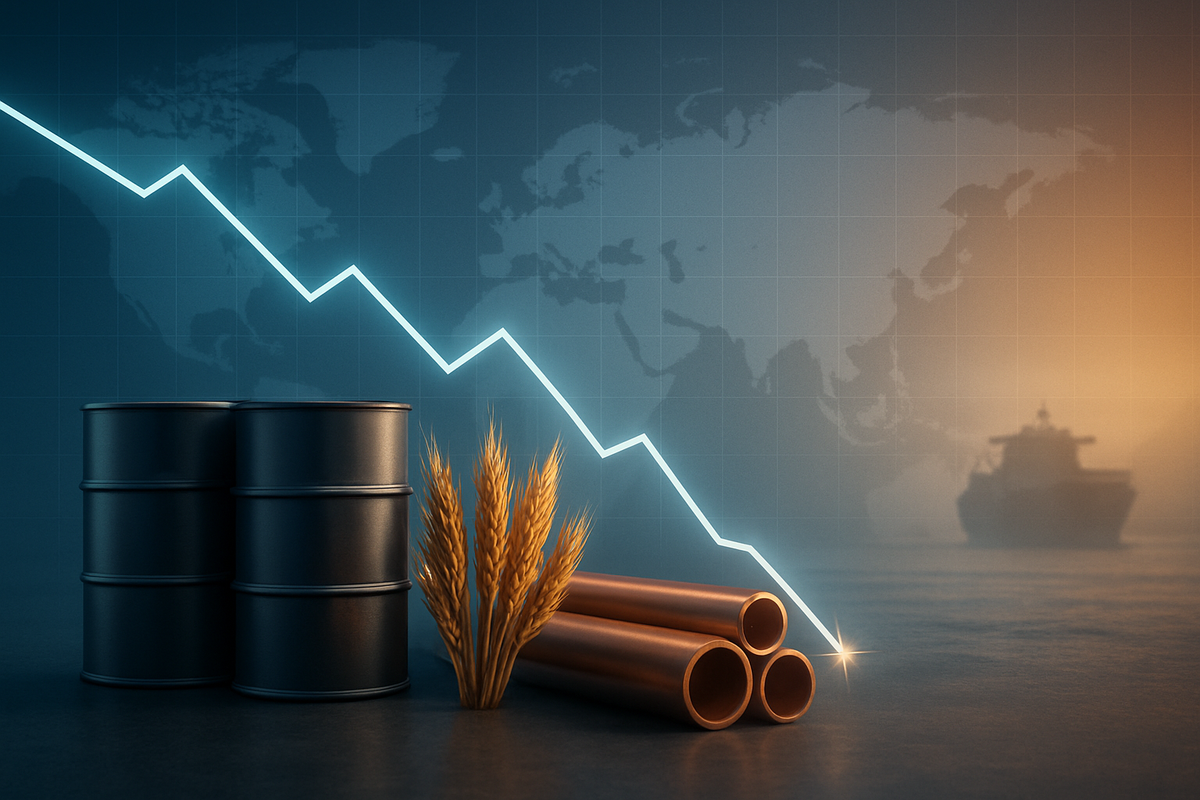
The global economy is entering a definitive new chapter in its post-pandemic recovery. According to the latest analysis from the World Bank’s Commodity Markets Outlook, global commodity prices are projected to reach a six-year low by the end of 2026. Driven by a massive surplus in crude oil and a cooling industrial appetite in China, the aggregate commodity price index is expected to slide by 7% this year, marking the fourth consecutive year of decline and providing a significant disinflationary tailwind for central banks worldwide.
While the forecast offers a rare moment of relief for energy-importing nations and consumer-facing industries, it arrives against a backdrop of intense geopolitical fragility. Ongoing tensions in the Middle East and disruptions in critical maritime corridors like the Strait of Hormuz continue to act as "wildcards" that could abruptly reverse these downward trends. Economists at the World Bank warn that while the "Great Commodity Respite" is here, the global supply chain remains just one major conflict away from a renewed inflationary spike.
A Structural Shift in Global Supply and Demand
The projected 7% decline in 2026 follows a similar 7% drop in 2025, effectively unwinding the price surges seen during the 2021–2022 recovery period. The primary engine behind this slump is the energy sector, where a "Great Oil Glut" has emerged. The World Bank estimates a global oil surplus of roughly 1.2 million barrels per day in 2026. This surplus is largely fueled by the "Americas Quintet"—the United States, Brazil, Canada, Guyana, and Argentina—all of which have ramped up production to record levels, challenging the traditional market influence of the OPEC+ alliance.
The timeline leading to this moment began in late 2023, as non-OPEC production started to outpace global consumption growth. By 2025, the impact of high interest rates and the rapid adoption of electric vehicles (EVs) in China—the world's largest oil importer—began to structurally erode demand. As of early 2026, Brent crude is projected to average near $60 per barrel, a five-year low that has fundamentally altered the calculus for global energy markets. Agriculture is also contributing to the decline; record harvests in grain-producing regions and lower shipping costs are expected to bring food prices down by another 6% to 7% this year, offering a vital reprieve for developing economies struggling with food insecurity.
Corporate Winners and Losers in the Deflationary Wave
The 2026 commodity slump is creating a sharp divide between "cost-takers" and "price-makers" in the public markets. Among the primary winners are the major airlines and logistics firms, which are seeing their largest margin expansions in a decade. Delta Air Lines (NYSE: DAL) has emerged as a standout beneficiary, with lower jet fuel costs allowing the carrier to project record free cash flow for the fiscal year. Similarly, FedEx Corp. (NYSE: FDX) is leveraging cheaper diesel and lower operational overhead to expand its operating margins even as global trade volumes remain modest.
Consumer staples giants are also reaping the rewards of lower input costs. Procter & Gamble (NYSE: PG) and Kraft Heinz (NASDAQ: KHC) are seeing the costs for resins, pulp, and agricultural raw materials retreat, allowing them to rebuild margins that were decimated by the inflation of the previous years. In the energy space, while most producers are hurting, "downstream" focused companies like Valero Energy (NYSE: VLO) may find a silver lining as lower crude input costs can often support healthy refining margins, provided consumer demand for gasoline remains stable.
Conversely, the "upstream" energy titans are facing significant revenue compression. ExxonMobil (NYSE: XOM) and Chevron (NYSE: CVX) are navigating a environment where $60 oil significantly reduces the capital available for the massive share buyback programs that fueled their stock performance in 2023 and 2024. Smaller, more leveraged producers like Occidental Petroleum (NYSE: OXY) are already moving to slash capital expenditure (Capex) by double digits to preserve cash. Outside of energy, diversified miners such as BHP Group (NYSE: BHP) and Rio Tinto (NYSE: RIO) are struggling with a double whammy: falling prices for iron ore and copper, combined with a structural slowdown in Chinese property development that has removed the floor from under industrial metal prices.
Analyzing the Significance: Cyclical Slump or Structural Pivot?
This 2026 commodity retreat bears a superficial resemblance to the oil price crash of 2014–2016, but economists argue the underlying drivers are profoundly different. While the 2014 crash was a cyclical battle for market share between U.S. shale and OPEC, the current slump appears structural. For the first time, global GDP growth is "decoupling" from oil demand. The World Bank notes that the energy transition—specifically the electrification of transport—is no longer a future projection but a present-day reality that is capping the upside for fossil fuels.
The broader significance for the market lies in the hands of central banks. The 7% drop in commodities provides the "last mile" of disinflation needed for the Federal Reserve and the European Central Bank to comfortably maintain lower interest rates. However, this shift also carries a "ripple effect" for commodity-exporting nations in Africa and Latin America, many of whom are facing fiscal crises as their primary revenue sources dry up. Unlike 2014, the 2026 environment features a massive "oil buffer" created by the Americas’ production, which World Bank Chief Economist Indermit Gill suggests could absorb minor geopolitical shocks without the catastrophic price spikes seen in previous decades.
The Road Ahead: Geopolitical Wildcards and Strategic Pivots
Looking toward the latter half of 2026 and into 2027, the primary challenge for the market will be the "geopolitical premium." While the fundamentals point to oversupply, any escalation in the Middle East that affects the Strait of Hormuz remains a catastrophic risk. If regional tensions flare into a wider conflict, the 7% projected drop could instantly turn into a 40% spike. Investors and corporations must remain agile, balancing the current era of low costs with the reality of a world where trade barriers and sanctions are increasingly used as economic weapons.
Strategic pivots are already underway. Energy companies are expected to accelerate their diversification into "transition minerals" like lithium and copper, even as those markets currently face their own price pressures. For consumer-facing companies, the opportunity lies in using the "commodity windfall" to invest in automation and supply chain resilience rather than just short-term dividends. The market is moving from an era of "scarcity management" to one of "surplus optimization," requiring a fundamental change in how corporate treasuries manage commodity risk.
Summary of the Market Outlook
The World Bank’s 2026 Commodities Outlook marks a definitive end to the inflationary era that defined the first half of the decade. With prices hitting a six-year low, the global economy is benefiting from an unexpected "disinflationary gift." Key takeaways for the coming months include the emergence of a structural oil surplus led by the Americas, a significant easing of food price pressures, and a widening performance gap between energy-intensive industries and commodity extractors.
Moving forward, the market will be characterized by lower volatility in core prices but higher sensitivity to geopolitical events. Investors should keep a close watch on Chinese industrial data and the production strategies of non-OPEC nations. While the 2026 outlook is overwhelmingly bearish for commodity prices, the underlying fragility of global trade routes means that "lower for longer" is a forecast, not a guarantee. The "Great Respite" is a window of opportunity for the global economy to stabilize, but only if it can successfully navigate the geopolitical minefields that remain.
This content is intended for informational purposes only and is not financial advice