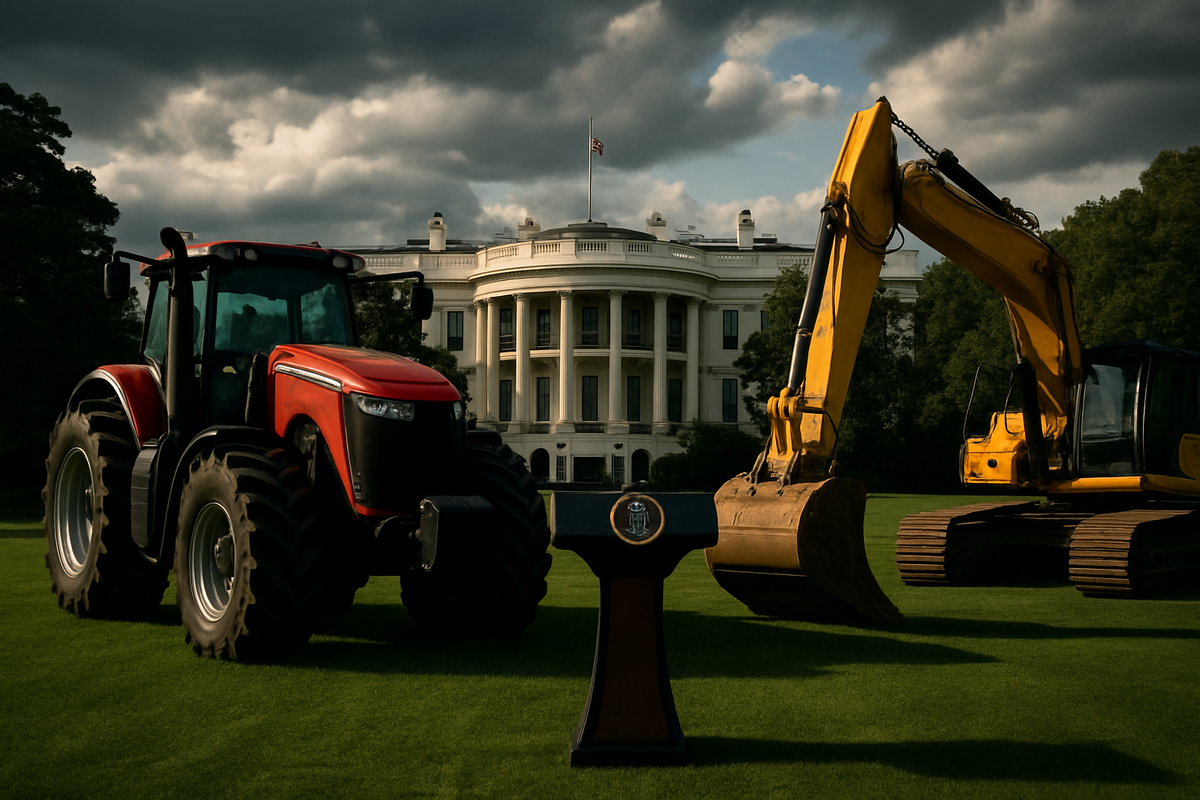
In a bold escalation of his "America First" economic agenda, President Donald Trump took to the White House South Lawn on March 27, 2026, to deliver a direct mandate to the titans of the agricultural machinery industry. Standing before a curated display of heavy equipment during a "Celebration of Agriculture" event, the President called on industry leaders to immediately slash equipment costs for American farmers. The move signals a new phase of populist pressure on major corporations, shifting from trade protectionism to direct interference in domestic pricing strategies.
The immediate implications of this rhetoric were felt across the trading floor, as investors weighed the potential for margin compression against the administration’s promises of sweeping regulatory relief. While the President framed the demand as a necessary relief for a struggling agricultural sector, the ultimatum places companies like Deere & Co. (NYSE: DE) and Caterpillar Inc. (NYSE: CAT) in a precarious position: they must now balance the high costs of manufacturing—exacerbated by ongoing steel and aluminum tariffs—with the political necessity of appeasing a White House that is increasingly willing to use the "bully pulpit" to dictate market terms.
The South Lawn Standoff: A Timeline of Escalation
The "Celebration of Agriculture" event on March 27 served as the climax of a multi-year campaign to reshape the relationship between the federal government and industrial manufacturers. During his remarks, President Trump specifically identified John Deere (NYSE: DE), Caterpillar (NYSE: CAT), and CNH Industrial (NYSE: CNH) as the primary targets of his cost-reduction initiative. The President’s rhetoric was fueled by a desire to see the benefits of his administration’s regulatory rollbacks passed directly to the consumer. "They’re going to have to reduce their prices because farming equipment has gotten too expensive," Trump declared, pointing to a gold-painted Fendt tractor—a brand owned by AGCO Corporation (NYSE: AGCO)—as a symbol of the "excess" he seeks to dismantle.
This moment was years in the making. The friction began in September 2024, when Trump first threatened John Deere with a 200% tariff if the company proceeded with plans to move production of skid steer and compact loaders from Iowa to Mexico. By December 2025, the administration had pivoted, tying a $12 billion "Farmer Bridge Assistance" (FBA) package to the demand for lower machinery prices. The White House argues that by stripping away "complicated" environmental technology and EPA-mandated emissions systems, manufacturers should be able to offer simpler, more reliable, and significantly cheaper tractors to the American heartland.
Initial market reactions to the March 27 comments were swift but varied. Shares of John Deere dipped 2% in mid-day trading as analysts recalculated earnings-per-share (EPS) projections in light of potential price cuts. CNH Industrial followed with a 1% decline. Conversely, Caterpillar’s stock remained relatively resilient, bolstered by its diversified revenue streams in the construction and data center power sectors, which have remained robust despite the agricultural downturn. However, the underlying sentiment across the sector is one of caution, as the industry awaits concrete policy measures that could enforce these verbal demands.
Winners and Losers in the New Agricultural Economy
The primary intended beneficiaries of this policy shift are American farmers, who have struggled with the rising cost of capital and machinery. For the small-to-medium-sized operator, a government-mandated price cut—combined with the recently issued EPA guidance on "Right to Repair"—could provide a significant lifeline. By allowing farmers to bypass expensive dealership service centers and purchase equipment stripped of costly Selective Catalytic Reduction (SCR) technology, the administration hopes to lower the total cost of ownership for essential farm tools.
However, the "losers" in this scenario are clearly the manufacturers and their shareholders. John Deere (NYSE: DE), which has invested over $2.5 billion in U.S. manufacturing over the last five years, now faces a margin squeeze. If the company is forced to lower prices while still paying elevated costs for tariffed steel and aluminum, its industry-leading margins could be significantly eroded. Caterpillar (NYSE: CAT) has already warned investors of a potential $2.6 billion hit from tariffs in 2026, and a forced price reduction on the sales side would only compound the pressure on its bottom line.
Dealers also face a precarious future. With high interest rates already leading to "stalled" markets and excess inventory by early 2026, the prospect of government-enforced price drops could lead to a "wait-and-see" approach from buyers, further slowing turnover. Companies like Titan Machinery Inc. (NASDAQ: TITN), one of the largest Case IH dealers, may find themselves caught between a manufacturer unwilling to lower wholesale prices and a customer base emboldened by the President’s rhetoric to demand discounts.
A Fundamental Shift in Industrial Policy
This event marks a significant departure from traditional free-market conservatism, fitting into a broader trend of "nationalist industrialism." By directly targeting the pricing models of private companies, the Trump administration is signaling that it views major manufacturers not just as private entities, but as instruments of national policy. This fits a pattern seen in other sectors, where the administration has used the threat of tariffs and the promise of deregulation to coerce corporate behavior.
The ripple effects are likely to be felt by international competitors and supply chain partners. If American manufacturers are forced to produce "simplified" equipment for the domestic market, they may create a bifurcated supply chain—one for the highly regulated European and Asian markets and another for a deregulated United States. This could lead to inefficiencies and higher R&D costs in the long run. Furthermore, the administration’s focus on the "Right to Repair" and the removal of Diesel Exhaust Fluid (DEF) requirements sets a historical precedent that could undermine global emissions standards, potentially leading to trade friction with environmental-focused trading partners in the EU.
Historically, this level of executive pressure on industrial pricing is rare, drawing comparisons to the 1962 clash between President John F. Kennedy and the steel industry. However, unlike the 1960s, the current conflict is deeply intertwined with a "trade war" framework, where the President views every dollar spent on foreign-made parts or Mexican labor as a loss for the American worker.
The Path Forward: Strategic Pivots and Scenarios
In the short term, manufacturers will likely attempt to appease the White House through symbolic gestures rather than wholesale price cuts. We may see the introduction of "Value Lines" or "Heritage Editions" of popular tractor models—machines that lack modern GPS and emissions tech, marketed as a direct response to the President’s call for affordability. John Deere (NYSE: DE) has already begun this pivot by requesting EPA guidance to allow emissions control overrides in certain "emergency" agricultural situations, a move aimed at neutralizing the "limp mode" complaints that have plagued its modern fleet.
Long-term, the industry may be forced into a massive strategic reorganization. If the 200% tariff threat remains a credible deterrent to near-shoring, companies will have to double down on U.S.-based automation to keep labor costs in check. The market opportunity lies in creating "simplified" technology that meets the President’s reliability standards while still offering the productivity gains that modern farming requires. However, the challenge will be doing so without sacrificing the software-as-a-service (SaaS) revenue models that have become central to the valuations of companies like Deere and Trimble Inc. (NASDAQ: TRMB).
Potential scenarios range from a "Grand Bargain," where the administration provides further tax credits in exchange for price caps, to a "Regulatory War," where manufacturers legal teams fight the EPA rollbacks to protect their intellectual property and service monopolies. Investors should prepare for a period of heightened volatility as these two powerful forces—the American presidency and the industrial elite—negotiate the future of the heartland's economy.
Market Outlook: What Investors Should Watch
The March 27 "Celebration of Agriculture" has rewritten the playbook for industrial investing. The key takeaway is that revenue and earnings are no longer purely a function of market demand and operational efficiency; they are now subject to political risk and the direct intervention of the executive branch. Moving forward, the market will be hyper-focused on the quarterly margin reports of the "Big Three" equipment makers to see if the President’s pressure is resulting in actual price concessions.
Investors should closely monitor the "Farmer Bridge Assistance" program’s implementation. If the $12 billion in aid successfully stimulates demand without manufacturers lowering prices, it could provide a temporary boost to stock prices. However, if the administration follows through on its tariff threats against those who do not comply with the "cost-cutting" mandate, we could see a significant re-rating of the industrial sector.
In the coming months, the focus will shift from the South Lawn to the boardrooms of Moline and Peoria. The question remains: can John Deere (NYSE: DE) and Caterpillar (NYSE: CAT) find a way to satisfy the President’s populist agenda without sacrificing the profitability that has made them cornerstones of the American industrial complex? For now, the "gold-painted tractor" remains a symbol of an industry in the crosshairs of a transformative political movement.
This content is intended for informational purposes only and is not financial advice.