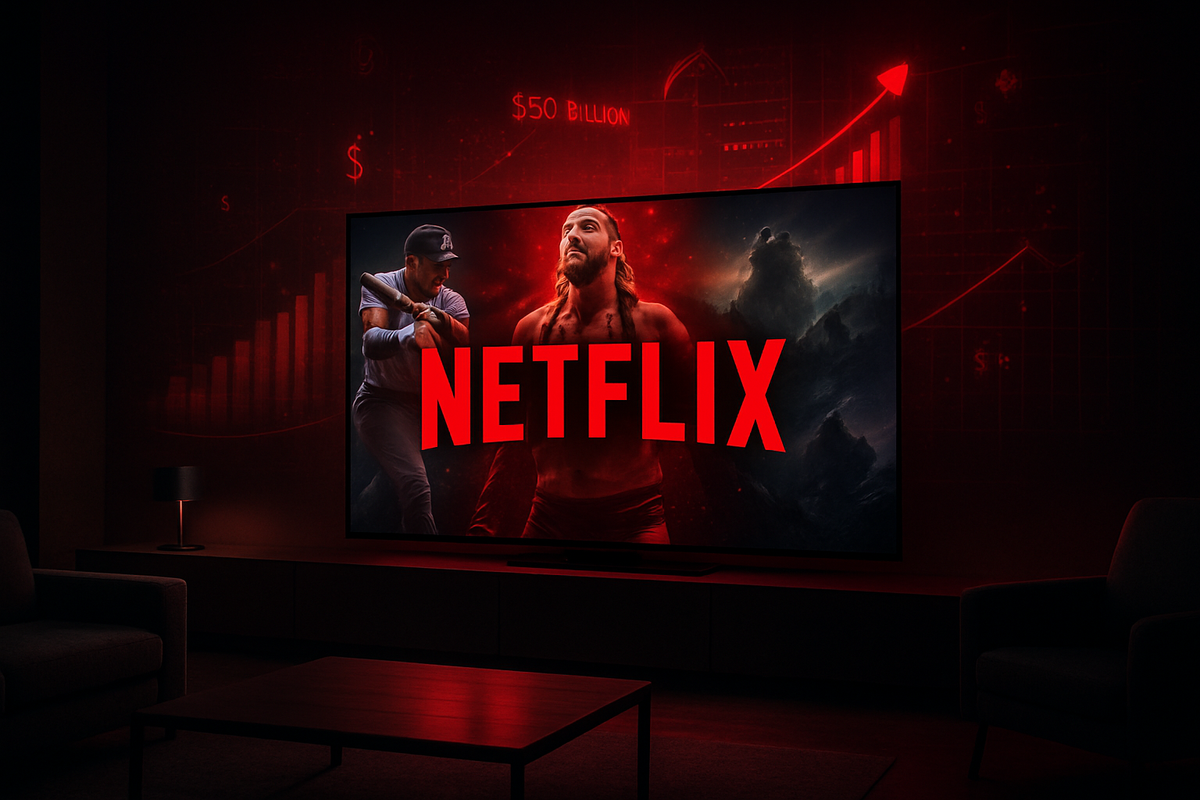
Netflix Inc. (NASDAQ: NFLX) sent shockwaves through the media landscape yesterday, March 26, 2026, by announcing a comprehensive price hike across all its subscription tiers. The move is designed to bankroll a record-breaking $20 billion content budget for the 2026 fiscal year, as the streaming giant pivots aggressively toward live sports and "spectacle" events. This strategic shift comes as the company sets its sights on an ambitious $50 billion annual revenue target, signaling a transition from a pure-play streaming service to a global media conglomerate that rivals traditional broadcasting in both scale and influence.
The immediate implications are clear: Netflix is testing the upper limits of consumer price elasticity. By raising the Premium tier to a staggering $26.99 per month, the company is betting that its unrivaled library and its new "must-see" live programming—including exclusive Major League Baseball (MLB) games and a multi-year WWE residency—will prevent mass churn. While the price increase may frustrate budget-conscious households, Wall Street reacted with cautious optimism, as early trading saw Netflix shares climb nearly 3% on expectations of expanded average revenue per member (ARM).
The 2026 content budget of $20 billion represents a 10% increase over the previous year and a definitive statement of intent. This massive war chest is being deployed to maintain Netflix’s dominance in scripted content while funding a high-stakes entry into live broadcasting. The announcement follows a turbulent first quarter in which Netflix walked away from a multi-billion dollar acquisition bid for Warner Bros. Discovery (NASDAQ: WBD), choosing instead to double down on internal content production and strategic licensing. The timeline of this decision suggests that Netflix leadership believes organic growth and high-impact live events offer a better return on investment than the complicated integration of another legacy studio.
Key to the 2026 slate are "Global Juggernauts" like the second season of One Piece: Into the Grand Line and the highly anticipated Stranger Things animated spinoff, Tales from '85. However, the real change lies in the "Major Spectacles" strategy. Just two days ago, on March 25, Netflix hosted its first-ever exclusive global broadcast of MLB Opening Night, featuring the Yankees vs. the Giants. This, combined with a $60 million annual MLB deal and the ongoing success of NFL Christmas Day games, positions Netflix as a formidable competitor to traditional sports networks like ESPN, owned by The Walt Disney Company (NYSE: DIS).
The new pricing structure, effective immediately for new members, sees the "Standard with Ads" tier rise to $8.99, "Standard Ad-Free" to $19.99, and the "Premium" 4K tier to $26.99. Management justified the hikes by pointing to the "increased value" of live events and new interactive features, such as "cloud-first gaming" and a revamped mobile app that integrates video podcasts. By resolution-gating high-bitrate 4K streaming behind the $27 tier, Netflix is clearly positioning high-quality video as a luxury feature, effectively bifurcating its audience between value-seekers on the ad-tier and premium enthusiasts.
The primary "winner" in this scenario, at least in the short term, is Netflix’s burgeoning advertising business. With 190 million monthly active viewers on its ad-supported tier as of late 2025, the company expects to double its ad revenue to roughly $3 billion in 2026. Advertisers are gaining access to high-intent audiences through new AI-powered "interactive mid-roll" ads that allow viewers to purchase products directly from their TV screens. This puts pressure on traditional ad-supported platforms and rivals like Roku, Inc. (NASDAQ: ROKU), which may struggle to match Netflix's global reach and sophisticated data targeting.
Conversely, the "losers" may include legacy media companies that are still struggling to find their footing in the "post-streaming war" era. Warner Bros. Discovery (NASDAQ: WBD) is in a particularly precarious position; after the Netflix acquisition deal fell through in early March, the company’s stock has faced downward pressure as investors question its path to scale without a larger partner. Similarly, Disney (NYSE: DIS) and Paramount Global (NASDAQ: PARA) now face a competitor that is not only outspending them on original content but is also successfully poaching their most valuable asset: live sports.
Consumers, meanwhile, find themselves in a complex position. While the variety and quality of content have never been higher, the "streaming bundle" of 2026 is becoming as expensive as the cable packages it once sought to replace. Households that subscribe to Netflix, Disney+, and Amazon (NASDAQ: AMZN) Prime Video could easily see their monthly entertainment costs exceed $80, leading to a potential resurgence in "subscription hopping" or a migration toward free, ad-supported streaming television (FAST) channels.
This move by Netflix fits into a broader industry trend toward consolidation and "Live-ification." The era of "Peak TV"—where dozens of streamers spent recklessly on niche scripted dramas—is over. In its place is a more disciplined, albeit more expensive, focus on "water-cooler" events that drive immediate, massive viewership. Netflix is no longer just competing with HBO or Hulu; it is competing with the Super Bowl, the Oscars, and the Saturday night lights of professional wrestling. By integrating WWE Raw and MLB specials, Netflix is solving the one problem streaming has always had: the lack of a "communal moment."
The regulatory implications of this shift are also beginning to surface. As Netflix moves into live sports and news-adjacent content (like its new video podcast deals), it may face increased scrutiny regarding its dominance in the digital advertising market. Comparisons are already being drawn to the historical "Fin-Syn" rules of the 1970s, which restricted broadcast networks from owning the programming they aired. While no such rules exist for streamers yet, Netflix’s march toward $50 billion in revenue and its control over both the platform and the content will likely attract the attention of the Federal Trade Commission (FTC).
Historically, Netflix has used price hikes as a signal of its own confidence. Every time the company has raised prices in the past decade, analysts predicted a "churn-pocalypse" that never materialized. However, the jump to a $27 Premium tier is a psychological threshold. If Netflix can maintain its subscriber base of 325 million at these price points, it will have fundamentally rewritten the economics of digital media, proving that high-quality, exclusive content is a "must-have" utility rather than a discretionary luxury.
In the short term, the market will be watching the second-quarter earnings report closely for any signs of subscriber cooling. The success of the MLB partnership and the WWE residency will be the primary bellwethers for the company’s "spectacle" strategy. If these live events drive significant engagement and, more importantly, attract high-CPM advertisers, Netflix will likely stay the course. However, if the price hike triggers a significant uptick in cancellations, the company may be forced to lean more heavily into its ad-supported tier, perhaps eventually phasing out the mid-priced ad-free options entirely.
Long-term, Netflix is clearly preparing for a world where the TV screen is a portal for more than just movies. The planned release of a cloud-based FIFA title in late 2026 suggests that gaming will be the next frontier in the quest for $50 billion. By leveraging its existing relationship with 325 million households, Netflix aims to become the "OS of the Living Room," a strategic pivot that would place it in direct competition with tech giants like Apple Inc. (NASDAQ: AAPL) and Google (NASDAQ: GOOGL) in the interactive entertainment space.
Netflix's decision to hike prices to fund a $20 billion content budget is a calculated gamble on its own indispensability. The company is betting that the combination of "must-see" scripted hits and exclusive live sports will create a moat that competitors cannot cross. With a target of over $50 billion in revenue and an operating margin goal of 31.5%, Netflix is no longer a growth-at-all-costs startup; it is a mature, cash-generating machine that is aggressively defining the next era of media.
For investors, the key metric to watch over the coming months is not just the total subscriber count, but the "Average Revenue per Member" (ARM) and the growth of the advertising segment. As the company rolls out its TikTok-style vertical feed and AI-integrated ad units, the ability to monetize every minute of attention will be the deciding factor in whether Netflix hits its ambitious financial targets. The "Netflix Tax" has arrived, and the rest of the industry is watching to see if the world will pay it.
This content is intended for informational purposes only and is not financial advice.