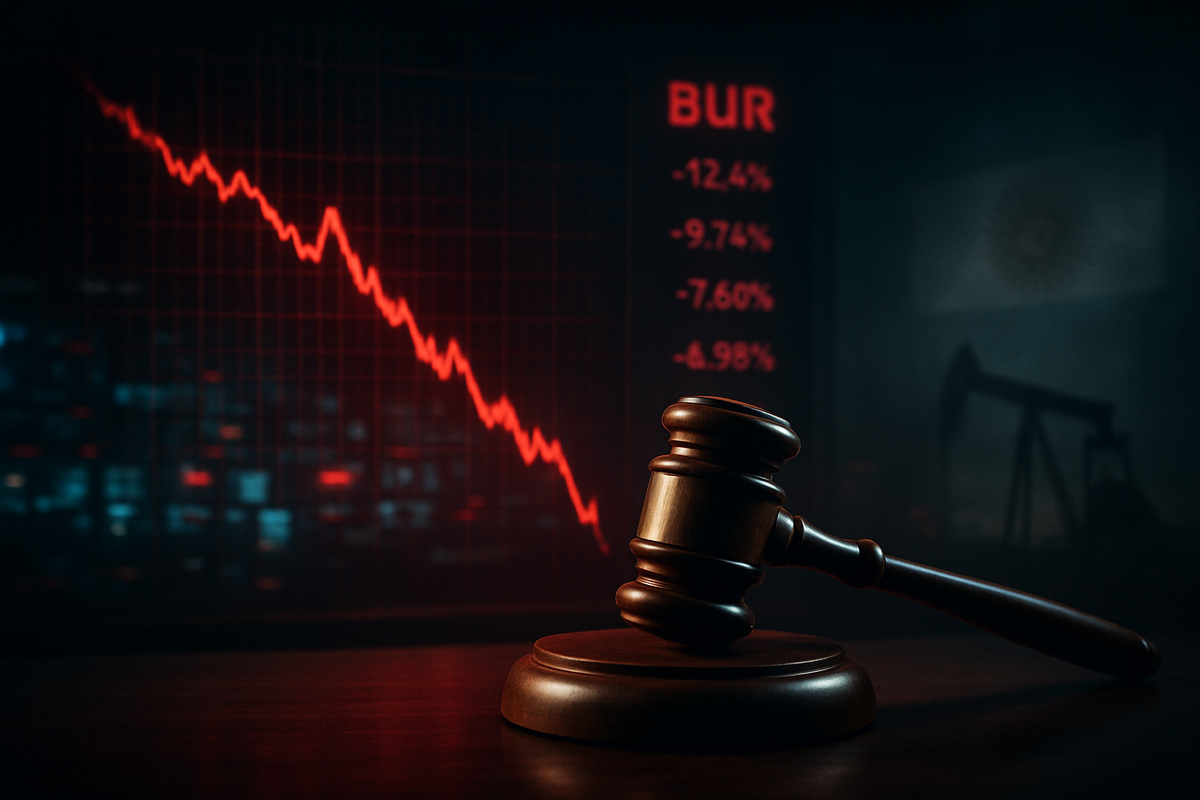
In a stunning reversal that has sent shockwaves through the global legal and financial sectors, shares of Burford Capital (NYSE: BUR) plummeted by more than 45% on Friday, March 27, 2026. The massive sell-off followed a landmark ruling by the U.S. Second Circuit Court of Appeals, which completely overturned a previous $16.1 billion judgment against the Republic of Argentina. The ruling effectively erases the largest award in the history of the litigation finance industry and strips Burford of a multi-billion dollar "accrued gain" that had been a cornerstone of its valuation for years.
The market reaction was immediate and punishing. Trading of Burford’s stock was halted multiple times throughout the morning session as the share price spiraled from its previous close, eventually settling near $4.14—a level not seen in years. For investors, the reversal represents a "black swan" event, exposing the extreme binary risks inherent in high-stakes litigation funding and raising urgent questions about the firm’s future revenue streams and the valuation of its remaining portfolio.
The Verdict That Shook the Markets
The crisis centers on a decade-long legal battle over the 2012 nationalization of the Argentine oil giant YPF (NYSE: YPF). In 2023, District Judge Loretta Preska had ruled in favor of plaintiffs Petersen Energia and Eton Park Capital Management—claims largely funded and owned by Burford—awarding them $16.1 billion for Argentina’s failure to launch a mandatory tender offer during the expropriation. However, in a 2-1 decision released early Friday, the Second Circuit Court of Appeals in Manhattan vacated that entire judgment.
Circuit Judge Denny Chin, writing for the majority, held that the breach-of-contract claims were "not cognizable" under the specific interplay of Argentine law and sovereign rights. The court determined that when a state exercises its sovereign power of expropriation, such actions are governed by public law, which takes precedence over private corporate bylaws. Consequently, the court found that Argentina was not contractually obligated to make a tender offer to minority shareholders under the circumstances of a state-led nationalization. This legal pivot effectively invalidated the logic that had underpinned Burford’s massive valuation hike over the past three years.
The timeline leading to this collapse was marked by a series of high-stakes procedural battles. Throughout late 2025, Judge Preska had ordered Argentina to begin turning over its controlling stake in YPF to satisfy the judgment, a move that the Republic fought tooth and nail. However, signs of trouble emerged in October 2025 during oral arguments, when appellate judges expressed deep skepticism about why a case involving Argentine sovereign acts was being adjudicated in a U.S. courtroom. Today’s ruling marks the definitive end of that phase of the litigation, leaving Burford with virtually nothing from its most prized asset.
Winners and Losers in the Wake of the Reversal
The primary "winner" in this legal earthquake is undoubtedly the Republic of Argentina and its state-controlled energy firm, YPF. Argentine President Javier Milei hailed the ruling as a "historic victory for the people," noting that the judgment would have represented nearly 45% of the nation's annual budget. Shares of YPF surged by over 6% following the news, as the looming threat of asset seizures and a massive financial liability vanished. Argentina’s sovereign bonds also saw a modest uptick as international creditors viewed the removal of the $16 billion "hidden debt" as a significant improvement to the country's credit profile.
Conversely, Burford Capital stands as the day's biggest loser. The firm had spent hundreds of millions of dollars in legal fees and capital to keep the case alive for over a decade. Beyond the direct financial loss, the firm faces a crisis of confidence. Institutional investors, who had previously been comfortable with Burford’s "unrealized gain" accounting—where cases are marked up on the balance sheet before they reach a final settlement—are now reassessing the validity of those marks. The sudden evaporation of nearly half the firm's net asset value (NAV) has sparked fears that other cases in Burford's portfolio may also be overvalued.
Other players in the litigation finance space, such as Omni Bridgeway (ASX: OBL) and various private credit funds, may see a chilling effect. While these competitors were not directly involved in the YPF case, the ruling highlights the "concentration risk" that plagues the industry. Small and mid-cap litigation funders may find it harder to raise capital in the coming months as investors demand more diversified portfolios and less exposure to single "mega-cases" that can make or break a company's balance sheet.
A Watershed Moment for Litigation Finance
This event fits into a broader, more troubling trend for the third-party litigation funding (TPLF) industry. For years, critics have argued that the practice of "investing in lawsuits" turns courtrooms into casinos. The Burford-YPF reversal provides ammunition for those seeking tighter regulations. Specifically, it coincides with the introduction of the "Protecting Our Courts from Foreign Manipulation Act of 2025," a legislative effort aimed at limiting the role of foreign-funded entities in U.S. litigation involving sovereign interests. The Second Circuit's ruling reinforces the idea that U.S. courts are becoming increasingly wary of being used as a tool to pressure sovereign nations over internal policy decisions.
Historically, this event draws comparisons to the 2019 Muddy Waters short-seller report that initially sent Burford shares into a tailspin. However, today's crash is seen as more fundamental; while the 2019 event was a critique of accounting practices, this 2026 crash is the result of a definitive legal failure in the firm's "crown jewel" case. It underscores the "Sovereign Immunity" hurdle that many litigation funders have struggled to clear. Reaching a judgment against a country is one thing; collecting on it or maintaining it through the appellate process is an entirely different, and far more precarious, challenge.
The ripple effects will likely extend to how litigation finance firms are valued by the market. The "Burford Model," which relies heavily on high-probability, high-impact wins to drive stock price, may be replaced by more conservative models that focus on a higher volume of smaller, more predictable settlements. Analysts expect a shift toward "portfolio-based" funding, where the success of a funder is not tied to the outcome of a single, binary event.
Navigating the Path Forward
In the short term, Burford Capital has already indicated its intention to fight on. Management has hinted at two possible paths: an appeal to the U.S. Supreme Court or pursuing an "arbitration path" through international bodies like the International Centre for Settlement of Investment Disputes (ICSID). However, both paths are fraught with difficulty. The Supreme Court hears only a fraction of the cases presented to it, and international arbitration can take another five to seven years to reach a conclusion, with enforcement being notoriously difficult against sovereign states.
Strategically, Burford may be forced to pivot its business model. The firm might look to increase its focus on corporate "legal asset management"—helping Fortune 500 companies monetize their own legal claims—rather than betting on high-risk, high-reward sovereign disputes. This shift would likely lead to lower margins but more stable, predictable earnings, which could help rebuild investor trust over the long term. Additionally, the firm may face pressure to sell off portions of its other successful cases to raise cash and shore up its balance sheet in the wake of the YPF disaster.
Market opportunities may emerge for distressed debt investors who specialize in buying deeply discounted claims. If Burford decides to liquidate its stake in the YPF litigation to focus on other areas, these specialized funds may step in, though they will likely demand a massive discount. For the broader market, the "Burford Crash of '26" serves as a stark reminder that in the world of litigation finance, the law is the ultimate arbiter, and no judgment is truly final until the last appeal is exhausted.
Summary and Investor Outlook
The 45% crash of Burford Capital marks a definitive end to the "gold rush" era of sovereign litigation funding. The key takeaway for investors is the reality of concentration risk; when a single case accounts for a nearly half of a company's perceived value, any legal setback becomes an existential threat. The market is now moving toward a period of intense skepticism regarding the valuation of legal assets, and transparency will be the new currency for firms wishing to remain public.
Moving forward, the litigation finance industry will likely face increased regulatory scrutiny and a more cautious investor base. For Burford, the coming months will be a period of painful restructuring and reputation management. Investors should watch closely for any news regarding the firm's Supreme Court petition, as well as its quarterly earnings reports, which will reveal the full extent of the damage to its NAV.
Ultimately, the Burford-YPF saga serves as a cautionary tale of the intersection between high finance and the complexities of international law. While litigation finance remains a viable asset class, the era of the "multi-billion dollar windfall" may be closing, replaced by a more disciplined and diversified approach to legal investment.
This content is intended for informational purposes only and is not financial advice.