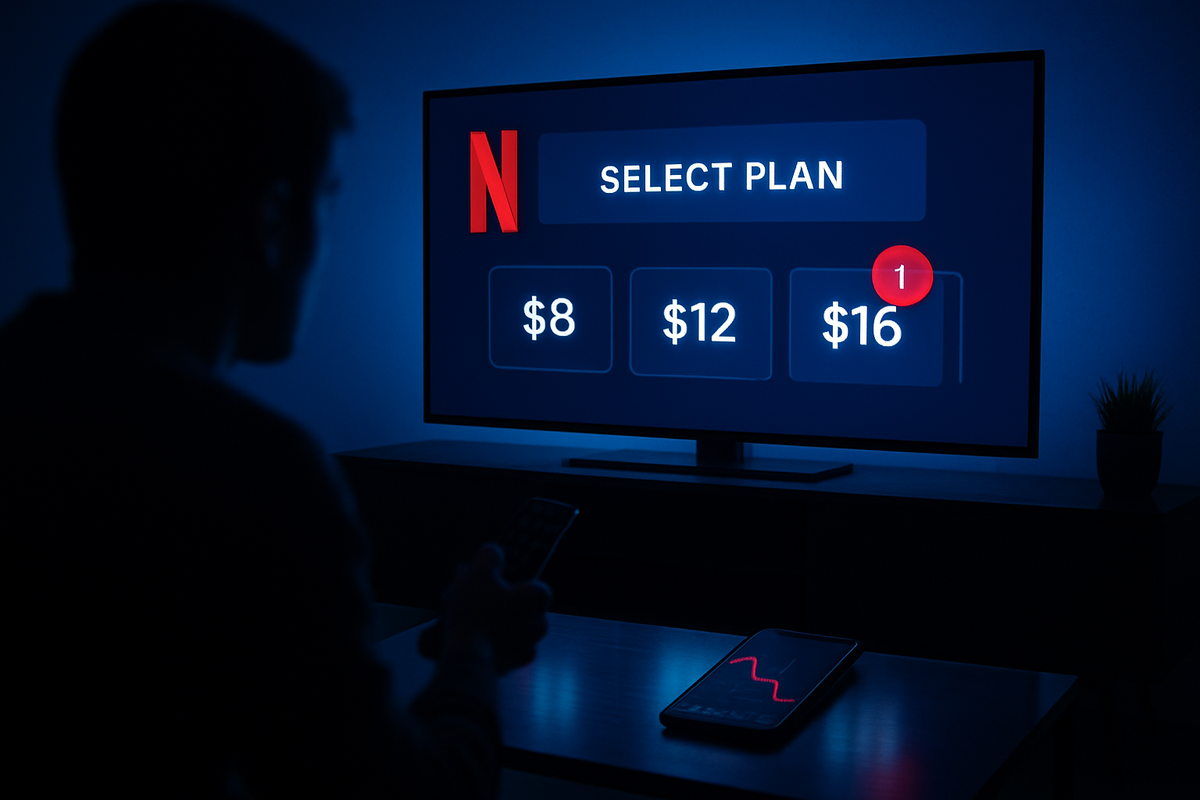
Shares of Netflix Inc. (NASDAQ: NFLX) experienced a notable pullback during Friday’s trading session, as investors weighed the long-term sustainability of the company’s latest aggressive pricing restructure. The streaming giant announced a sweeping series of price hikes across all its subscription tiers on March 26, 2026, marking its second major cost adjustment in just over a year. While the company framed the move as a necessary step to fund its record-breaking $20 billion content budget, the market’s reaction was decidedly lukewarm, reflecting deep-seated concerns over a "sensitive consumer environment" where digital fatigue has begun to set in.
The immediate market dip highlights a growing rift between Netflix’s push for higher Average Revenue Per Member (ARM) and a consumer base that is increasingly price-sensitive. As the cost of a "Standard" ad-free subscription nears the $20-per-month threshold, analysts are warning that the streaming industry may have finally hit its "pricing ceiling." For a market that has recently rewarded profitability over pure subscriber growth, the sudden volatility in Netflix stock suggests that Wall Street is beginning to fear a resurgence in churn rates as households grapple with the cumulative effect of "streamflation."
A Calculated Gamble in a Maturing Market
The pricing overhaul, which officially rolled out on March 26, 2026, saw Netflix increase its "Standard with Ads" tier by $1.00 to $8.99, while the "Standard" ad-free and "Premium" 4K tiers rose by $2.00 each, bringing them to $19.99 and $26.99 respectively. This timeline follows a period of intense capital deployment for the company, including its high-profile pivot into live sports with exclusive Major League Baseball (MLB) Opening Day rights and a weekly residency for WWE Raw. To fuel these massive "live-ification" projects, Netflix executives argued that the value proposition of the platform has never been higher, justifying the increased cost to the consumer.
However, the initial market reaction was characterized by volatility. After a brief morning rally on the day of the announcement, Netflix shares dipped by 1.8% in early trading on March 27, as several prominent research firms issued warnings. Needham analysts lowered their price target for NFLX, citing a projected slowdown in revenue growth from 17% in late 2025 to just 12% in 2026. Key stakeholders, including institutional investors who have recently cheered Netflix’s "pricing power," are now closely monitoring whether this hike will be the catalyst for a "subscription-hopping" trend that could erode the company’s industry-leading engagement numbers.
Winners and Losers in the Streaming Arms Race
The primary loser in this scenario—at least in the short term—appears to be the Netflix consumer, but the competitive fallout extends much further. Netflix (NASDAQ: NFLX) faces a newly consolidated rival in the form of the merged Paramount-Skydance (NASDAQ: PARA), which recently finalized its $111 billion acquisition of Warner Bros. Discovery. This "New Paramount" has emerged as a formidable "value" alternative, strategically keeping its premium tier at $13.99 to capture price-sensitive refugees from Netflix’s ecosystem. By positioning its massive library—including HBO, CNN, and DC content—at a lower price point, Paramount-Skydance stands to gain significant market share during this transition.
Conversely, Amazon.com Inc. (NASDAQ: AMZN) may find itself in a "winning" position by default. As Netflix pushes users toward its $8.99 ad-supported tier, Amazon has doubled down on its own ad-tier dominance, keeping its base Prime Video offering integrated within the broader Prime ecosystem. Meanwhile, The Walt Disney Company (NYSE: DIS) is also poised to benefit; by bundling Disney+, Hulu, and ESPN+ at a price point that now rivals a single Netflix Premium subscription, Disney is making a compelling case for "bundle value" that could attract families looking to maximize their entertainment dollar.
The Broader Impact of 'Streamflation'
Netflix’s decision to raise prices fits into a broader industry trend where "monetizing engagement" has replaced "subscriber acquisition" as the primary North Star. This shift is a direct response to the saturation of the U.S. and European markets. Historically, when Netflix raised prices in 2022 and late 2023, the stock eventually recovered as churn remained lower than expected. However, the 2026 economic landscape is different; government data from early 2026 indicates that while general inflation has cooled to 2.7%, streaming service costs have surged by over 20% year-over-year. This creates a "ripple effect" where consumers are no longer just canceling one service, but are migrating toward free, ad-supported (FAST) platforms like YouTube and Tubi.
Furthermore, the "live-ification" of streaming—where Netflix, Disney, and Amazon are all bidding billions for sports rights—has created a permanent upward pressure on subscription fees. This mirrors the historical trajectory of cable television, which eventually priced itself out of the average consumer's budget. Regulatory bodies have also begun to take notice; several consumer advocacy groups in early 2026 have called for more transparency in how "hidden" fees, such as Netflix’s $9.99 extra member charge, are marketed to the public.
The Road Ahead: Strategic Pivots and Scenarios
In the short term, Netflix is likely to lean heavily into its advertising business to cushion the blow of any premium-tier cancellations. By widening the price gap between its ad-supported plan ($8.99) and its standard plan ($19.99) to a massive $11 monthly difference, the company is effectively nudging its most price-sensitive users into the ad-supported funnel. This is a strategic pivot; Netflix’s internal projections suggest that ad revenue could double to $3 billion by the end of 2026, which would provide a more stable, recurring revenue stream that is less dependent on quarterly price hikes.
Long-term, the challenge for Netflix will be maintaining its "must-have" status. If the company can prove that its live sports and "spectacle" programming—such as the upcoming 2026 slate of high-budget original films—can sustain engagement despite the $26.99 price tag for 4K streaming, the stock will likely rebound. However, if churn rates spike in the coming quarters, Netflix may be forced to reconsider its capital intensity, potentially leading to a pullback in content spending or a more aggressive push into gaming and immersive media to add value to existing tiers.
Conclusion: What to Watch in the Coming Months
The recent dip in Netflix stock serves as a stark reminder that even the king of streaming is not immune to the laws of consumer demand. The key takeaway for investors is that the "easy growth" era of streaming is over. Netflix is now operating in a "mature utility" phase, where every dollar of revenue growth must be balanced against the risk of alienating a consumer base that is increasingly frustrated by the rising cost of digital living. The market is no longer giving Netflix a "blank check" for content spending; it is demanding a clear path to sustained margin expansion.
As we move into the second half of 2026, investors should keep a close eye on Netflix's quarterly "churn" metrics and the growth of its ad-supported tier. If the migration to the ad-tier happens faster than anticipated without a significant drop in total subscribers, the current stock dip may be seen as a buying opportunity. However, if the "New Paramount" and Disney bundles start to eat into Netflix’s core North American base, the company may face its most significant strategic test since the dawn of the streaming era. For now, Netflix remains the industry leader, but its crown is feeling heavier—and more expensive—than ever before.
This content is intended for informational purposes only and is not financial advice.