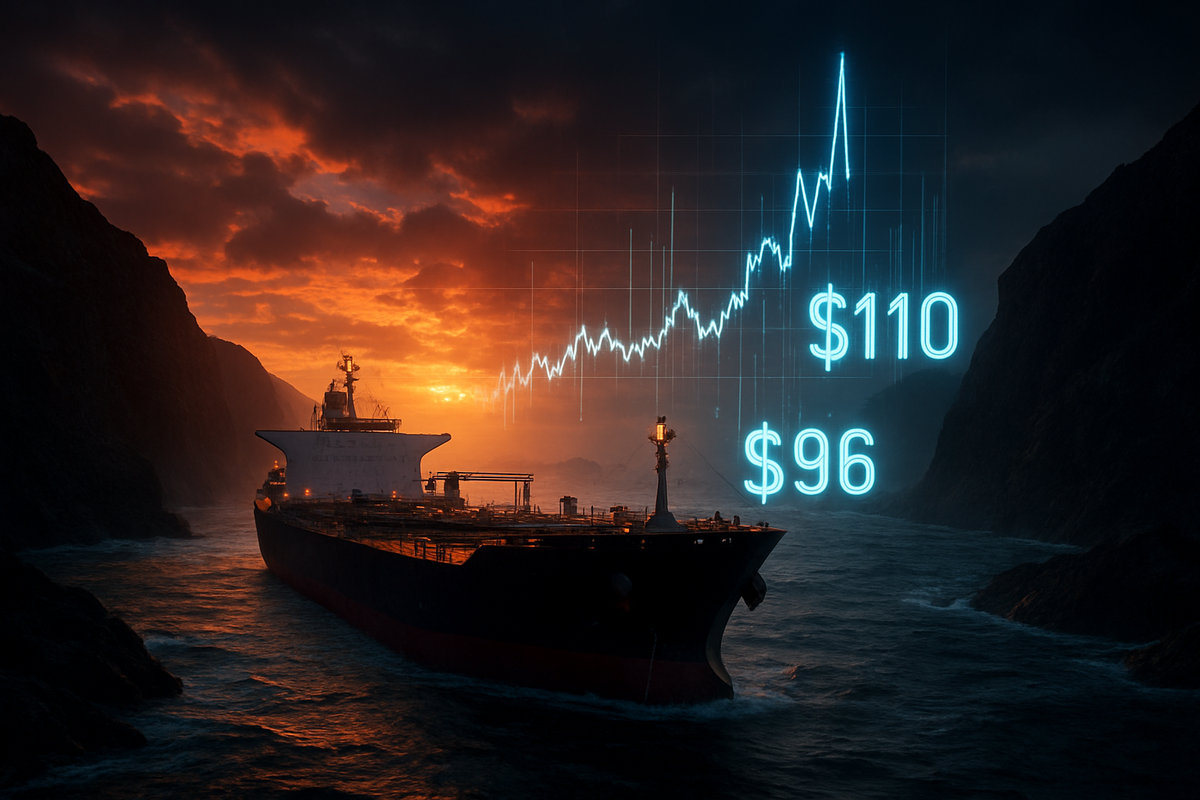
LONDON / NEW YORK — In a week marked by escalating geopolitical instability, global energy markets have been sent into a tailspin as Brent crude oil prices surged past the $110 per barrel mark, with West Texas Intermediate (WTI) following closely at over $96. The catalyst for this dramatic spike is a critical disruption in the Strait of Hormuz, the world’s most vital maritime energy artery, where recent military hostilities have brought tanker traffic to a virtual standstill. As of March 27, 2026, the global economy is bracing for a sustained period of high energy costs that threatens to reignite inflationary pressures and derail a fragile post-pandemic recovery.
The immediate implications are being felt across every corner of the financial landscape. Equity markets in New York, London, and Tokyo saw sharp sell-offs as investors moved away from risk-sensitive assets, fearing that triple-digit oil prices will squeeze corporate margins and force central banks to maintain restrictive monetary policies. For the average consumer, the surge is translating into immediate pain at the pump, with U.S. national average gasoline prices jumping over 30% in less than a month, while diesel and jet fuel prices have crossed levels not seen since the peak of the 2022 energy crisis.
Geopolitical Escalation and the Closing of the "Oil Tap"
The current crisis traces its roots to late February 2026, when a series of joint military strikes by the United States and Israel targeted key Iranian energy and military infrastructure. In a swift and severe retaliation, Iran’s Islamic Revolutionary Guard Corps (IRGC) declared a "security zone" across the Strait of Hormuz, effectively issuing a blockade on vessels traveling to or from the United States and its regional allies. By mid-March, maritime insurance rates had skyrocketed to prohibitive levels, and by March 19, standard commercial tanker traffic through the 21-mile-wide waterway had dropped to near zero.
The Strait of Hormuz is the single most important chokepoint in the global oil trade, with approximately 20.5 million barrels of oil and petroleum products—nearly 25% of the world’s seaborne oil—passing through it daily. Unlike other regions, major producers such as Kuwait, Qatar, and Iraq have limited pipeline infrastructure to bypass the Strait, leaving over 10 million barrels per day (mb/d) of production effectively "locked" and unable to reach global markets. This sudden physical shortage has decoupled oil prices from traditional supply-demand fundamentals, moving instead into a "war premium" phase driven by the immediate threat of a prolonged supply gap.
Market analysts noted that while the International Energy Agency (IEA) has authorized a record release of 400 million barrels from Strategic Petroleum Reserves (SPR), the volume is viewed as a "stop-gap measure" that can only cover the shortfall for approximately 20 to 30 days. The initial market reaction was a "flight to safety," pushing the Brent-WTI spread to an unusually wide $12.50, reflecting the acute shortage of international crude compared to the relatively more stable, domestically produced U.S. shale.
A Tale of Two Markets: Winners and Losers
As the energy sector surges, the divergence between industry "winners" and "losers" has become starkly apparent. The primary beneficiaries are the global integrated oil majors, who are seeing record expansion in their upstream margins. ExxonMobil (NYSE: XOM) and Chevron (NYSE: CVX) have both seen their share prices climb as investors bet on multi-quarter profit windfalls. Similarly, European giants Shell (NYSE: SHEL) and BP (NYSE: BP) are capturing significant gains from their massive portfolios in Liquefied Natural Gas (LNG), which has also seen price spikes as European and Asian nations scramble for non-Middle Eastern energy sources. Beyond the "Big Oil" firms, defense contractors like Lockheed Martin (NYSE: LMT) have seen increased interest as regional tensions signal a potential long-term increase in military procurement.
Conversely, the transportation and logistics sectors are bearing the brunt of the crisis. Major airlines, including Delta Air Lines (NYSE: DAL) and United Airlines (NASDAQ: UAL), have seen their stock prices retreat by more than 15% this month. Fuel typically accounts for a quarter of airline operating expenses, and with jet fuel prices mirroring the surge in Brent, these companies are being forced to implement aggressive fuel surcharges, threatening to dampen demand for summer travel. Logistics and delivery firms like FedEx (NYSE: FDX) and UPS (NYSE: UPS) are also facing margin compression as the cost of operating their massive air and ground fleets climbs, though analysts suggest these firms may eventually pass most of those costs onto customers via "energy adjustors."
Historical Parallels and the Broader Industry Shift
The current crisis draws inevitable comparisons to the 1973 Oil Embargo and the 2022 energy spike following the invasion of Ukraine. However, the 2026 scenario presents a unique set of challenges. Unlike 1973, the world is significantly more energy-efficient, yet demand for oil is more "sticky," as it is now concentrated in hard-to-electrify sectors like aviation, heavy shipping, and petrochemicals. Furthermore, the global reliance on AI-driven data centers, managed by firms like Microsoft (NASDAQ: MSFT) and NVIDIA (NASDAQ: NVDA), has created a new, massive demand for electricity, much of which still relies on natural gas—a commodity whose price is closely correlated with crude oil.
From a policy perspective, this surge is likely to accelerate the "Green Transition" in the long term, potentially benefiting electric vehicle manufacturers like Tesla (NASDAQ: TSLA) and renewable energy providers. However, in the short term, the crisis highlights the "energy trilemma"—the struggle to balance energy security, affordability, and sustainability. Governments that had previously pivoted away from fossil fuels are now finding themselves in the politically difficult position of subsidizing oil and gas production to prevent economic collapse, mirroring the regulatory U-turns seen in Europe during 2022.
What Comes Next: Strategic Pivots and Scenarios
The coming months will be defined by the success or failure of diplomatic and military efforts to reopen the Strait of Hormuz. In a "Best Case" scenario, a de-escalation agreement could see oil prices quickly retreat toward the $80 range. However, a "Worst Case" scenario involves a prolonged military conflict that could see Brent crude challenge the $150 mark, a level that most economists agree would trigger a global recession.
Investors should watch for a "Strategic Pivot" among energy companies toward increased domestic production in stable regions like the Permian Basin and the North Sea. For the broader market, the focus will shift to "demand destruction"—the point at which prices become so high that consumers stop spending on other goods and services. If oil stays above $110 for more than a single quarter, the likelihood of a "hard landing" for the U.S. and European economies increases significantly, as high energy costs act as a massive tax on global productivity.
Market Outlook and Final Thoughts
The surge in Brent crude to $110 and WTI to $96 represents more than just a fluctuation in commodity prices; it is a systemic shock to the global geopolitical order. The vulnerability of the Strait of Hormuz has once again been exposed, proving that despite decades of talk about energy independence, the global economy remains tethered to the stability of the Middle East.
Moving forward, the key metrics for investors will be maritime insurance rates, the pace of IEA reserve releases, and the ability of Asian economies—particularly China and India—to source "dark" or diverted barrels. While oil majors (XOM, CVX) offer a hedge against these risks, the broader market faces a period of intense volatility. The lasting impact of this event may well be a permanent shift in how nations view energy security, favoring domestic renewables and nuclear power over the fragile long-distance supply chains that have characterized the last century of global trade.
This content is intended for informational purposes only and is not financial advice.