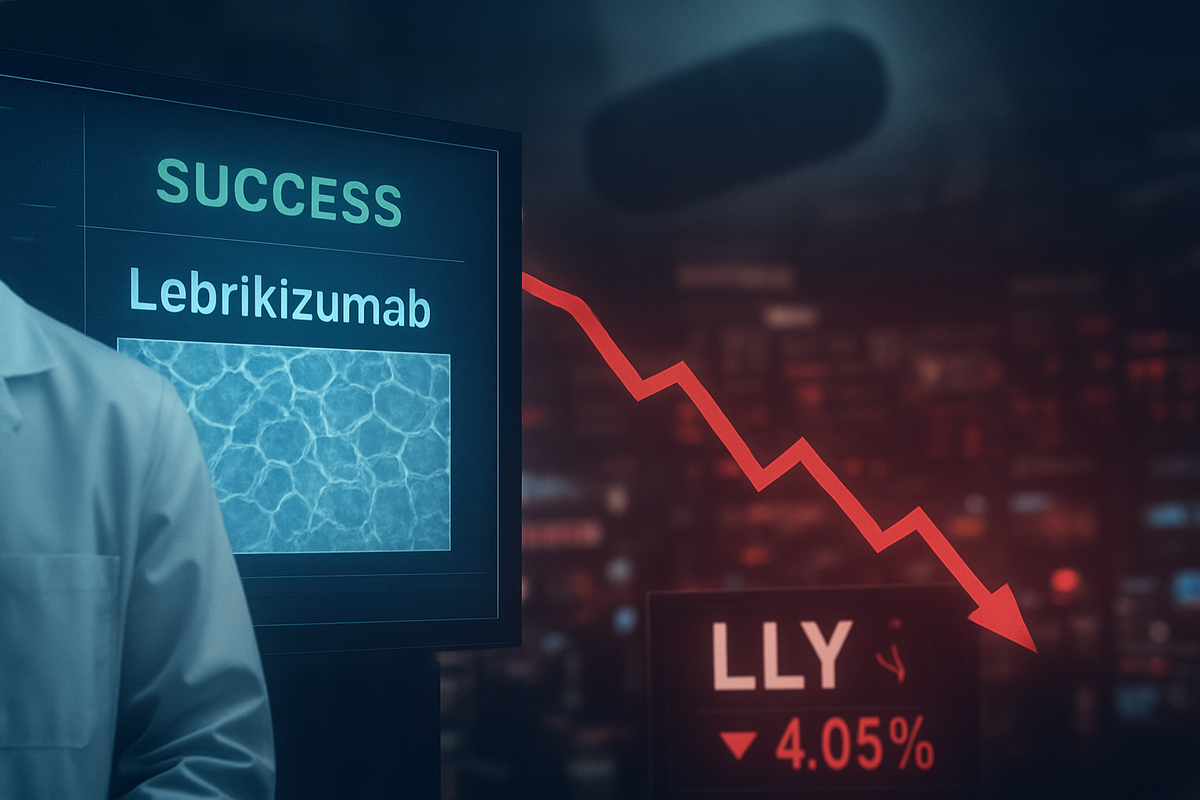
INDIANAPOLIS – In a move that has left some retail investors scratching their heads, shares of Eli Lilly and Company (NYSE: LLY) have trended lower this week, despite the pharmaceutical giant releasing stellar long-term clinical data for its atopic dermatitis (eczema) treatment, Ebglyss. The disconnect between the laboratory and the trading floor highlights a shifting landscape in the high-stakes dermatology market and a growing "obesity or bust" sentiment surrounding the company's valuation.
As of the market close on March 27, 2026, Lilly’s stock has slipped approximately 8% over the month, settling in the $915 range. This decline comes even as the company presented data at the American Academy of Dermatology (AAD) annual meeting showing that Ebglyss (lebrikizumab) maintains skin clearance for up to four years in a majority of patients. The cool reception suggests that for a company with a trillion-dollar aspiration, "good news" in secondary therapeutic areas is no longer sufficient to drive the needle.
A Four-Year Win Met with a Shrug
The clinical data released during the final week of March 2026 was, by most medical standards, a definitive victory. The ADlong study—a long-term extension of the pivotal ADvocate 1 & 2 trials—showed that nearly 80% of patients who achieved clear or almost clear skin at the start of the maintenance phase sustained those results for four years. Perhaps more importantly, the drug demonstrated a consistent safety profile over the extended period, with no new safety signals emerging.
Earlier in the month, Lilly also touted success in its ADorable-1 pediatric trial. The study confirmed that Ebglyss was effective in infants as young as six months, potentially clearing the path for a label expansion that would allow Lilly to compete across the entire age spectrum of eczema sufferers. This followed a turbulent history for the drug, which faced a 2023 Complete Response Letter from the FDA due to manufacturing issues at a third-party site—an obstacle the company finally cleared in late 2024.
Despite these milestones, the market's reaction has been anchored by broader concerns. Institutional investors appear to be "de-risking" their portfolios ahead of a massive April catalyst: the FDA decision on orforglipron, Lilly’s highly anticipated oral obesity pill. Furthermore, a mid-month downgrade from HSBC Holdings (NYSE: HSBC) added fuel to the fire, with analysts suggesting that the market’s expectations for Lilly’s profit margins in the coming decade may be overly optimistic given the rising tide of competition.
The "Dupixent Wall" and Emerging Disruptors
The primary hurdle for Ebglyss is not its efficacy, but its timing. It entered a market currently dominated by the "gold standard" treatment, Dupixent, co-developed by Sanofi (Nasdaq:SNY) and Regeneron Pharmaceuticals, Inc. (Nasdaq:REGN). By 2026, Dupixent has become a multi-billion-dollar fortress with deep-rooted physician loyalty and favorable placement on insurance formularies.
While Ebglyss offers a convenient once-monthly maintenance dose—compared to Dupixent’s bi-weekly schedule—analysts note that many insurers still require "step therapy," forcing patients to fail on Dupixent before Ebglyss is covered. This regulatory and commercial friction makes it difficult for Lilly to steal significant market share, regardless of how impressive its four-year data looks.
The competitive landscape is also shifting toward even greater convenience. Just days ago, Apogee Therapeutics (Nasdaq:APGE) released Phase 2 data for its candidate, zumilokibart, which hints at the possibility of dosing every three to six months. In a world where patients are increasingly seeking "set it and forget it" treatments, Lilly’s monthly injection, while an improvement over the status quo, may already be looking like a bridge to a more convenient future rather than the final destination.
The Obesity Overshadow and Industry Trends
The current volatility in LLY shares underscores a broader trend in the pharmaceutical industry: the "winner-takes-most" dynamic of the GLP-1 obesity market. For companies like Lilly and its chief rival, Novo Nordisk (NYSE: NVO), every other therapeutic area—be it oncology, immunology, or neurology—is now viewed through the lens of how it supports or distracts from the obesity franchise.
The market’s cool reaction to Ebglyss is a symptom of "therapeutic overshadowing." Investors are currently valuing Lilly as a growth stock driven by Mounjaro and Zepbound; consequently, incremental wins in dermatology are often ignored, while even the slightest hint of pricing pressure or regulatory delays in the obesity space triggers a sell-off. The HSBC downgrade specifically pointed to the $150 billion obesity market estimate as potentially fragile, creating a "guilt by association" effect that pulled down the entire stock, irrespective of the eczema news.
Historically, this mirrors the period when AbbVie (NYSE: ABBV) was heavily dependent on Humira. Any news regarding AbbVie’s secondary pipeline was often ignored as the market focused solely on the impending "patent cliff" for its blockbuster. Lilly finds itself in the opposite but equally stressful position: the market is so focused on the upside of its obesity drugs that it has become hypersensitive to anything that doesn't contribute directly to that narrative.
The Road Ahead: April is the Crucial Month
As the calendar turns to April 2026, the short-term trajectory of Lilly's stock will likely decouple entirely from its dermatology successes. The looming April 10 FDA decision on orforglipron is the "make-or-break" moment for the quarter. If approved, the oral GLP-1 would revolutionize the obesity market by removing the need for injections, potentially justifying Lilly’s premium valuation and erasing the losses seen in March.
However, the strategic pivot for Ebglyss will require more than just trial data. To break the "Dupixent Wall," Lilly will likely need to engage in aggressive pricing strategies or direct-to-consumer marketing campaigns to convince patients and doctors that the once-monthly dosing is worth the switch. Investors should also keep a close eye on Lilly’s manufacturing scaling. Having been burned by CRLs in the past, the company must prove it can supply both its blockbuster obesity drugs and its specialty dermatology products without further hiccups.
Investor Takeaway: A Value Play in a Growth Shell?
The divergence between Eli Lilly’s clinical performance and its stock price in March 2026 serves as a reminder that "the map is not the territory." While Ebglyss is objectively a clinical success that will likely generate billions in peak sales, it is currently a "minor note" in a much larger symphony.
For long-term investors, the current slip may represent a buying opportunity, as the underlying business fundamentals in immunology remain robust. However, the immediate future will be dictated by the FDA’s appetite for oral weight-loss drugs and the evolving competitive landscape in the GLP-1 space.
Moving forward, the key metrics to watch are not just the clearance rates in eczema trials, but the "access rates" on insurance tiers and the pace of the orforglipron rollout. In 2026, Lilly is no longer just a pharma company; it is a barometer for the most lucrative drug market in history, and everything else is just noise.
This content is intended for informational purposes only and is not financial advice.