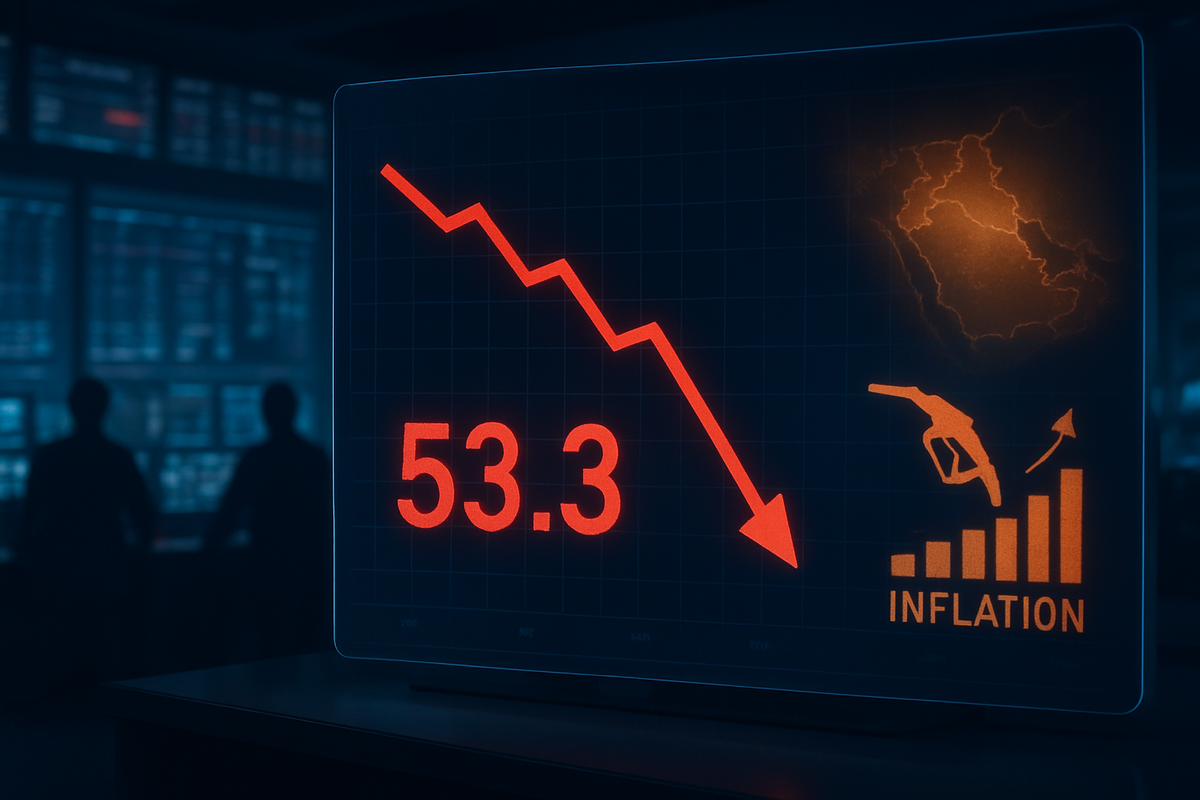
The University of Michigan’s final March consumer sentiment reading, released today, March 27, 2026, has sent a chill through financial markets as it revealed a sharper-than-expected decline in American economic optimism. Driven by a volatile geopolitical landscape and a sudden spike in energy costs, the headline index tumbled to 53.3, down from a preliminary reading of 55.5 and well below February’s 56.6. This marks the lowest level of consumer confidence since late 2025, signaling that the "soft landing" narrative many investors had embraced for 2026 is facing its most significant challenge yet.
The immediate implications of the report are stark: a broad sell-off in equities and a surge in Treasury yields as traders grapple with the reality of "stagflationary" pressures. With short-term inflation expectations jumping to 3.8%, the data suggests that the recent military escalations in the Middle East are beginning to bleed into the domestic economy, forcing the Federal Reserve into a defensive posture. Market participants who were once hopeful for a series of interest rate cuts throughout the year are now pricing in the possibility of a rate hike as early as June to combat the resurgence of price instability.
Geopolitical Shockwaves and the Consumer Psyche
The final March data paints a picture of a consumer base increasingly under duress. The Index of Consumer Expectations, a key forward-looking component, dropped to 51.7, a four-month low that underscores deepening anxiety about the future. This pessimism is largely rooted in the U.S.-Israeli military conflict with Iran that ignited in late February, an event that has since disrupted global oil supplies and sent gasoline prices soaring at American pumps. The "Current Economic Conditions" sub-index also took a hit, falling to 55.8, as the sticker shock of higher energy and food costs begins to erode discretionary income.
This downward trajectory comes at a delicate time for the U.S. economy. Following a relatively stable 2025, the first quarter of 2026 had shown signs of moderating growth. However, the suddenness of the March decline—falling into the bottom 1st percentile of the survey’s historical data—indicates that the psychological impact of the conflict has been more severe than initially anticipated by economists. Initial market reactions were swift; the S&P 500 and the Nasdaq Composite (NASDAQ: QQQ) both retreated to six-month lows shortly after the 10:00 AM ET release, as investors moved toward defensive assets.
Key stakeholders, including policymakers at the Federal Reserve and executives at major retail chains, are now monitoring these figures for signs of a "buyer's strike." While the labor market has remained relatively resilient throughout early 2026, the Michigan survey suggests that consumers are beginning to retrench. The 1-year inflation expectation, which surged to 3.8% from February’s 3.4%, is particularly troubling for the Fed, as it indicates that inflation expectations are becoming "unanchored" once again, reminiscent of the volatile period seen in 2022.
Winners and Losers in a High-Inflation, Low-Sentiment Environment
The diverging fortunes of public companies were on full display following today’s report. Traditional consumer discretionary giants are bearing the brunt of the sentiment collapse. Amazon.com, Inc. (NASDAQ: AMZN) and Tesla, Inc. (NASDAQ: TSLA) saw their shares slide as investors fretted over the impact of higher fuel costs and diminishing consumer confidence on big-ticket spending. Target Corporation (NYSE: TGT) and other mid-to-high-end retailers also faced selling pressure, as the Michigan data showed a marked decline in intentions to purchase durable goods and household appliances over the next six months.
Conversely, the energy sector has emerged as a primary "winner" in terms of stock performance, albeit for reasons that harm the broader economy. Exxon Mobil Corporation (NYSE: XOM) and Chevron Corporation (NYSE: CVX) have seen their valuations buoyed by the same crude oil price spikes that are depressing consumer sentiment. As global supply chains tighten due to the conflict in the Middle East, these integrated energy firms are benefiting from higher realized prices for their upstream production. Similarly, defense contractors such as Lockheed Martin Corporation (NYSE: LMT) and Northrop Grumman Corporation (NYSE: NOC) have seen increased interest as the geopolitical situation remains unresolved.
The banking sector presents a more complex picture. While JPMorgan Chase & Co. (NYSE: JPM) and its peers might typically benefit from higher interest rates, the threat of a consumer-led recession looms large. If the Michigan sentiment reading translates into a significant drop in loan demand and an uptick in credit defaults, the "higher-for-longer" interest rate environment could become a double-edged sword for the financial industry. For now, the rise in the 10-year Treasury yield to an 8-month high is providing some support for net interest margins, but the overarching fear of economic stagnation is capping gains.
The Fed’s Conundrum: Inflation vs. Growth
This latest data set fits into a broader, more worrying trend of "sticky" inflation that has plagued the early months of 2026. After a multi-year battle to bring inflation down to the 2% target, the recent military conflict has effectively reset the clock. The 5-year inflation expectation, while slightly lower at 3.2% compared to February, remains uncomfortably high for a Federal Reserve that has staked its credibility on price stability. The FOMC’s decision on March 18 to hold rates steady at 3.5% to 3.75% now looks increasingly like a temporary pause before a potential pivot back to tightening.
Historically, periods of geopolitical conflict accompanied by energy shocks have forced the Fed into difficult "no-win" scenarios. Today's Michigan report draws comparisons to the 1970s oil shocks, where the central bank had to choose between supporting a flagging economy and crushing rampant inflation. In the modern context, the Fed has been hoping for a "divine coincidence" where inflation falls without a significant rise in unemployment. However, with the CME FedWatch tool now showing a greater than 50% probability of a rate hike in the second quarter of 2026, the market is signaling that the "inflation fight" is far from over.
The ripple effects of this sentiment shift extend beyond the U.S. borders. A more hawkish Fed would likely bolster the U.S. Dollar, putting further pressure on emerging markets that hold dollar-denominated debt. Furthermore, if the American consumer—the primary engine of global growth—curtails spending, the impact will be felt by manufacturing hubs in Southeast Asia and Europe. The Michigan survey is often considered a "canary in the coal mine" for global demand, and today's reading is chirping a warning that is being heard in boardrooms worldwide.
What Comes Next: The Road to the June FOMC Meeting
In the short term, all eyes will shift from sentiment surveys to hard spending data. If the "Personal Consumption Expenditures" (PCE) report due next month confirms that consumers are indeed pulling back, the Fed may be forced to stay on the sidelines despite rising inflation. However, if spending remains robust while expectations remain high, a rate hike in June becomes an almost certainty. This creates a volatile "data-dependent" environment for investors, where every economic release could trigger significant swings in both the bond and equity markets.
The longer-term challenge for the U.S. economy will be a potential strategic pivot by major corporations. If consumer sentiment remains depressed at these levels (near the 53.0 mark), firms like Walmart Inc. (NYSE: WMT) and other discount retailers may see a "trade-down" effect as consumers move away from premium brands. Companies with strong pricing power and essential service offerings will likely outperform, while those reliant on cheap credit and high consumer confidence will need to adapt their growth strategies to a more austere economic reality.
Scenario planning for the rest of 2026 now includes the distinct possibility of "stagflation"—a period of low growth and high inflation. Investors should watch for the next preliminary Michigan reading in April to see if the March dip was a "flash in the pan" reaction to the initial conflict or the start of a prolonged decline. A stabilization of the index above 60 would be seen as a major relief, while a further drop toward the 50-level could signal an impending recession.
Conclusion: A Turning Point for the 2026 Market
The final March University of Michigan consumer sentiment reading of 53.3 is more than just a data point; it is a signal of a significant shift in the American economic narrative. The combination of geopolitical strife, rising energy costs, and unanchored inflation expectations has effectively ended the era of "disinflationary optimism" that characterized the end of 2025. Investors are now forced to confront a reality where the Federal Reserve may be forced to raise rates into a slowing economy, a move that would test the resilience of both the consumer and the corporate sector.
Moving forward, the market will likely remain in a state of heightened sensitivity. The key takeaways from today are the sharp jump in 1-year inflation expectations and the broad-based decline in consumer confidence across all demographic groups. This suggests that the impact of the Middle East conflict is being felt universally, rather than just by a specific segment of the population. For investors, the months ahead will require a defensive posture, with a focus on companies that can withstand higher input costs and a more cautious consumer base.
What to watch for: The April "Consumer Price Index" (CPI) release and the Fed’s messaging in the lead-up to the May and June meetings. If the rhetoric shifts from "patience" to "vigilance," it will be a clear sign that the Michigan sentiment reading was the first domino to fall in a new cycle of monetary tightening.
This content is intended for informational purposes only and is not financial advice