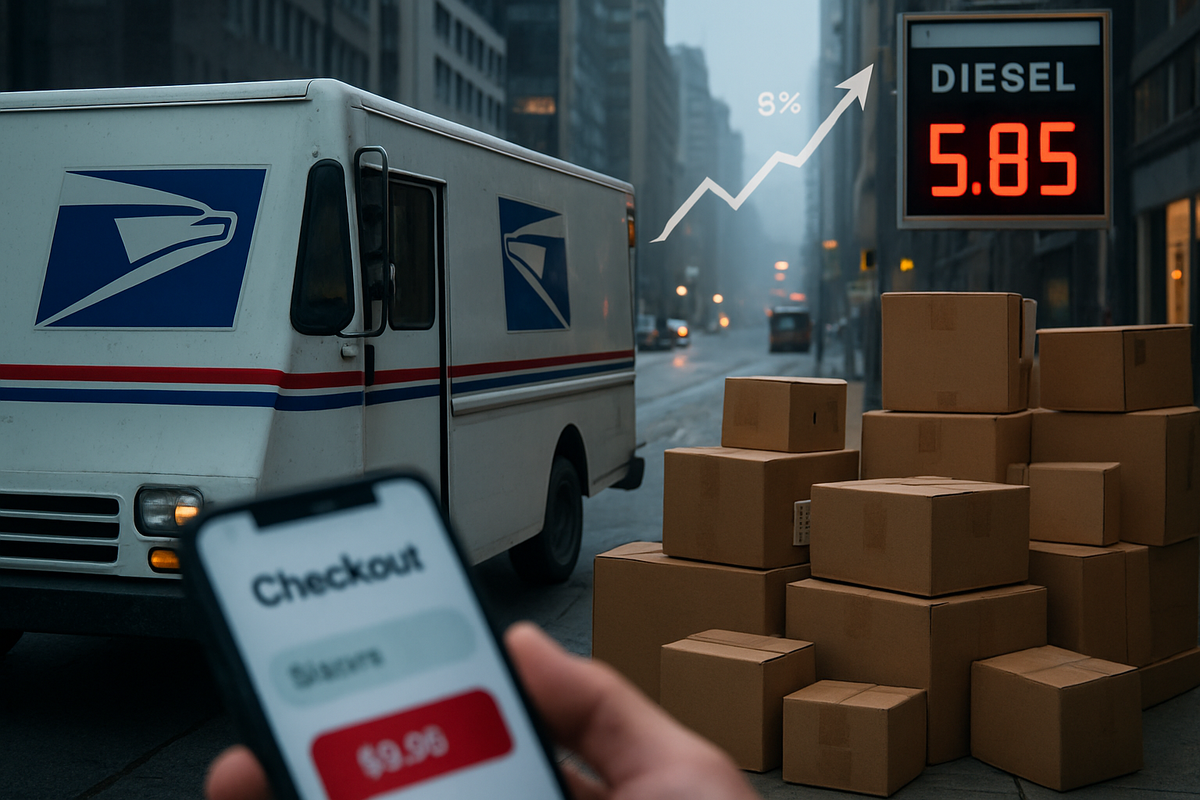
The USPS took a historic step on March 25, 2026, by filing a formal notice with the Postal Regulatory Commission (PRC) to implement a new 8% surcharge on its primary package delivery services. This move, aimed at combating a severe cash crisis and skyrocketing fuel costs, represents the first time the agency has adopted the dynamic fuel-surcharge model long used by its private-sector rivals. Scheduled to take effect on April 26, 2026, the surcharge is poised to send shockwaves through an e-commerce industry already struggling with "sticky" inflation and shifting consumer habits.
The timing of this announcement is particularly sensitive for the U.S. economy. With the February 2026 Consumer Price Index (CPI) showing inflation stalled at 2.4% and energy prices rebounding due to geopolitical tensions in the Middle East, the USPS surcharge acts as a "second-round effect" of persistent price pressures. For millions of American consumers and small businesses, the era of predictable, flat-rate shipping from the government’s postal arm appears to be coming to an end, replaced by a more volatile, market-driven pricing structure.
The Push for Financial Self-Sufficiency Under the Steiner Era
The proposed "Transportation-Related, Time-Limited Price Change" adds an 8% increase to the base postage for competitive products including Priority Mail, Priority Mail Express, USPS Ground Advantage, and Parcel Select. Notably, the surcharge does not apply to First-Class Mail or standard postage stamps, shielding traditional letter-mail users from the hike. Postmaster General David Steiner, who took the helm in July 2025 following the resignation of Louis DeJoy, framed the move as a necessary "bridge to a permanent mechanism" that will allow the agency to adjust prices dynamically based on market conditions—specifically the cost of diesel, which recently surged to over $5.36 per gallon amid the ongoing conflict in Iran.
This decision is the latest evolution of the "Delivering for America" (DFA) 10-year modernization plan. While the plan initially focused on infrastructure and service standards, the 2026 fiscal reality forced a shift toward aggressive revenue generation. In mid-March, the USPS warned Congress that it faced a liquidity crisis that could see it run out of operational cash by the end of the calendar year without drastic intervention. By mirroring the surcharge strategies of private carriers, Steiner aims to reduce the agency's reliance on taxpayer subsidies while addressing the massive margin erosion caused by rising transportation and labor costs.
The industry reaction was swift and varied. Small business owners and marketplace sellers on platforms like eBay and Etsy expressed immediate concern, noting that this 8% surcharge follows a general rate increase of up to 7.8% that already hit in January 2026. For a standard 2-pound package sent via Ground Advantage, the new surcharge adds roughly $1.00 per shipment. For high-volume, low-margin sellers, this represents a significant threat to profitability that many will have no choice but to pass on to the end consumer.
Logistics Giants and E-Commerce Titans: A Divergent Impact
The market response to the USPS announcement highlighted a growing divide between those who control their own logistics and those who remain dependent on third-party carriers. Amazon.com, Inc. (NASDAQ: AMZN) saw its stock rise 2.16% to $211.71 following the news. Investors interpreted the move as a validation of Amazon’s massive investment in its own delivery network, which officially overtook the USPS as the largest domestic parcel carrier in late 2025. By "in-sourcing" its logistics, Amazon has built a defensive moat that protects its Prime margins from the very surcharges now hitting its competitors. Reports suggest Amazon is already planning to slash its USPS shipping volume by two-thirds by the end of 2026.
Conversely, legacy carriers like United Parcel Service, Inc. (NYSE: UPS) and FedEx Corporation (NYSE: FDX) saw more muted stock movements. FedEx closed down 0.68% at $357.52, while UPS remained nearly flat at $98.37. For these companies, the USPS surcharge effectively levels the playing field, as their own fuel surcharges have recently hovered between 25% and 28%. However, the broader trend for UPS remains challenging; the company has been intentionally "gliding down" its exposure to Amazon volume, which has fallen by 50% over the last two years. As the USPS raises rates, these private carriers may pick up some displaced volume, but they must do so while grappling with the same inflationary pressures that forced the Postal Service's hand.
The biggest "losers" in this scenario are likely the small-to-medium enterprises (SMEs) and Direct-to-Consumer (DTC) brands that lack the scale of an Amazon. Analysts at TD Cowen and Evercore ISI predict a "margin squeeze" for online retailers throughout Q2 and Q3 of 2026. Fulfillment costs, which historically accounted for 15% of operational expenses for many brands, are projected to climb toward 25%. This will force a strategic pivot toward regional carriers like OnTrac or Veho, as businesses look for any possible way to bypass the national surcharge networks.
Sticky Inflation and the End of the "Zero-Surcharge" Era
The USPS surcharge is a significant marker of how "sticky inflation" is reshaping the American economy in 2026. While headline inflation has cooled from the peaks of 2022-2023, core services and energy remain volatile. The USPS, traditionally the "carrier of last resort" that absorbed price shocks to provide a public service, can no longer afford to ignore the market. This shift signifies a broader trend toward the "commoditization of delivery," where the cost of moving goods is treated with the same dynamic pricing as airline seats or ride-sharing.
Historically, the USPS has been slow to raise rates, often requiring months of regulatory review and public comment. The 2026 filing represents a more nimble, corporate-style approach to management. This has significant policy implications; critics argue that the USPS is moving too far away from its mandate to provide affordable universal service, while proponents argue that without these changes, the agency would collapse under the weight of its own debt. The ripple effects will also be felt in the labor market, as the USPS continues to modernize its sorting facilities and move toward a more automated, efficient—but potentially more expensive—operational model.
The surcharge also complicates the Federal Reserve’s path. As shipping costs rise, they are almost inevitably passed through to consumers in the form of higher "shipping and handling" fees or increased product prices. This contributes to the very "service sector inflation" that the Fed has been fighting to contain. If e-commerce prices remain elevated, the dream of reaching a sustained 2% inflation target may continue to move further out of reach for policymakers.
Navigating the Q2 and Q3 Margin Squeeze
Looking ahead to the remainder of 2026, the primary challenge for the e-commerce sector will be adaptation. In the short term, retailers will likely implement "shipping thresholds"—increasing the minimum order value required for free shipping—to preserve their margins. We may also see a resurgence of "Buy Online, Pick Up In Store" (BOPIS) initiatives as retailers try to eliminate the last-mile delivery cost entirely. For the holiday 2026 season, planning will likely begin earlier than ever, with brands locking in contracts with regional carriers to avoid the expected year-end peak surcharges.
Market opportunities may emerge for third-party logistics (3PL) providers that can offer consolidated shipping rates and better technology for carrier diversification. However, for many small businesses, the challenge will be survival. If consumer spending softens in response to these pass-through costs, we could see a slowdown in the broader e-commerce growth rate for the first time in years. The transition to a "permanent mechanism" for USPS pricing also means that volatility is here to stay; businesses must now build "shipping hedges" into their financial models much like airlines do for fuel.
The Investor’s Watchlist for the Coming Months
In summary, the USPS 8% surcharge is more than just a price hike; it is a fundamental shift in how one of the world’s largest logistics networks operates. The era of the USPS as a low-cost, flat-rate alternative to private carriers is fading. Moving forward, the market will reward those companies that possess the infrastructure to control their own destiny—like Amazon—while punishing those who remain vulnerable to third-party price fluctuations.
Investors should closely monitor several key indicators over the next few months. First, the PRC’s final approval of the surcharge, which is expected by mid-April. Second, the Q2 earnings reports from major retailers, which will reveal the initial impact of the surcharge on operating margins. Finally, watch for any further developments in the Middle East that could drive diesel prices even higher, potentially triggering another round of surcharges before the year is out. As inflation remains sticky, the cost of the "last mile" has never been more critical to the health of the U.S. consumer economy.
This content is intended for informational purposes only and is not financial advice.