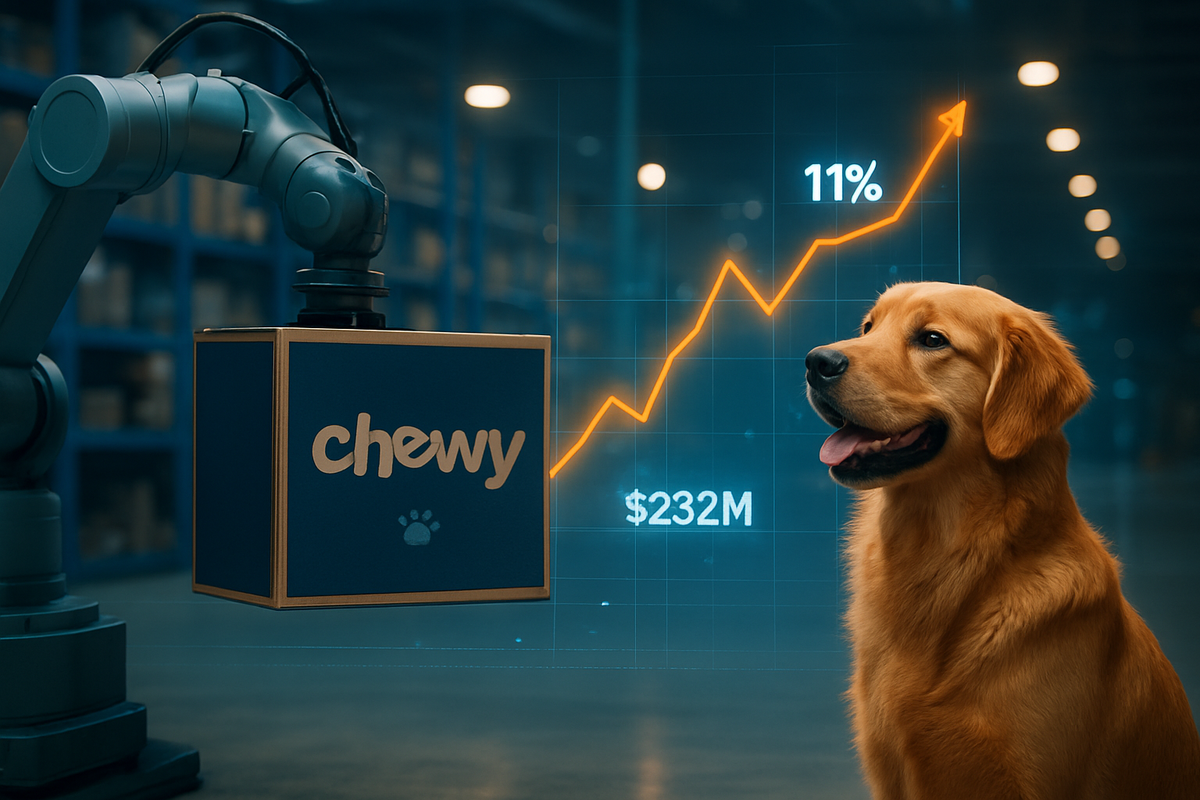
FORT LAUDERDALE, FL — In a market increasingly obsessed with bottom-line sustainability over raw user acquisition, Chewy, Inc. (NYSE: CHWY) delivered a masterclass in capital efficiency this morning. The online pet retail giant reported its fiscal fourth-quarter and full-year 2025 results on March 25, 2026, headlined by a record-breaking $232 million in free cash flow (FCF) for the quarter. While the report initially drew a mixed reaction due to a slight miss on earnings-per-share (EPS) and seemingly flat revenue growth, investors quickly looked past the surface-level noise, sending shares surging more than 11% in early trading.
The results underscore a pivotal shift for the pet industry leader, which has successfully transitioned from an aggressive growth-at-all-costs model to a high-margin, cash-generating powerhouse. By leaning into its high-moat "Autoship" subscription service and expanding into specialized pet healthcare, Chewy is proving that it can thrive even as the post-pandemic "pet boom" stabilizes into a more mature, predictable market.
The Numbers Behind the Surge: Efficiency Over Expansion
Chewy’s fourth-quarter performance was a tale of two balance sheets. On a GAAP basis, revenue for the quarter ending January 2026 came in at $3.26 billion, a modest 0.5% increase year-over-year. However, the company noted that this figure was impacted by a 53rd week in the prior-year comparison; on a normalized 13-week basis, revenue actually grew a healthy 8.1%. Net income for the quarter rose to $39.2 million, up from $22.8 million a year prior, though its adjusted diluted EPS of $0.27 narrowly missed consensus estimates of $0.28.
The true star of the report was the $232 million in quarterly free cash flow—a 48% increase from the $157 million produced in the same period last year. For the full fiscal year 2025, Chewy generated $562.4 million in FCF, supported by a disciplined reduction in capital expenditures, which totaled just $129.2 million. This cash windfall is largely attributed to the company’s massive investment in automated fulfillment centers and the continued dominance of its Autoship program, which now accounts for a staggering 84% of total net sales ($2.74 billion in Q4 alone). Active customers also showed a return to growth, reaching 21.3 million, a 4% increase year-over-year.
Winners and Losers in the Pet Retail War
The market's reaction today clearly positions Chewy (NYSE: CHWY) as the "Cash King" of the specialized pet sector, but the ripples are being felt across the competitive landscape. Petco Health and Wellness Company, Inc. (NASDAQ: WOOF) remains the primary specialized challenger, though it continues to operate in Chewy's shadow regarding capital efficiency. While Petco has recently stabilized its own balance sheet—reporting $187 million in FCF for the entire fiscal year 2025—it still lags behind Chewy’s single-quarter performance. Petco's strength remains its 1,300+ physical locations that offer grooming and veterinary services, a physical "moat" that Chewy is only beginning to challenge through its nascent clinic partnerships.
On the other side of the spectrum, Amazon.com, Inc. (NASDAQ: AMZN) continues to be the logistical "boogeyman" for the industry. Amazon maintains a 59% share of online private-label pet food sales, yet its broader retail margins face pressure from massive AI-driven capital expenditure plans. For investors, the "win" for Chewy today is the realization that it has carved out a loyal, recurring customer base that is relatively immune to Amazon's generalized convenience. Meanwhile, traditional big-box retailers like Walmart Inc. (NYSE: WMT) are seeing steady growth in their pet departments, but they lack the specialized data and pharmacy integration that drove Chewy’s $591 net sales per active customer (NSPAC) this quarter.
A Wider Significance: The "Humanization" of Cash Flow
Chewy’s results offer a window into broader industry trends, most notably the "humanization" of pet care and the resulting shift toward non-discretionary spending. Pet owners are increasingly viewing their animals as family members, leading to consistent spending on high-margin items like prescription diets, medications, and insurance. Chewy’s move into the pharmacy and health space has allowed it to maintain a 29.4% gross margin, even as the cost of customer acquisition in the general retail space has climbed.
Historically, e-commerce companies were judged by their ability to gain market share at any cost. However, in the 2026 economic environment, the "Chewy Playbook" has become the new standard: utilize massive scale to drive down fulfillment costs via automation, then lock in customers with high-frequency subscription models. This shift mirrors the evolution of software-as-a-service (SaaS) companies, where recurring revenue and cash-flow yields are the primary metrics of health. Chewy’s ability to generate more than half a billion dollars in annual FCF marks the moment the company moved from a "disruptor" to an "incumbent."
What Comes Next: The Path to $14 Billion
Looking ahead to fiscal year 2026, Chewy management has issued a confident outlook, guiding for net sales between $13.6 billion and $13.75 billion. The strategic pivot for the coming months will likely focus on two areas: international expansion and the deepening of its health services ecosystem. CEO Sumit Singh noted in the earnings call that the company exited 2025 in a "position of real strength," suggesting that the company may use its mounting cash pile for strategic acquisitions or to accelerate the rollout of "Chewy Vet Care" clinics.
The primary challenge moving forward will be maintaining this margin expansion as competitors like Petco (NASDAQ: WOOF) refine their membership models and Walmart (NYSE: WMT) expands its in-store pet services. Furthermore, any significant downturn in consumer discretionary spending could test the "recession-proof" narrative of the pet industry, though Chewy’s 84% Autoship rate provides a substantial safety net that most retailers can only envy.
Investing in the "New" Chewy
The key takeaway for investors is that Chewy is no longer just a "dog food delivery company." It is a data-driven logistics and healthcare platform that has finally reached the "profitable scale" it promised at its IPO. The record $232 million quarterly free cash flow is not an anomaly but the result of years of infrastructure investment finally bearing fruit.
As we move through 2026, investors should keep a close eye on the Net Sales Per Active Customer (NSPAC) and the growth of the pharmacy business. If Chewy can continue to increase the "wallet share" of its 21 million active users while keeping its capital expenditures lean, the stock's current surge may only be the beginning of a long-term re-rating. In a volatile market, the predictability of a pet’s appetite—and the efficiency of the company that feeds it—is a narrative that Wall Street is clearly willing to buy.
This content is intended for informational purposes only and is not financial advice.