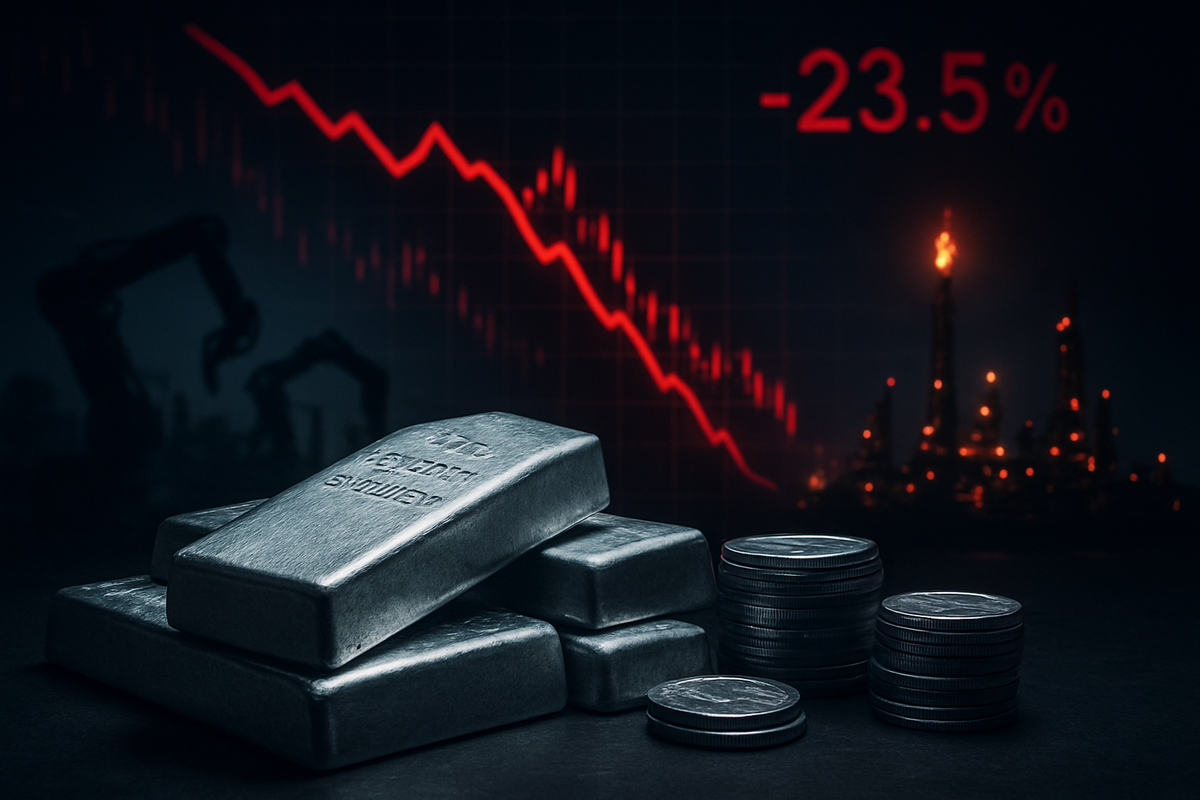
LONDON — The global silver market is reeling this week as a perfect storm of geopolitical escalation, energy supply shocks, and a regulatory-driven liquidity crunch sent the price of the "white metal" into a tailspin. Silver prices plummeted to a recent low of $70.90 per ounce, marking a staggering 23.5% decline since the onset of the current Middle East conflict. The crash has blindsided investors who had viewed silver as a dual-threat hedge against both inflation and industrial expansion, only to see it buckle under the weight of a systemic "paper market" liquidation.
The move marks a dramatic reversal for a commodity that many analysts predicted would reach triple digits this year. As of March 24, 2026, the market is grappling with the realization that even record-breaking physical demand from China cannot offset the massive outflows from exchange-traded funds and the rising costs of industrial production. What began as a flight to safety has rapidly transformed into a flight for liquidity, leaving miners and manufacturers alike scrambling to recalibrate their balance sheets in an increasingly volatile environment.
The descent began in earnest following a series of missile strikes on Qatar’s Ras Laffan Industrial City, a critical hub for global energy. The resulting damage to LNG production Trains 4 and 6 led to an immediate 17% reduction in Qatar’s liquefied natural gas (LNG) export capacity. With QatarEnergy declaring force majeure on long-term contracts, the shockwaves were felt instantly in the manufacturing hubs of East Asia. The loss of nearly 20% of global LNG supply sent energy benchmarks soaring, but rather than boosting silver’s "precious metal" appeal, it triggered a panic over silver’s industrial utility.
Leading up to this crisis, silver had been trading near $92.70/oz, supported by a massive 790-ton import surge into China during the first two months of 2026. However, as energy costs spiked, the narrative shifted from supply scarcity to demand destruction. On March 19, the situation reached a breaking point. The CME Group (NASDAQ: CME) implemented aggressive margin hikes on silver futures to curb volatility, which instead acted as a catalyst for a "Warsh Shock"—named after the hawkish rhetoric of the new Federal Reserve leadership. Leveraged traders were forced to liquidate positions, turning a controlled correction into a full-scale rout.
The panic culminated in a historic liquidity event for the iShares Silver Trust (NYSE Arca:SLV), managed by BlackRock (NYSE: BLK). On March 19, the fund faced its largest single-day outflow in over a decade. Compounding the misery was a new SEC regulation requiring 100% allocated physical backing certification. As institutional investors dumped shares to cover margin calls in other sectors, SLV traded at a rare and significant discount to its Net Asset Value (NAV), signaling a total decoupling between the digital "paper" silver market and the physical metal sitting in London vaults.
The primary victims of this slump are the primary silver producers and royalty companies. Industry giants like Wheaton Precious Metals (NYSE: WPM) and Pan American Silver (NYSE: PAAS) have seen their market capitalizations erode as the spot price fell below their projected 2026 incentive levels. For these companies, the "margin squeeze" is two-fold: they are receiving less for their product while facing higher operational costs driven by the global energy spike. Smaller miners, particularly those in high-cost jurisdictions, may face temporary shutdowns if prices do not stabilize above $75/oz.
In China, the semiconductor and solar sectors are navigating a "double-edged sword." On one hand, companies like Jinko Solar (NYSE: JKS) benefit from lower raw material costs for silver paste, which accounts for nearly 30% of solar cell costs. On the other hand, the Qatari energy crisis has decimated the supply of helium—a byproduct of LNG processing essential for cooling silicon wafers. High-end chip foundries are now facing production delays, which could lead to a broader slowdown in the hardware needed for the ongoing AI infrastructure build-out.
Conversely, some "winners" may emerge from the wreckage. Manufacturers that have aggressively pursued "thrifting"—the process of reducing silver content in industrial applications—are seeing their R&D investments pay off. Longi Green Energy (SSE:601012) recently announced a pivot toward silver-free back-contact solar cells using copper metallization. As silver’s volatility makes it an unreliable industrial input, companies that can successfully substitute the metal with copper or aluminum may gain a long-term competitive advantage and more stable margins.
The current silver slump is more than just a price correction; it is a symptom of a broader shift in how the market values industrial commodities in a "higher-for-longer" interest rate environment. The "Warsh Shock" at the Federal Reserve has pushed the 10-year Treasury yield above 4.25%, strengthening the US Dollar and making non-yielding assets like silver far less attractive to institutional desks. This event mirrors the historical "Hunt Brothers" collapse of 1980 and the 2022 LME Nickel crisis, where the mechanics of the exchange itself became the story.
The regulatory implications are also profound. The SEC’s focus on 100% physical backing for ETFs like SLV suggests a new era of transparency that the "paper" market is clearly not yet ready for. By forcing a closer link between physical inventory and traded shares, regulators are inadvertently exposing the fragility of the silver market's liquidity. This trend toward "real asset" verification is likely to spread to other commodity ETFs, potentially leading to further volatility as funds scramble to audit their holdings and prove they are not "trading air."
Furthermore, the decoupling of the Shanghai silver premium from Western benchmarks highlights a growing fragmentation in global trade. While London and New York are liquidating paper contracts, China continues to hoard physical metal. This divergence suggests that the "physical floor" for silver may be much higher than the "paper ceiling," setting the stage for a potential "short squeeze" of epic proportions if physical deliveries are ever demanded en masse during a period of low exchange inventory.
In the short term, the market will look for a floor around the $70.00 psychological level. If the Middle East conflict stabilizes and LNG production in Qatar can be partially restored, the immediate energy-driven demand concerns may ease. However, the long-term strategic pivot away from silver in the solar industry is a trend that cannot be easily reversed. Companies that have already committed to copper-based manufacturing are unlikely to switch back, meaning silver’s industrial "moat" may be narrowing for the first time in the green energy era.
Investors should expect a period of consolidation as the market digests the March 19 liquidity event. The central question moving forward is whether the record-breaking Chinese imports of early 2026 represent a long-term strategic stockpile or a one-time "front-loading" effort that has now exhausted itself. If Chinese demand remains robust despite the high energy costs, we could see a V-shaped recovery as the paper market realizes it has oversold the physical reality.
Strategic adaptations will be required for both miners and tech firms. We may see a wave of consolidation in the silver mining space as larger players with stronger balance sheets acquire distressed assets at a discount. In the tech sector, the helium shortage will likely accelerate domestic helium exploration in North America and Russia, as the world seeks to de-risk its semiconductor supply chain from the volatile Strait of Hormuz.
The 23.5% slump in silver prices serves as a stark reminder that in the modern financial ecosystem, "safe havens" are never truly safe from the tides of liquidity. The convergence of a 17% reduction in Qatari LNG, a hawkish Federal Reserve, and a massive deleveraging event in the SLV trust has created a historic buying—or selling—opportunity, depending on one's view of silver’s industrial future. The key takeaway is the widening gap between the physical demand (790 tons imported by China) and the paper market’s capacity to handle systemic shocks.
Moving forward, the market will be defined by its ability to resolve the tension between silver’s role as a vital industrial component in the AI and solar revolutions and its role as a speculative financial instrument. Investors should keep a close eye on the SLV NAV discount; if the discount persists, it indicates that institutional trust in the paper silver market remains broken. Conversely, a narrowing of the discount combined with stabilizing energy prices could signal that the worst of the liquidation is over.
Ultimately, the "Silver Slump of 2026" will be remembered as the moment the market was forced to choose between the physical metal and the paper promise. As the dust settles, the survivors will be those who prioritized real-world utility over speculative leverage.
This content is intended for informational purposes only and is not financial advice.